4,068 posters, 219 videos, 101 topics, 69 sessions, 14,365 authors, 6,128 institutions
ePostersLive by SciGen Technologies S.A. All rights reserved.
Alzheimer's Association International Conference 2026
July 12-15, 2026 | London, United Kingdom, and Online

1602
Walking With Creativity: How We Came To Look At Dementia With New Eyes
Poster Presenter
Authors
Lenisa Brandao, Alan Young, Belen Custodio, Karen Young, Kevin Cullen, Madalena P. Liougas, Meron Abey, Prabha Shrestha, Sara L. Bartels, Thérèse Maher, Tom Hennessy, Fernando A. Peres
Affiliations
Federal University of Santa Maria, RS, Brazil, Unidad de Investigación de Deterioro Cognitivo y Prevención de Demencia, Instituto Peruano de Neurociencias, Lima, Peru;, Lewy Body Society, London, United Kingdom;, The Alzheimer Society of Ireland, Dublin, Ireland;, University of Toronto, Toronto, ON, Canada;, ACHC, Adis Abeba, Ethiopia;, Kathmandu University, Dhulikhel, Nepal;, Maastrich University, Maastrich, Netherlands;, ⁹WTD Istitute, Kilkenny, Ireland;, ⁴The Alzheimer Society of Ireland, Dublin, Ireland, WTD Institute, Porto Alegre, Brazil.
Part of Topic
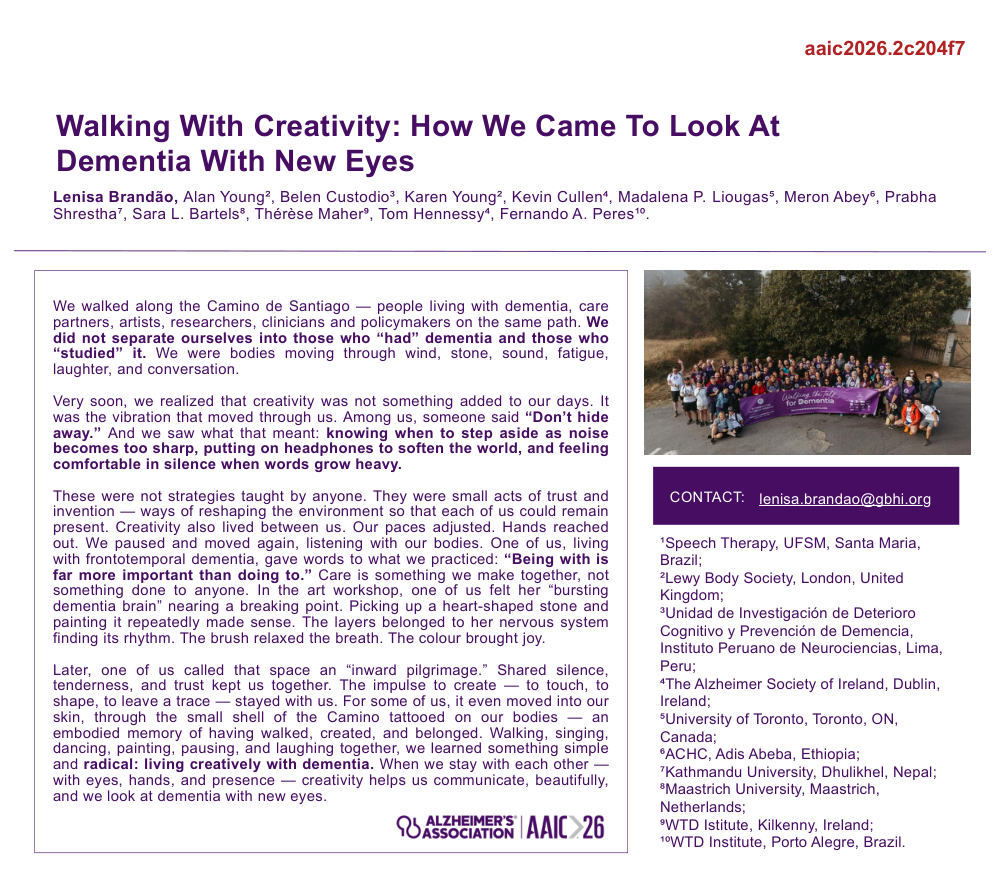
We walked along the Camino de Santiago — people living with dementia, care partners, artists, researchers, clinicians and policymakers on the same path. We did not separate ourselves into those who “had” dementia and those who “studied” it. We were bodies moving through wind, stone, sound, fatigue, laughter, and conversation.
Very soon, we realized that creativity was not something added to our days. It was the vibration that moved through us. Among us, someone said“Don’t hide away.” And we saw what that meant: knowing when to step aside as noise becomes too sharp, putting on headphones to soften the world, and feeling comfortable in silence when words grow heavy.
These were not strategies taught by anyone. They were small acts of trust and invention — ways of reshaping the environment so that each of us could remain present. Creativity also lived between us. Our paces adjusted. Hands reached out. We paused and moved again, listening with our bodies. One of us, living with frontotemporal dementia, gave words to what we practiced: “Being with is far more important than doing to.”Care is something we make together, not something done to anyone. In the art workshop, one of us felt her “bursting dementia brain” nearing a breaking point. Picking up a heart-shaped stone and painting it repeatedly made sense. The layers belonged to her nervous system finding its rhythm. The brush relaxed the breath. The colour brought joy.
Later, one of us called that space an “inward pilgrimage.” Shared silence, tenderness, and trust kept us together. The impulse to create — to touch, to shape, to leave a trace — stayed with us. For some of us, it even moved into our skin, through the small shell of the Camino tattooed on our bodies — an embodied memory of having walked, created, and belonged. Walking, singing, dancing, painting, pausing, and laughing together, we learned something simple and radical: living creatively with dementia. When we stay with each other — with eyes, hands, and presence — creativity helps us communicate, beautifully, and we look at dementia with new eyes.
Comments
Email is required but is not shown publicly.
Loading comments...