4,068 posters, 219 videos, 101 topics, 69 sessions, 14,365 authors, 6,128 institutions
ePostersLive by SciGen Technologies S.A. All rights reserved.
Alzheimer's Association International Conference 2026
July 12-15, 2026 | London, United Kingdom, and Online

10199
A Digital Pathology Pipeline For Automatic Detection Of Tangle-bearing Neurons
Poster Presenter
Authors
Affiliations
Part of Topic
BACKGROUND: Neurofibrillary tau tangles are a hallmark pathological feature of Alzheimer’s disease (AD), yet their quantification remains challenging due to reliance on subjective manual annotation and the lack of standardized automated methods for assessing tau burden. As large-scale studies increasingly rely on digital neuropathology, there is a critical need for scalable, interpretable, and standardized approaches to tangle quantification.
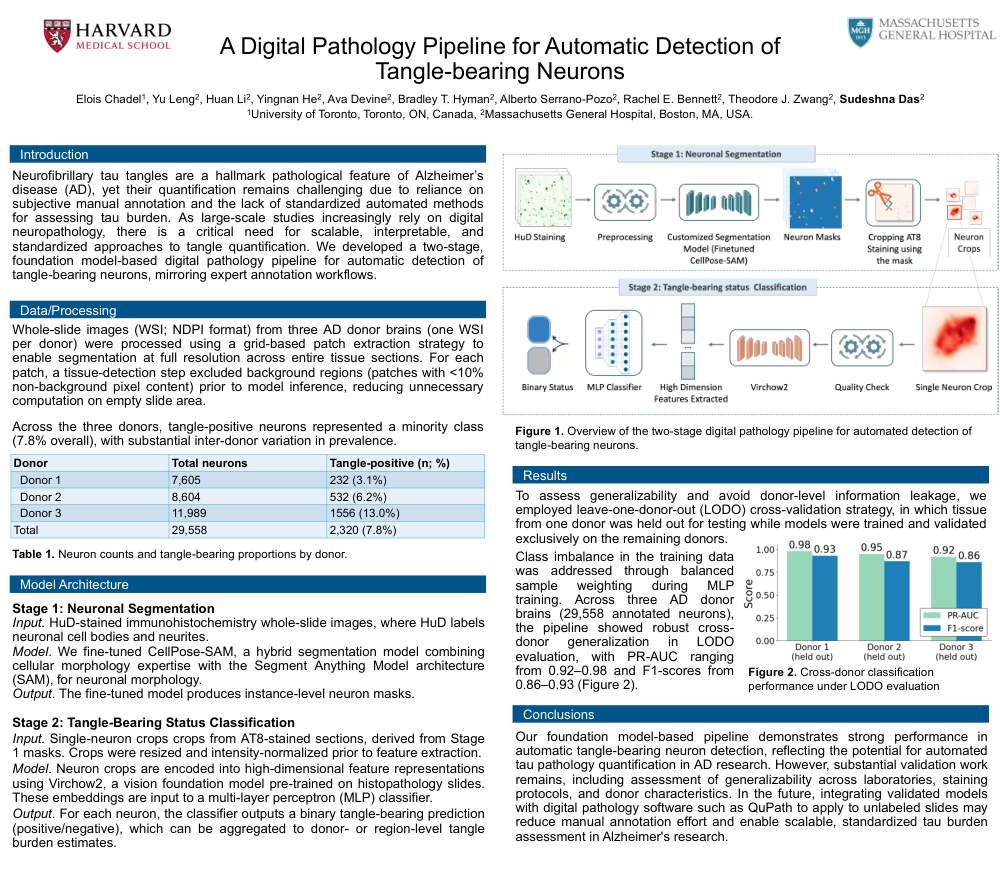
METHODS: We developed a two-stage, foundation model-based digital pathology pipeline for automatic detection of tangle-bearing neurons mirroring expert annotation workflows. In Stage 1 (Neuronal Segmentation), we fine-tuned CellPose-SAM—a hybrid segmentation model combining cellular morphology expertise with the Segment Anything Model architecture—on HuD-stained immunohistochemistry slides, a neuronal marker that labels cell bodies and neurites. In Stage 2 (Tangle-bearing Status Classification), we utilized the neuronal masks from Stage 1 to crop single-cell regions from co-registered AT8-stained tissue sections. For each cropped neuron, we extracted high-dimensional feature representations using Virchow2, a vision foundation model pre-trained on millions of histopathology slides. These cell-level embeddings were fed into a multi-layer perceptron (MLP) classifier trained to predict binary tangle-bearing status (positive/negative) for each neuron. To assess generalizability and avoid donor-level information leakage, we employed leave-one-donor-out (LODO) cross-validation strategy, in which tissue from one donor was held out for testing while models were trained and validated exclusively on the remaining donors.
RESULTS: Across three AD donor brains comprising 29,558 expert-annotated neurons, the proposed pipeline demonstrated robust cross-donor performance. In leave-one-donor-out evaluation, the classifier achieved PR-AUC values of 0.98, 0.95, and 0.92 on the three held-out donors, respectively, and corresponding F1-scores of 0.93, 0.87, and 0.86. These results indicate that the proposed framework generalizes well across individual brains despite substantial inter-donor variability in staining and pathology burden.
CONCLUSION: Our foundation model-based pipeline demonstrates strong performance in automatic tangle-bearing neuron detection, reflecting the potential for automated tau pathology quantification in AD research. However, substantial validation work remains, including assessment of generalizability across laboratories, staining protocols, and donor characteristics. In the future, integrating validated models with digital pathology software such as QuPath to apply to unlabeled slides may reduce manual annotation effort and enable scalable, standardized tau burden assessment in Alzheimer's research.
Comments
Email is required but is not shown publicly.
Loading comments...