4,068 posters, 219 videos, 101 topics, 69 sessions, 14,365 authors, 6,128 institutions
ePostersLive by SciGen Technologies S.A. All rights reserved.
Alzheimer's Association International Conference 2026
July 12-15, 2026 | London, United Kingdom, and Online

8878
Spatial Profiling Reveals Signatures Of Vulnerability And Resistance To Tau Aggregation In Alzheimer’S Disease
Poster Presenter
Part of Topic
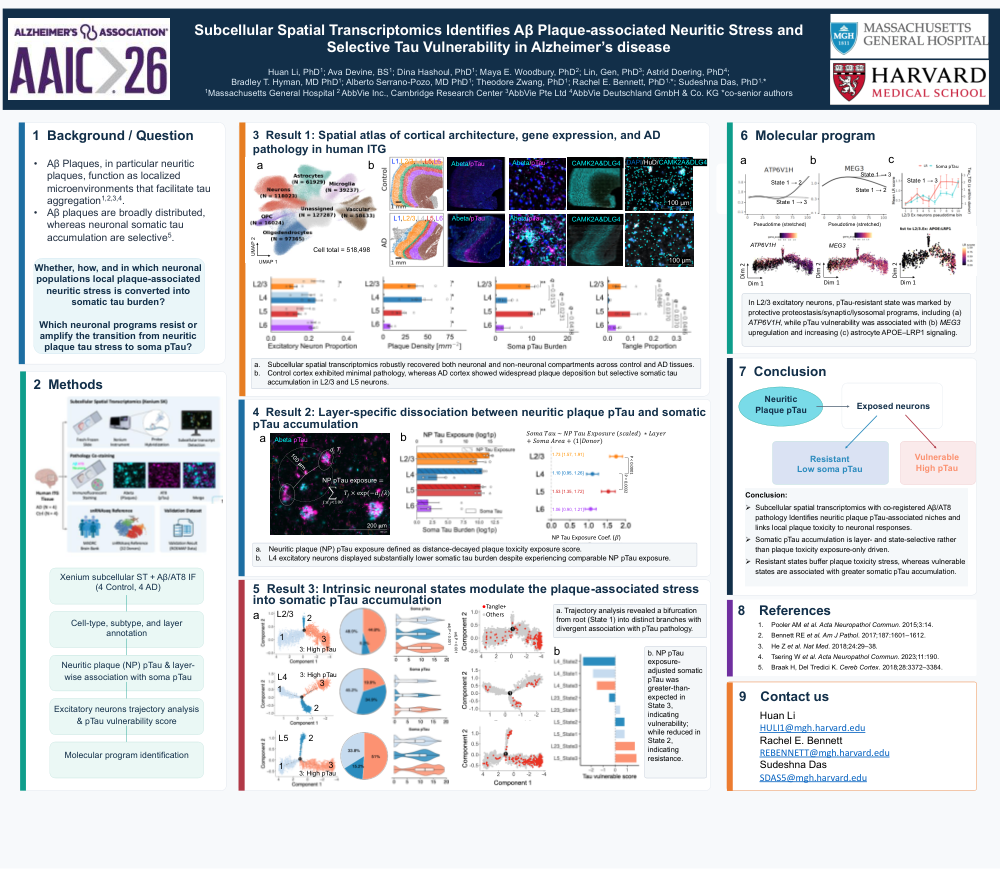
Subcellular Spatial Transcriptomics Identifies Aβ Plaque-associated Neuritic Stress and Selective Tau Vulnerability in Alzheimer’s disease
Key words: pTau; layer specific tau vulnerability; spatial transcriptomics; Aβ plaques; neuritic stress
Neuronal loss drives cognitive decline in Alzheimer’s disease (AD), with layer II/III (L2/3) pyramidal neurons demonstrating selective vulnerability to tau accumulation and degeneration. Yet the mechanisms underlying vulnerability and resistance remain poorly understood. Spatially resolved transcriptomics has the potential to reveal how neuron-intrinsic programs and local glial signals shape neuronal responses to tau pathology and determine neuronal outcomes.
We profiled the inferior temporal gyrus (ITG, BA20) of 4 Control and 4 AD donors using 10x Xenium subcellular-resolution spatial transcriptomics, co-registration with Abeta for plaque and AT8 immunohistochemistry to measure tau integrated density (TID) as a proxy for intraneuronal tau burden. Plaque-associated neuritic stress and glial activation occurred similarly across layers, but layer IV neurons showed attenuated somatic tau and reduced deployment of a shared neurite-to-soma gene program. Trajectory analysis identified tau-resistant layer IV states and tau-vulnerable layer II/III and V states, implicatingcalcium signaling, retrograde transport, and lysosomal dysfunction. Spatial proximity analysis of ligand-receptor interactions inferred astrocyte and microglial influences along the tau trajectory.
Comments
Email is required but is not shown publicly.
Loading comments...