4,068 posters, 219 videos, 101 topics, 69 sessions, 14,365 authors, 6,128 institutions
ePostersLive by SciGen Technologies S.A. All rights reserved.
Alzheimer's Association International Conference 2026
July 12-15, 2026 | London, United Kingdom, and Online

3214
Epigenetic signatures of blood-based neurodegenerative biomarkers in older adults from India
Poster Presenter
Authors
Jennifer Smith, Ruixuan Wang, Scott Ratliff, Hasan Abu-Amara, Wei Zhao, Eileen Crimmins, Bharat Thyagarajan, Masroor Anwar, Perry Hu, Aparajit Dey, Sharmistha Dey, Jinkook Lee, Sharon Kardia, Jean Morrison
Affiliations
Department of Epidemiology, University of Michigan, Department of Biostatistics, University of Michigan, Survey Research Center, University of Michigan, Davis School of Gerontology, University of Southern California, Department of Laboratory Medicine and Pathology, University of Minnesota, Department of Biophysics, All India Institute of Medical Sciences, New Delhi, India, Department of Medicine/Geriatrics, Geffen School of Medicine, University of California, Los Angeles, Department of Geriatric Medicine, All India Institute of Medical Sciences, New Delhi, India, Department of Economics, University of Southern California
Part of Topic
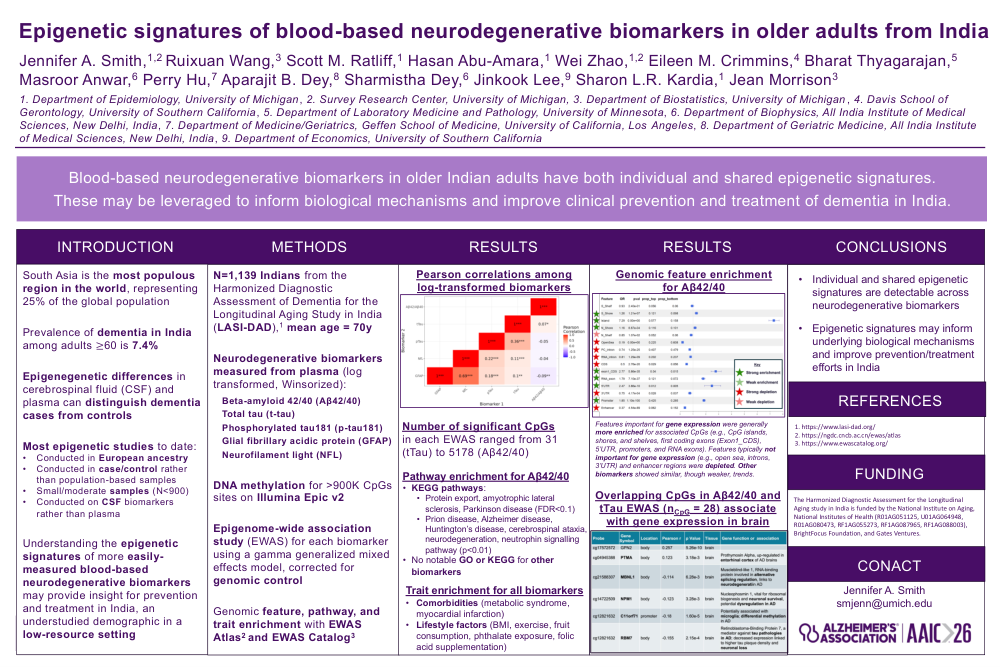
Background: Alzheimer’s disease (AD) and related dementias are an escalating public health challenge in India. In other populations, epigenetic associations with blood concentrations of neurodegenerative biomarkers have been detected. Understanding the epigenetic signatures of these biomarkers in India may provide insight for prevention and treatment in this understudied demographic.
Methods: We conducted epigenome-wide association studies (EWAS) of five neurodegenerative biomarkers measured in blood – Ab42/Ab40, total tau (tTau), tau phosphorylated at threonine 181 (pTau), glial fibrillary acidic protein (GFAP), and neurofilament light chain (NfL) – using >900,000 CpGs in 1,139 participants from the Diagnostic Assessment of Dementia for the Longitudinal Aging Study in India (LASI-DAD, mean age=69.8). Associations between CpG methylation and biomarkers were assessed using a gamma generalized linear mixed-effects model, adjusting for age, sex, smoking, BMI, WBC proportions, epigenetic principal components, and technical variables. Significantly associated CpGs (FDR-q<0.05) were assessed for enrichment in genomic features, previously associated traits, and biological pathways. We applied clustering and factor analysis to identify common patterns of epigenetic associations.
Results: A total of 26 (pTau) to 1,346 (Ab42/Ab40) CpG sites were associated with each neurodegenerative biomarker. Identified CpGs for Ab42/Ab40, tTau, and GFAP were highly enriched in promoter regions, 1st exon (Ab42/Ab40 only), and CpG islands (tTau and GFAP; all p<0.0001). CpGs associated with Ab42/Ab40 were enriched for KEGG pathways including Prion disease, amyotrophic lateral sclerosis, Parkinson disease, and neurodegeneration, and Gene Ontology pathways related to inflammation and mitochondrial function (all p<0.0001). Identified CpGs overlapped with those detected in EWAS of other traits, including autoimmune diseases, lifestyle factors (BMI, fruit consumption, and smoking), and mortality (all p<0.002). Clustering and factor analysis showed that associated CpGs overlapped most strongly between Ab42/Ab40 and tTau (28 CpGs), two primary biomarkers of Alzheimer’s disease, and between GFAP and NfL (24 CpGs), markers of neuroinflammation and neurodegeneration. Some overlapping CpGs have been associated with expression of genes in the brain previously linked to Alzheimer’s disease pathology and/or neurodegeneration (MBNL1, NPM1, FADS2, ADGRA1, and NINL).
Conclusions: Blood-based neurodegenerative biomarkers in older Indian adults have both individual and shared epigenetic signatures, which may be leveraged to inform biological mechanisms and improve clinical prevention and treatment of dementia.
Comments
Email is required but is not shown publicly.
Loading comments...