4,068 posters, 219 videos, 101 topics, 69 sessions, 14,365 authors, 6,128 institutions
ePostersLive by SciGen Technologies S.A. All rights reserved.
Alzheimer's Association International Conference 2026
July 12-15, 2026 | London, United Kingdom, and Online

6749
Neighborhood Deprivation And The Risk Of Young-onset Dementia And Its Subtypes: An Analysis Of The All Of Us Research Program
Poster Presenter
Authors
Affiliations
Rory Meyers College of Nursing, New York University, New York, NY 10010, USA, Edson College of Nursing and Health Innovation, Arizona State University, Phoenix, AZ 85004, USA, Center for Health Outcomes and Interdisciplinary Research, Department of Psychiatry, Massachusetts General Hospital, Boston, Massachusetts, United States, NYU Shanghai, Shanghai 200124, China
Part of Topic
Background: Young-onset dementia (YOD, onset <65 years) is an emerging public health challenge affecting over 200,000 Americans, yet risk factor other than genetics remain poorly defined. Neighborhood socioeconomic deprivation has been linked to late-life dementia, but its relationship with YOD is unclear. We investigated whether higher neighborhood deprivation increases YOD risk in a large, diverse U.S. cohort.
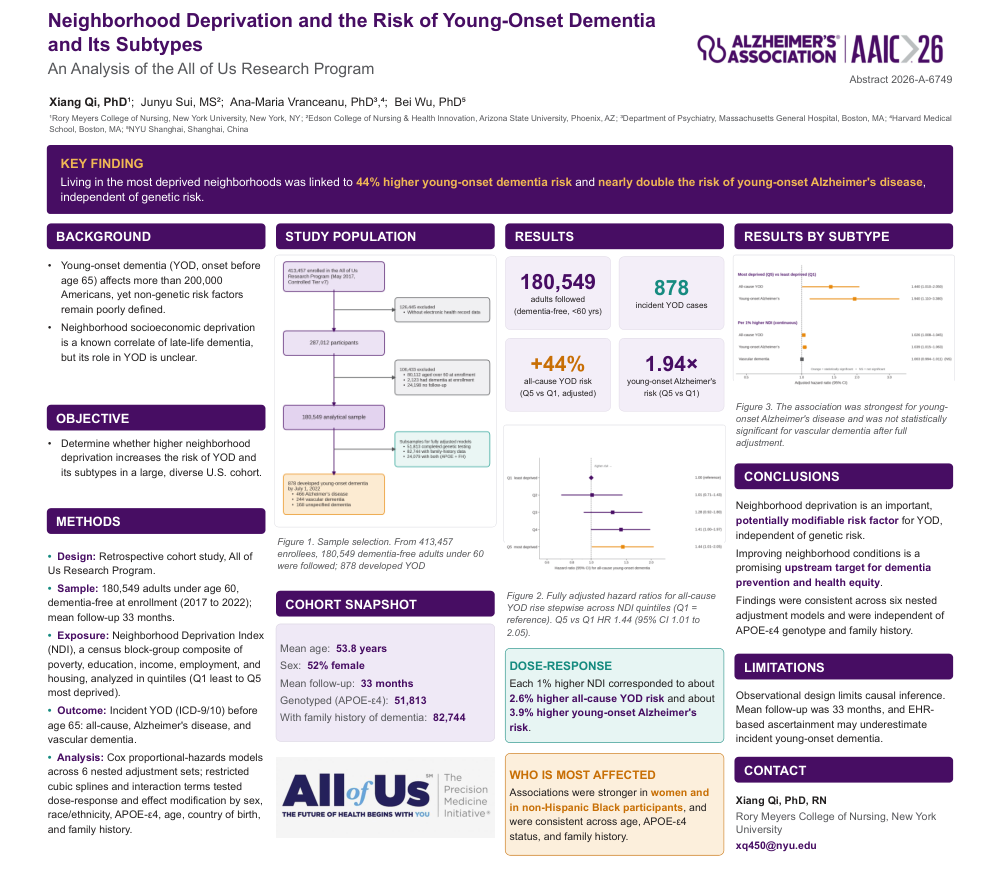
Methods: We conducted a retrospective cohort study using All of Us Research Program data. Participants (N=180,549) were aged <60 years, dementia-free at enrollment (2017–2022), and were followed for incident YOD through mid-2022 (mean follow-up 33 months). Neighborhood deprivation was assessed via the Neighborhood Deprivation Index (NDI) at baseline, a census block-group composite of community poverty, education, income, employment, and housing conditions. NDI was categorized into quintiles (Q1=least deprived, Q5=most deprived). Incident YOD was defined as any dementia diagnosis (ICD-9/10) occurring before age 65. We used Cox proportional hazards models to estimate hazard ratios (HRs) for all-cause YOD and subtypes (young-onset Alzheimer’s disease [AD] or vascular dementia) across NDI levels. Restricted cubic spline analyses and interaction terms tested dose–response relationships and effect modification by sex, race/ethnicity, APOE-ε4 genotype, age, country of birth, and family history of dementia.
Results: 180,549 participants (Figure 1) were included (mean age 53.8 years; 52% female). During follow-up, 878 developed YOD, including 466 Alzheimer’s disease and 244 vascular dementia. In fully adjusted analyses, the most deprived quintile had a 44% higher hazard of all-cause YOD (95%CI 1.01–2.05) and nearly double the hazard of young-onset AD (HR 1.94, 95%CI 1.11–3.38) versus Q1. Each 1% increase in NDI corresponded to ~2.6% higher all-cause YOD risk (HR 1.026) and ~3.9% higher young-onset AD risk (HR 1.039; Figure 2, Table 1). Results were consistent across subgroups defined by age, APOE-ε4 status, and family history. However, significant effect modification by sex and race/ethnicity was observed: the association was more pronounced in women and in non-Hispanic Black participants, while it did not vary by APOE status.
Conclusions: Neighborhood deprivation is an important and potentially modifiable risk factor for YOD. Public health efforts to improve neighborhood conditions may help reduce the burden of YOD.
Comments
Email is required but is not shown publicly.
Loading comments...