4,068 posters, 219 videos, 101 topics, 69 sessions, 14,365 authors, 6,128 institutions
ePostersLive by SciGen Technologies S.A. All rights reserved.
Alzheimer's Association International Conference 2026
July 12-15, 2026 | London, United Kingdom, and Online

338
Psychometric Network Analysis: A Novel Framework For Sex-sensitive Cognitive Aging Research
Poster Presenter
Authors
Part of Topic
Psychometric Network Analysis: A Novel Framework for Sex-Sensitive Cognitive Aging Research
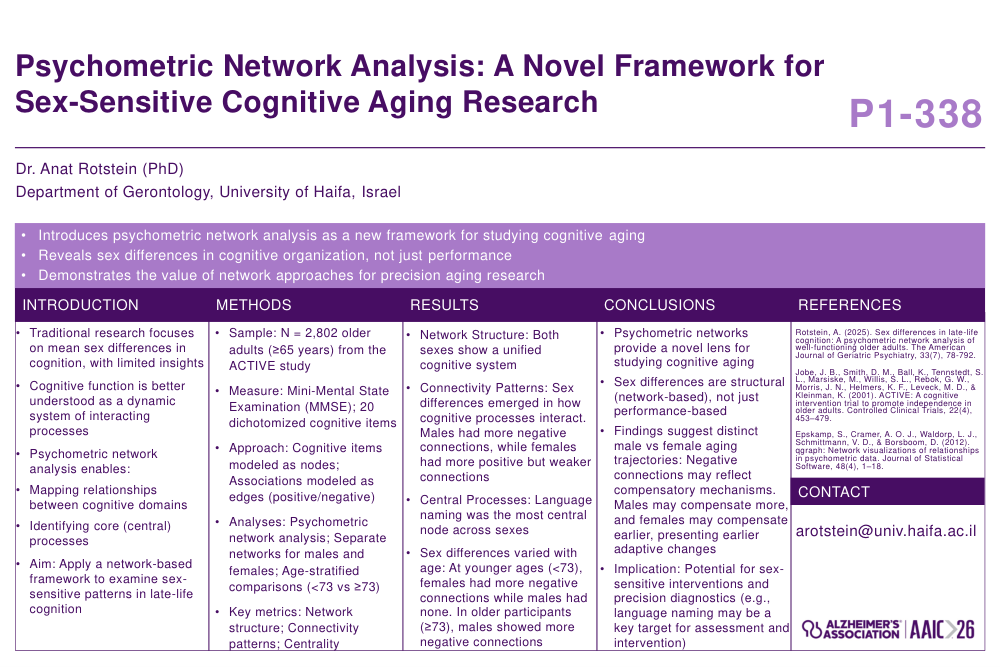
Psychometric network analysis offers a novel framework for studying cognitive aging by moving beyond traditional approaches that focus on mean sex differences in cognitive performance. Instead, cognition is conceptualized as a dynamic system of interacting processes, allowing researchers to examine how cognitive domains are organized and interconnected. Using data from 2,802 community-dwelling older adults aged 65 and over from the ACTIVE study, cognitive functioning was assessed באמצעות the Mini-Mental State Examination (MMSE), with items modeled as nodes and their associations as positive or negative connections (edges). Separate psychometric networks were estimated for males and females, with additional comparisons across age groups (<73 vs. ≥73), and key metrics included network structure, connectivity patterns, and centrality.
Findings demonstrated that both sexes share a unified cognitive system, supporting the idea of cognition as an integrated construct in late life. However, important sex differences emerged in how cognitive processes interact: males showed more negative connections, whereas females exhibited more positive but weaker connections. Language naming was identified as the most central cognitive process across both sexes. Moreover, sex differences varied by age, with younger females showing more negative connections while younger males showed none, and older males exhibiting more negative connections than females. These negative connections may reflect compensatory mechanisms, suggesting that males may compensate more strongly for age-related decline, whereas females may engage in compensatory processes earlier in the aging trajectory.
Overall, psychometric network analysis provides a powerful new lens for understanding cognitive aging, highlighting that sex differences are structural and network-based rather than purely performance-based. These findings point to distinct male and female aging trajectories and underscore the potential for developing sex-sensitive interventions and precision diagnostics. In particular, language naming may serve as a key target for assessment and intervention in late-life cognition.
Comments
Email is required but is not shown publicly.
Loading comments...