4,068 posters, 219 videos, 101 topics, 69 sessions, 14,365 authors, 6,128 institutions
ePostersLive by SciGen Technologies S.A. All rights reserved.
Alzheimer's Association International Conference 2026
July 12-15, 2026 | London, United Kingdom, and Online

8995
Associations Between Higher Dietary Inflammatory Index Scores And Blood-based Biomarkers Of Dementia
Poster Presenter
Authors
Debora Melo van Lent, Rebecca Bernal, Crystal Wiedner, Alexa Beiser, Changzheng Yuan, Paul Jacques, Claudia L. Satizabal Barrera, Vasan Ramachandran, Sudha Seshadri, Jayandra J. Himali, Jeremy Tanner
Affiliations
Glenn Biggs Institute, University of Texas Health Science Center, San Antonio, TX, USA, Boston University and the NHLBI's Framingham Heart Study, Boston, MA, USA, School of Public Health, Zhejiang University Medical School, Hangzhou, Zhejiang, China, Jean Mayer US Department of Agriculture Human Nutrition Research Center on Aging, Tufts University, Boston, MA, USA, University Of Texas Health Science Center School of Public health, San Antonio, TX, USA
Part of Topic
Introduction:
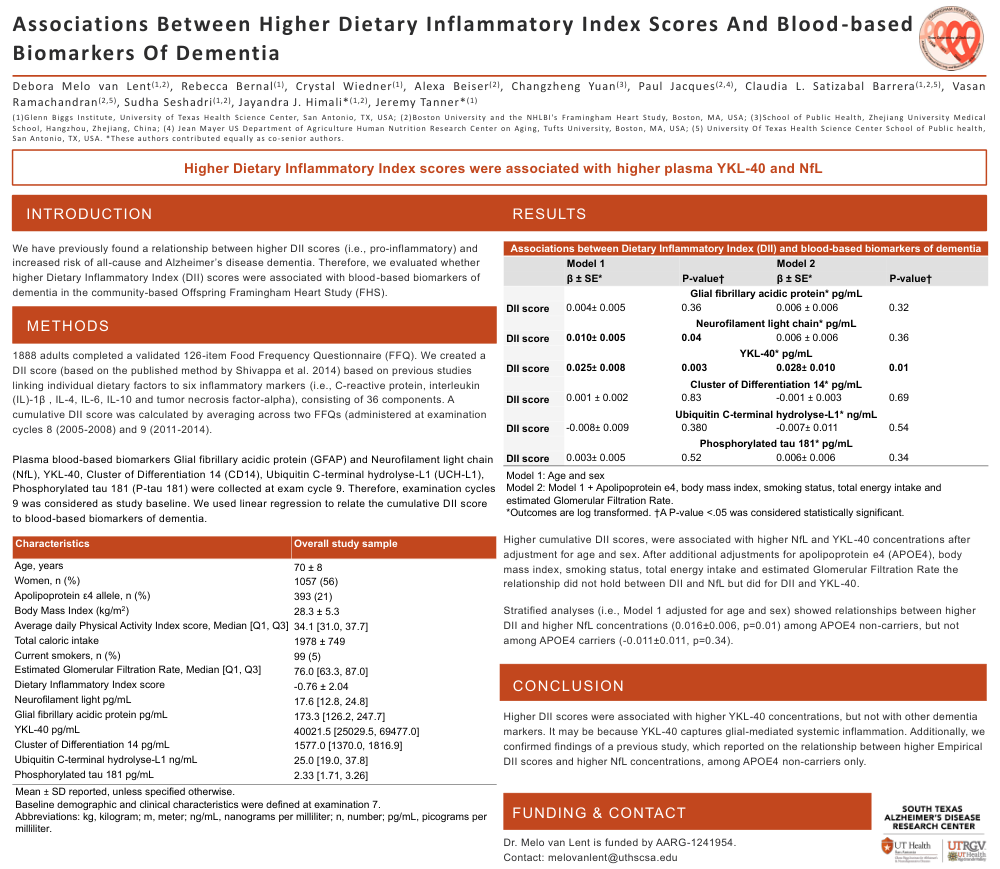
We have previously found a relationship between higher DII scores (i.e., pro-inflammatory) and increased risk of all-cause and Alzheimer’s disease dementia. Therefore, we evaluated whether higher Dietary Inflammatory Index (DII) scores were associated with blood-based biomarkers of dementia in the community-based Offspring Framingham Heart Study (FHS).
Methods:
1888 adults completed a validated 126-item Food Frequency Questionnaire (FFQ). We created a DII score (based on the published method by Shivappa et al. 2014) based on previous studies linking individual dietary factors to six inflammatory markers (i.e., C-reactive protein, interleukin (IL)-1β , IL-4, IL-6, IL-10 and tumor necrosis factor-alpha), consisting of 36 components. A cumulative DII score was calculated by averaging across two FFQs (administered at examination cycles 8 (2005-2008) and 9 (2011-2014).
Plasma blood-based biomarkers Glial fibrillary acidic protein (GFAP) and Neurofilament light chain (NfL), YKL-40, Cluster of Differentiation 14 (CD14), Ubiquitin C-terminal hydrolyse-L1 (UCH-L1), Phosphorylated tau 181 (P-tau 181) were collected at exam cycle 9. Therefore, examination cycles 9 was considered as study baseline. We used linear regression to relate the cumulative DII score to blood-based biomarkers of dementia.
Results:
Higher cumulative DII scores, were associated with higher NfL and YKL-40 concentrations after adjustment for age and sex. After additional adjustments for apolipoprotein e4 (APOE4), body mass index, smoking status, total energy intake and estimated Glomerular Filtration Rate the relationship did not hold between DII and NfL but did for DII and YKL-40.
Stratified analyses (i.e., Model 1 adjusted for age and sex) showed relationships between higher DII and higher NfL concentrations (0.016±0.006, p=0.01) among APOE4 non-carriers, but not among APOE4 carriers (-0.011±0.011, p=0.34).
Conclusion:
Higher DII scores were associated with higher YKL-40 concentrations, but not with other dementia markers. It may be because YKL-40 captures glial-mediated systemic inflammation. Additionally, we confirmed findings of a previous study, which reported on the relationship between higher Empirical DII scores and higher NfL concentrations, among APOE4 non-carriers only.
Comments
Email is required but is not shown publicly.
Loading comments...