4,068 posters, 219 videos, 101 topics, 69 sessions, 14,365 authors, 6,128 institutions
ePostersLive by SciGen Technologies S.A. All rights reserved.
Alzheimer's Association International Conference 2026
July 12-15, 2026 | London, United Kingdom, and Online

9407
Cognitive Reserve And Longitudinal Changes In Brain And Cognition In Semantic Variant Primary Progressive Aphasia
Poster Presenter
Authors
Lauren Grebe, Brittany Morin, Janhavi Pillai, David Paul Galang Baquirin, Buddhika Ratnasiri, Rian Bogley, Zoe Ezzes, Lisa Wauters, Maria Luisa Mandelli, Zachary Miller, Boon Lead Tee, Jessica de Leon, Kaitlin Casaletto, Howard Rosen, Maria Luisa Gorno Tempini, Elizabeth Galletta, Mira Goral, Jet Vonk
Affiliations
University of California, San Francisco, St. John’s University; University of California, San Francisco; The Graduate Center, City University of New York, University of California, San Francisco; University of Texas at Austin, NYU Grossman School of Medicine; SUNY Plattsburgh, The Graduate Center, City University of New York; Lehman College
Part of Topic
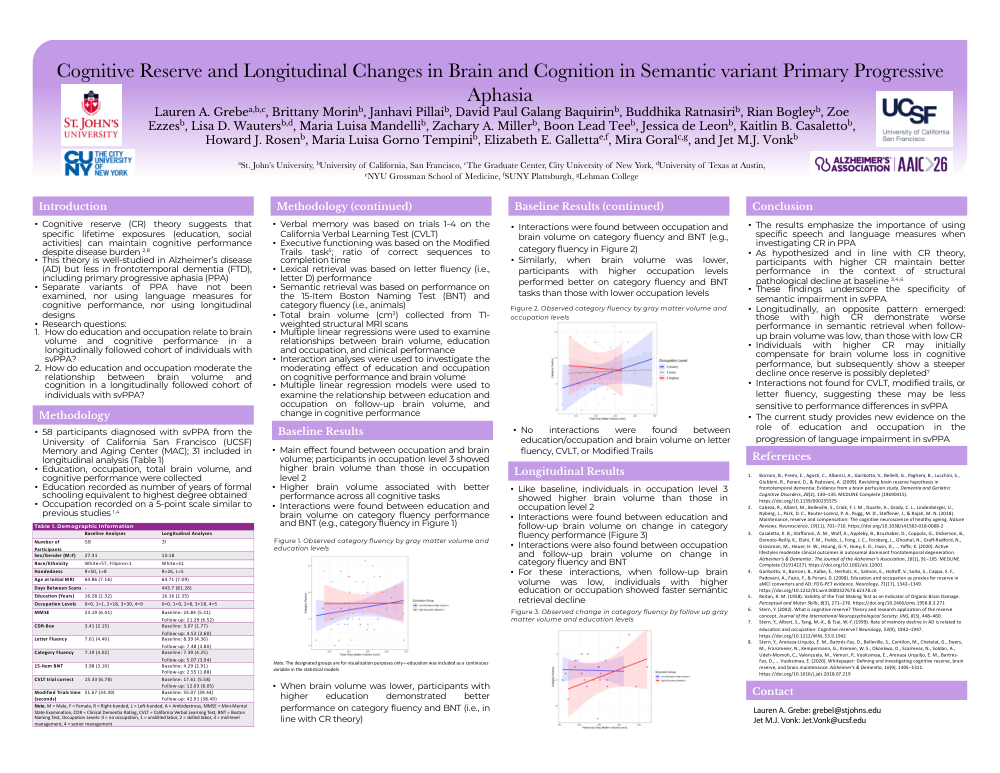
Cognitive Reserve and Longitudinal Changes in Brain and Cognition in Semantic variant Primary Progressive Aphasia
Cognitive reserve (CR) theory suggests that specific lifetime exposures (education, social activities) can maintain cognitive performance despite disease burden
This theory is well-studied in Alzheimer’s disease (AD) but less in frontotemporal dementia (FTD), including primary progressive aphasia (PPA)
Separate variants of PPA have not been examined, nor using language measures for cognitive performance, nor using longitudinal designs
Research questions:
1. How do education and occupation relate to brain volume and cognitive performance in a longitudinally followed cohort of individuals with svPPA?
2. How do education and occupation moderate the relationship between brain volume and cognition in a longitudinally followed cohort of individuals with svPPA?
Comments
Email is required but is not shown publicly.
Loading comments...