4,068 posters, 219 videos, 101 topics, 69 sessions, 14,365 authors, 6,128 institutions
ePostersLive by SciGen Technologies S.A. All rights reserved.
Alzheimer's Association International Conference 2026
July 12-15, 2026 | London, United Kingdom, and Online

6080
Partnering With Bilingual Caseworker-cultural Mediators To Engage Vietnamese Older Adults With Memory Concerns In Dementia Research
Poster Presenter
Authors
Kris Pui Kwan Ma, Kim Lundgreen, Asmeret Tesfalem, Angella Kim, Jacqueline Raetz, Annette Fitzpatrick, Kari Stephens
Affiliations
Department of Family Medicine, University of Washington, Community House Calls, Interpreter Services, Harborview Medical Center, Department of Health Systems & Population Health, University of Washington
Part of Topic
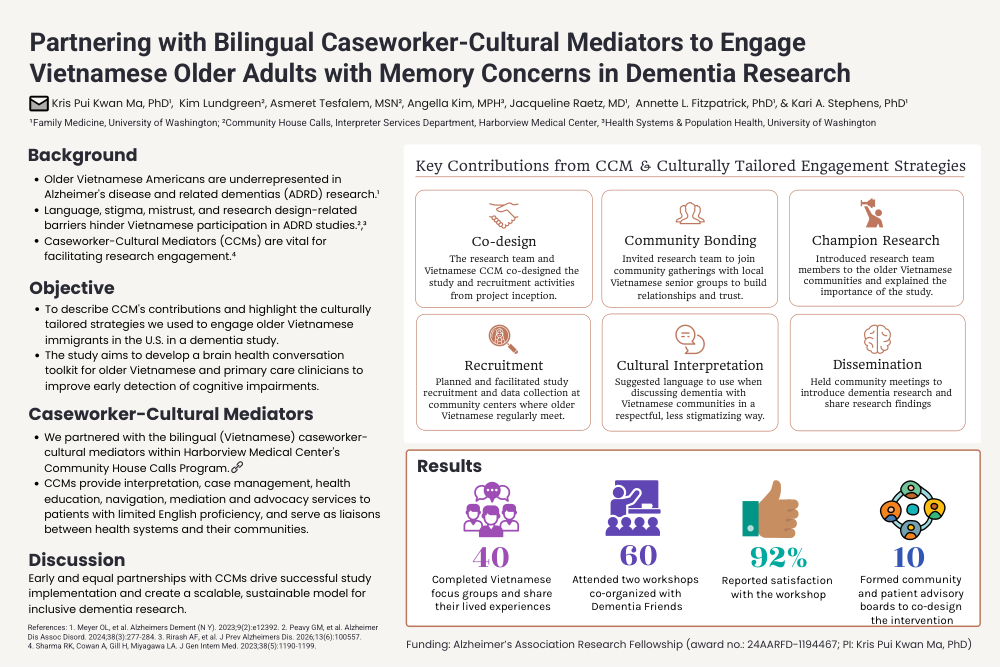
Background:Vietnamese Americans remainunderrepresented in Alzheimer’s Disease and Related Dementias (ADRD) research. Limited language access, dementia-related stigma, historical mistrust, structural barriers within research design, and insufficient awareness of research opportunities hinder Vietnamese Americans from research participation. To address this gap, bilingual-bicultural caseworker-cultural mediators (CCMs) play a vital role in facilitating research engagement and centering the lived experiences of older Vietnamese in ADRD research. This presentation describes our partnership with a Vietnamese CCM and highlights the culturally responsive strategies we employed to engage Vietnamese older immigrants in dementia research.
Methods: Our partnership with the Vietnamese CCM was supported by our ongoing Alzheimer’s Association funded research project focused on improving early dementia detection for Vietnamese-speaking patients. From project inception, the research team and Vietnamese CCM co-designed the study and planned recruitment activities. Through the CCM, we joined several community gatherings at local Vietnamese Senior Association and bonded with the Vietnamese community. We held educational activities around brain health and memory and conducted study recruitment as well as focus groups at the community center where the older Vietnamese communities regularly meet. These strategies were designed to reduce language and cultural barriers and build trust with Vietnamese community members to discuss a topic (dementia) that is unfamiliar and stigmatized in their community.
Results: Partnering with CCM and employing culturally responsive strategies resulted in both successful study implementation and creation of a network of community organizations supporting dementia education and research. Within the first year, seven focus groups were completed with 40 older Vietnamese to understand their care-seeking challenges for memory concerns. Two dementia education workshops were co-organized with the Vietnamese Senior Association and Washington Dementia Friends, reaching 60 participants; 92% reported satisfaction. Two research workshops were conducted to introduce dementia research and disseminate focus group findings. Additionally, a community advisory board has been established to co-design a brain health intervention tailored for Vietnamese communities.
Conclusions: This work demonstrates the value of early and equal partnerships with CCMs in engaging underrepresented groups like Vietnamese immigrants in ADRD research. These partnerships offer a scalable and sustainable model to advance dementia research representation and inclusion.
Comments
Email is required but is not shown publicly.
Loading comments...