4,068 posters, 219 videos, 101 topics, 69 sessions, 14,365 authors, 6,128 institutions
ePostersLive by SciGen Technologies S.A. All rights reserved.
Alzheimer's Association International Conference 2026
July 12-15, 2026 | London, United Kingdom, and Online

1482
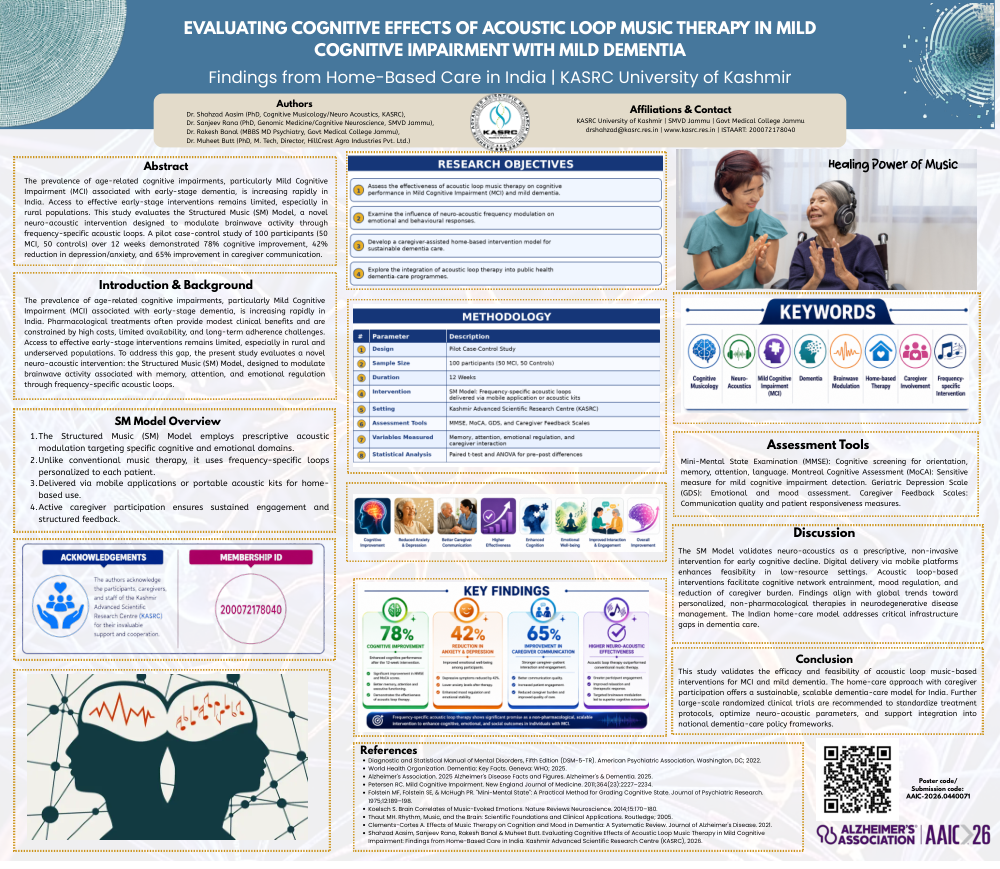
Evaluating Cognitive Effects Of Acoustic Loop Music Therapy In Mild Cognitive Impairment With Mild Dementia
Poster Presenter
Part of Topic
TITLE
Evaluating Cognitive Effects of Acoustic Loop Music Therapy in Mild Cognitive Impairment with Mild Dementia: Findings from Home-Based Care in India
Authors
- Dr. Shahzad Aasim (PhD in Music and its Scientific Interpretations) Cognitive Musicology/Neuro Acoustics Director KASRC, University of Kashmir, Srinagar)
- Dr Sanjeev Rana (PhD Clinico-Genetic profiling of dyslipidemia Genomic Medicine/Cognitive Neuroscience SMVD Jammu)
- Dr Rakesh Banal (MBBS MD (Psychiatry) Associate Professor Neuro Psychiatry Govt Medical College and Associate hospital Jammu)
- Dr Muheet Butt (B. E. Computer Science & Engineering) Data Scientist & QA Caps Technologies J&K India)
Correspondence: Kashmir Advanced Scientific Research Centre (KASRC)
drshahzad@kasrc.res.in, director@kasrc.res.in, | www.kasrc.res.in
ISTAART Membership ID: 200072178040
Abstract
The prevalence of age-related cognitive impairments, particularly Mild Cognitive Impairment (MCI) associated with early-stage dementia, is increasing rapidly in India. Access to effective early-stage interventions remains limited, especially in rural populations. This study evaluates the Structured Music (SM) Model, a novel neuro-acoustic intervention designed to modulate brainwave activity through frequency-specific acoustic loops. A pilot case-control study of 100 participants (50 MCI, 50 controls) over 12 weeks demonstrated 78% cognitive improvement, 42% reduction in depression/anxiety, and 65% improvement in caregiver communication.
Introduction & Background
The prevalence of age-related cognitive impairments, particularly Mild Cognitive Impairment (MCI) associated with early-stage dementia, is increasing rapidly in India. Pharmacological treatments often provide modest clinical benefits and are constrained by high costs, limited availability, and long-term adherence challenges. Access to effective early-stage interventions remains limited, especially in rural and underserved populations. To address this gap, the present study evaluates a novel neuro-acoustic intervention: the Structured Music (SM) Model, designed to modulate brainwave activity associated with memory, attention, and emotional regulation through frequency-specific acoustic loops
Research Objectives
- Assess the effectiveness of acoustic loop music therapy on cognitive performance in Mild Cognitive Impairment (MCI) and mild dementia.
- Examine the influence of neuro-acoustic frequency modulation on emotional and behavioural responses.
- Develop a caregiver-assisted home-based intervention model for sustainable dementia care.
- Explore the integration of acoustic loop therapy into public health dementia-care programmes.
Methodology
|
Parameter |
Details |
|
Design |
Pilot Case-Control Study |
|
Sample Size |
100 Participants (50 MCI, 50 Controls) |
|
Duration |
12 Weeks |
|
Intervention |
SM Model: Frequency-specific acoustic loops delivered via mobile application or acoustic kits |
|
Setting |
Kashmir Advanced Scientific Research Centre (KASRC) |
|
Assessment Tools |
MMSE, MoCA, GDS and Caregiver Feedback Scales |
|
Variables Measured |
Memory, attention, emotional regulation and caregiver interaction |
|
Statistical Analysis |
Paired t-test and ANOVA for pre-post differences |
SM Model Overview
- The Structured Music (SM) Model employs prescriptive acoustic modulation targeting specific cognitive and emotional domains.
- Unlike conventional music therapy, it uses frequency-specific loops personalized to each patient.
- Delivered via mobile applications or portable acoustic kits for home-based use.
- Active caregiver participation ensures sustained engagement and structured feedback.
Keywords
- Cognitive Musicology
- Neuro-Acoustics
- Mild Cognitive Impairment (MCI)
- Dementia
- Brainwave Modulation
- Home-Based Therapy
- Caregiver Involvement
- Frequency-specific Intervention
Assessment Tools
- Mini-Mental State Examination (MMSE): Cognitive screening for orientation, memory, attention and language.
- Montreal Cognitive Assessment (MoCA): Sensitive measure for mild cognitive impairment detection.
- Geriatric Depression Scale (GDS): Emotional and mood assessment.
- Caregiver Feedback Scales: Communication quality and patient responsiveness measures.
Discussion
The SM Model validates neuro-acoustics as a prescriptive, non-invasive intervention for early cognitive decline. Digital delivery via mobile platforms enhances feasibility in low-resource settings. Acoustic loop-based interventions facilitate cognitive network entrainment, mood regulation and reduction of caregiver burden. Findings align with global trends toward personalized, non-pharmacological therapies in neurodegenerative disease management. The Indian home-care model addresses critical infrastructure gaps in dementia care.
Conclusion
This study validates the efficacy and feasibility of acoustic loop music-based interventions for MCI and mild dementia. The home-care approach with caregiver participation offers a sustainable, scalable dementia-care model for India. Further large-scale randomized clinical trials are recommended to standardize treatment protocols, optimize neuro-acoustic parameters and support integration into national dementia-care policy frameworks.
Key Findings
- 78% Cognitive Improvement
- 42% Reduction in Anxiety & Depression
- 65% Improvement in Caregiver Communication
- Higher Neuro-Acoustic Effectiveness
ACKNOWLEDGEMENTS
The authors acknowledge the participants, caregivers, and staff of the Kashmir Advanced Scientific Research Centre (KASRC) for their invaluable support and cooperation
References
- Diagnostic and Statistical Manual of Mental Disorders, Fifth Edition (DSM-5-TR). American Psychiatric Association, Washington DC, 2022.
- World Health Organization. Dementia: Key Facts. Geneva: WHO; 2025.
- Alzheimer's Association. 2025 Alzheimer's Disease Facts and Figures.
- Petersen RC. Mild Cognitive Impairment. New England Journal of Medicine. 2011.
- Folstein MF, Folstein SE, McHugh PR. "Mini-Mental State." Journal of Psychiatric Research. 1975.
- Koelsch S. Brain Correlates of Music-Evoked Emotions. Nature Reviews Neuroscience. 2014.
- Thaut MH. Rhythm, Music, and the Brain. Routledge; 2005.
- Clements-Cortes A. Effects of Music Therapy on Cognition and Mood in Dementia. Journal of Alzheimer's Disease. 2021.
- Shahzad Aasim, Sanjeev Rana, Rakesh Banal & Muheet Butt. Evaluating Cognitive Effects of Acoustic Loop Music Therapy in Mild Cognitive Impairment: Findings from Home-Based Care in India. Kashmir Advanced Scientific Research Centre (KASRC), 2026.
Poster Code / Submission Code: AAIC-2026.0440071
Comments
Email is required but is not shown publicly.
Loading comments...