4,068 posters, 219 videos, 101 topics, 69 sessions, 14,365 authors, 6,128 institutions
ePostersLive by SciGen Technologies S.A. All rights reserved.
Alzheimer's Association International Conference 2026
July 12-15, 2026 | London, United Kingdom, and Online

3125
Preliminary Validation Of A Scale To Measure Caregiver Self-efficacy With Complex Care Tasks
Part of Topic
Title: Preliminary Validation of a Scale to Measure Caregiver Self‑Efficacy with Complex Care Tasks
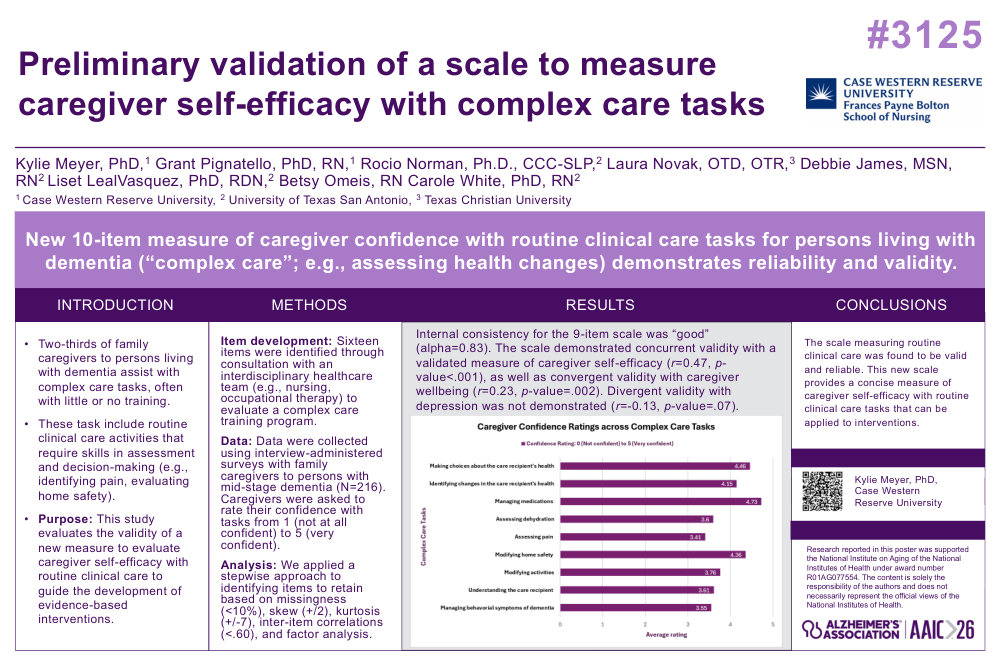
The poster presents research on the development and validation of a new 10‑item scale measuring caregiver confidence with routine clinical care tasks for people living with dementia. The layout includes institutional logos from Case Western Reserve University and the Frances Payne Bolton School of Nursing, along with author names and affiliations.
Overall Purpose
The poster introduces a new measure designed to assess caregiver self‑efficacy with “complex care” tasks, defined as routine clinical care activities requiring assessment and decision‑making (e.g., identifying pain, evaluating home safety). The stated purpose is to guide the development of evidence‑based caregiver interventions.
Introduction Section
The introduction highlights that two‑thirds of family caregivers for people with dementia perform complex care tasks, often without training. These tasks include identifying health changes, assessing pain, evaluating home safety, and other clinical‑style responsibilities. The poster states: “This study evaluates the validity of a new measure to evaluate caregiver self‑efficacy with routine clinical care.”
Methods Section
The methods describe a multi‑step item development and testing process:
-
Sixteen initial items were created with input from an interdisciplinary team (nursing, occupational therapy, speech‑language pathology).
-
Data were collected through interview‑administered surveys with 216 family caregivers of persons with mid‑stage dementia.
-
Caregivers rated confidence from 1 (not at all confident) to 5 (very confident).
-
Items were evaluated using thresholds for missingness, skew, kurtosis, inter‑item correlations, and factor analysis.
Results Section
The final scale includes 9 items with good internal consistency (α = 0.83). The scale demonstrated:
-
Concurrent validity with an established caregiver self‑efficacy measure (r = 0.47, p < .001).
-
Convergent validity with caregiver wellbeing (r = 0.23, p = .002).
-
No evidence of divergent validity with depression (r = –0.13, p = .07).
A bar chart titled “Caregiver Confidence Ratings across Complex Care Tasks” displays average confidence ratings (0–5 scale) for specific tasks. Higher‑confidence tasks include managing medications (4.73) and making health‑related decisions (4.46). Lower‑confidence tasks include assessing pain (3.41) and managing behavioral symptoms of dementia (3.55).
Conclusions Section
The poster concludes that the new scale is valid, reliable, and concise, offering a practical tool for evaluating caregiver self‑efficacy with routine clinical care tasks. It is positioned as useful for intervention development and evaluation.
Funding and Conference Information
The work is supported by the National Institute on Aging (R01AG077554). A note clarifies that the content does not necessarily represent NIH views. The poster includes the AAIC 2026 conference branding and the Alzheimer’s Association logo.
Comments
Email is required but is not shown publicly.
Loading comments...