4,068 posters, 219 videos, 101 topics, 69 sessions, 14,365 authors, 6,128 institutions
ePostersLive by SciGen Technologies S.A. All rights reserved.
Alzheimer's Association International Conference 2026
July 12-15, 2026 | London, United Kingdom, and Online

2103
Improving Access To Care Via A Geriatric Medicine Virtual Memory Clinic Model For Patients With Dementia In Underserved Areas
Poster Presenter
Authors
Part of Topic
Background
Alzheimer’s Disease and Related Dementia (ADRD) affect 55M people worldwide. Primary Care Providers (PCPs) are often the first manage ADRD, but nearly one-third of PCPs refer patients to specialized memory clinics.7,8 This creates a major barrier to care, particularly for older adults in rural areas where access to specialist care is limited.9,10
To bridge this gap and reach underserved populations, we launched an interdisciplinary Virtual Memory Clinic (VMC) staffed by geriatricians, nurses, and social workers. This study evaluates the clinic’s patient demographics, referral patterns, and early operational impact in improving access to specialized dementia care.
Methods
Results
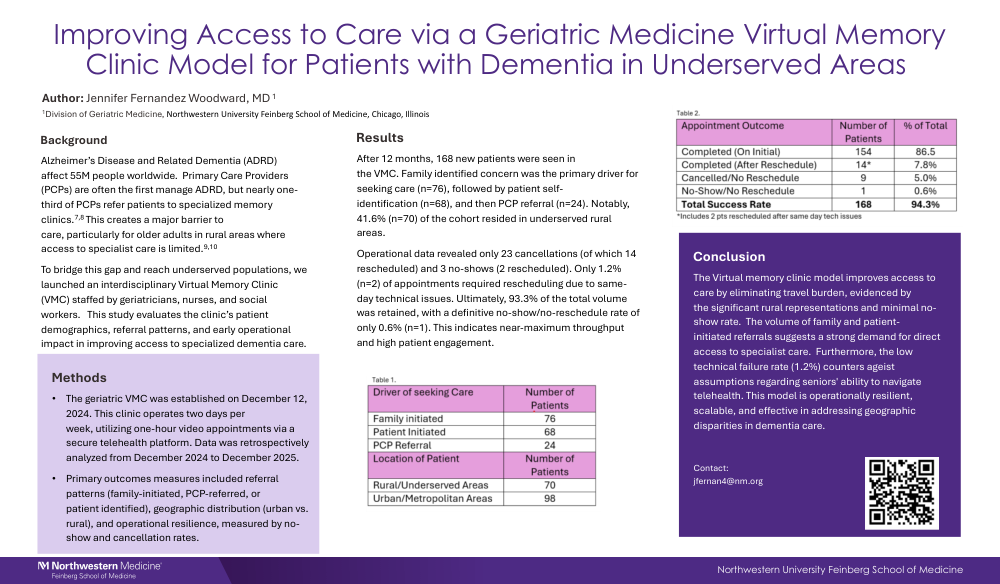
After 12 months, 168 new patients were seen in the VMC. Family identified concern was the primary driver for seeking care (n=76), followed by patient self-identification (n=68), and then PCP referral (n=24). Notably, 41.6% (n=70) of the cohort resided in underserved rural areas.
Operational data revealed only 23 cancellations (of which 14 rescheduled) and 3 no-shows (2 rescheduled). Only 1.2% (n=2) of appointments required rescheduling due to same-day technical issues. Ultimately, 93.3% of the total volume was retained, with a definitive no-show/no-reschedule rate of only 0.6% (n=1). This indicates near-maximum throughput and high patient engagement.
Conclusion
The Virtual memory clinic model improves access to care by eliminating travel burden, evidenced by the significant rural representations and minimal no-show rate. The volume of family and patient-initiated referrals suggests a strong demand for direct access to specialist care. Furthermore, the low technical failure rate (1.2%) counters ageist assumptions regarding seniors' ability to navigate telehealth. This model is operationally resilient, scalable, and effective in addressing geographic disparities in dementia care.
Contact:
jfernan4@nm.org
Comments
Email is required but is not shown publicly.
Loading comments...