4,068 posters, 219 videos, 101 topics, 69 sessions, 14,365 authors, 6,128 institutions
ePostersLive by SciGen Technologies S.A. All rights reserved.
Alzheimer's Association International Conference 2026
July 12-15, 2026 | London, United Kingdom, and Online

1210
A Digital Reading Intervention For Reducing Apathy Among Rural Older Adults With And Without Dementia: A Mixed-methods Pilot Study
Poster Presenter
Authors
Affiliations
Part of Topic
BACKGROUND
- Apathy is a common and clinically important neuropsychiatric symptom among older adults with and without dementia.
- It is associated with accelerated cognitive decline, functional disability, social withdrawal, and reduced quality of life.
- Access to effective non-pharmacological interventions remains limited in many rural communities.
- Guided by Socioemotional Selectivity Theory (SST), this study evaluated whether a digitally supported reading program could reduce apathy through emotionally meaningful engagement and social connection.
OBJECTIVE
To evaluate the effectiveness of an 8-week digital reading intervention in reducing apathy among rural community-dwelling older adults with and without dementia and explore the mechanisms underlying observed changes.
METHODS
- Single-group, pre–post mixed-methods pilot study
- 28 community-dwelling older adults (≥60 years)
- Conducted across three rural communities in Northern British Columbia, Canada
- Weekly facilitated eBook club sessions with independent reading using Kobo eReaders
- Apathy assessed using the 3-item Geriatric Depression Scale–Apathy Subscale (GDS-3A) before and after the intervention
- Semi-structured interviews explored participants' experiences and mechanisms of change
RESULTS
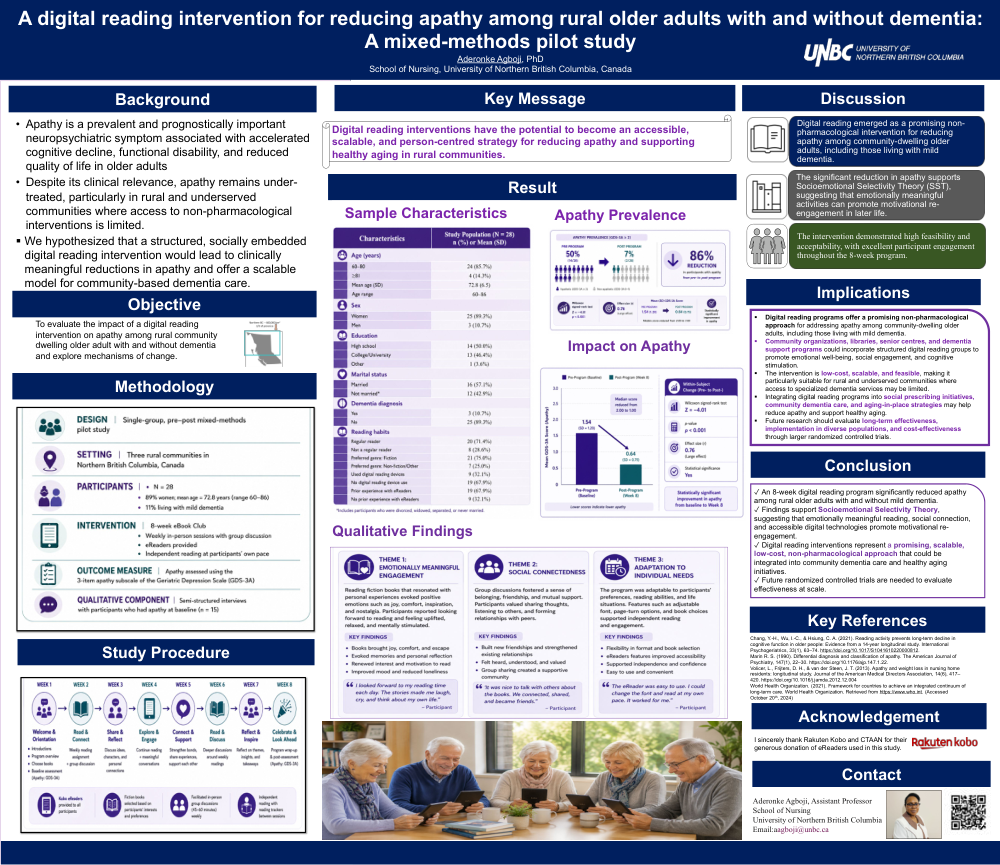
- Apathy prevalence decreased from 50% (14/28) at baseline to 7% (2/28) post-intervention.
- Mean GDS-3A score decreased from 1.54 ± 1.20 to 0.64 ± 0.75.
- Significant improvement in apathy was observed:
- Z = –4.01
- p < 0.001
- Effect size (r) = 0.76
HOW IT WORKED
Enhanced Emotional Regulation (Positivity Effect)
Emotionally meaningful narratives promoted enjoyment, comfort, and renewed motivation to engage in reading.
Emotionally Meaningful Social Connections
Small-group discussions fostered trust, belonging, and supportive relationships through shared reading experiences.
Adaptive Coping
Accessible eReader technology supported independent reading and sustained engagement despite physical or cognitive limitations.
DISCUSSION
- The intervention demonstrated promising potential as a non-pharmacological strategy for reducing apathy in rural older adults.
- Findings support Socioemotional Selectivity Theory, highlighting the importance of emotionally meaningful activities in later life.
- The combination of meaningful reading, peer interaction, and accessible technology may promote sustained motivation and social engagement.
- These findings provide preliminary evidence supporting digitally enabled reading programs as a community-based approach to healthy aging.
IMPLICATIONS
- Digital reading programs offer a low-cost, scalable, and person-centred approach to addressing apathy.
- Community organizations, libraries, and dementia support programs could integrate structured reading groups into existing services.
- The intervention may complement social prescribing, community dementia care, and aging-in-place initiatives, particularly in rural and underserved communities.
- Larger randomized controlled trials are needed to evaluate long-term effectiveness and implementation at scale.
CONCLUSIONS
- An 8-week digital reading intervention significantly reduced apathy among rural older adults with and without dementia.
- Improvements were supported by enhanced emotional regulation, meaningful social connections, and adaptive coping through accessible digital technology.
- Digital reading programs show promise as a scalable, theory-informed, non-pharmacological intervention to support healthy aging and dementia care in rural communities.
KEY MESSAGE
Digital reading programs may represent a scalable, person-centred, and non-pharmacological strategy for reducing apathy and supporting healthy aging among rural older adults with and without dementia.
Comments
Email is required but is not shown publicly.
Loading comments...