4,068 posters, 219 videos, 101 topics, 69 sessions, 14,365 authors, 6,128 institutions
ePostersLive by SciGen Technologies S.A. All rights reserved.
Alzheimer's Association International Conference 2026
July 12-15, 2026 | London, United Kingdom, and Online

9196
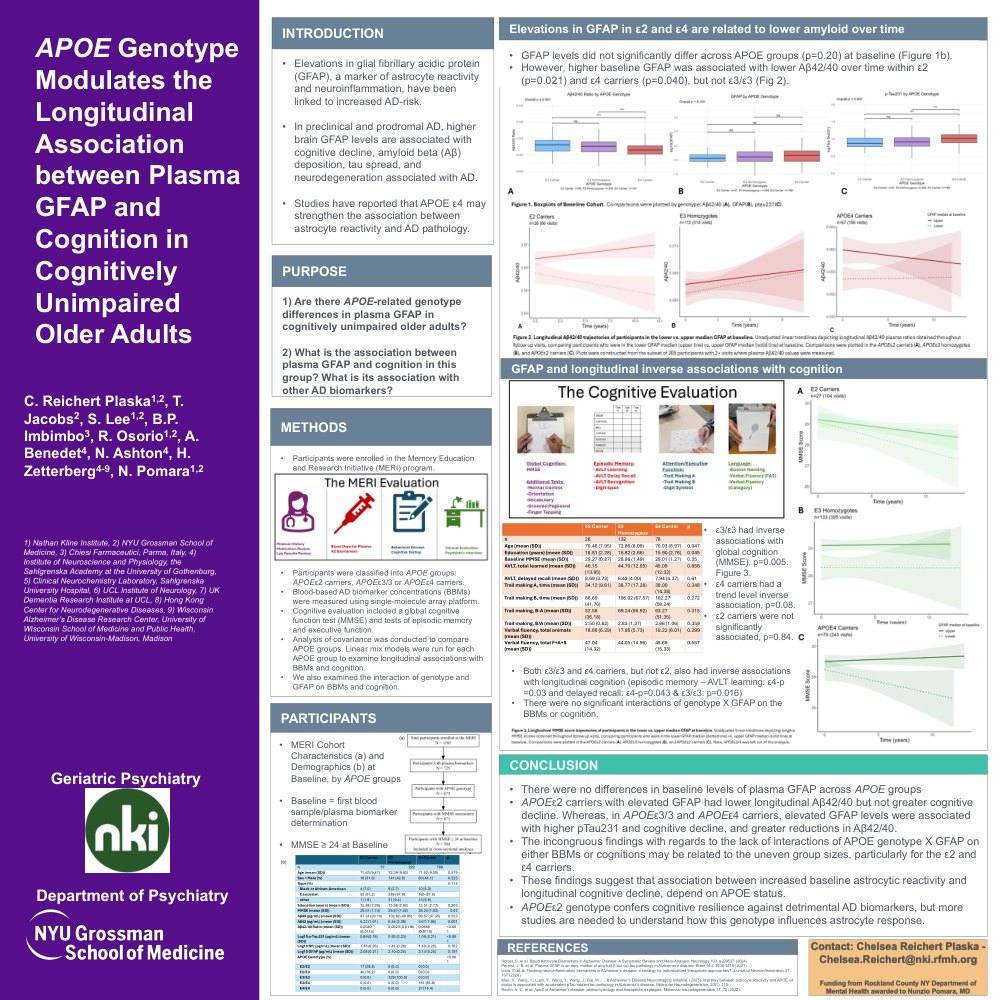
Apoe Genotype Modulates The Longitudinal Association Between Plasma Gfap And Cognition In Cognitively Unimpaired Older Adults
Poster Presenter
Authors
Chelsea Reichert Plaska, Tovia Jacobs, Sang Han Lee, Bruno Imbimbo, Ricardo Osorio, Andrea Benedet, Nicholas Ashton, Henrik Zetterberg, Nunzio Pomara
Affiliations
NYU Grossman School of Medicine, Nathan S. Kline Institute for Psychiatric Research; NYU Grossman School of Medicine, Chiesi Farmaceutici, Institute of Neuroscience and Physiology, the Sahlgrenska Academy at the University of Gothenburg
Part of Topic
Introduction
- Elevations in glial fibrillary acidic protein (GFAP), a marker of astrocyte reactivity and neuroinflammation, have been linked to increased AD-risk.
- In preclinical and prodromal AD, higher brain GFAP levels are associated with cognitive decline, amyloid beta (Aβ) deposition, tau spread, and neurodegeneration associated with AD.
- Carriers of certain Apolipoprotein E gene variants (ε4 allele) are at increased risk of AD.
- Studies have reported that APOE ε4 may strengthen the association between astrocyte reactivity and AD pathology.
- We previously reported elevations in GFAP in women from the same cohort, which were associated with longitudinal changes in amyloid burden, measured via plasma Aβ42/20, and decline in episodic memory performance. However, we did not consider the influence of genotype.
Purpose: 1) Are there APOE-related genotype differences in plasma GFAP in cognitively unimpaired older adults?
2) What is the association between plasma GFAP and cognition in this group? What is its association with other AD biomarkers?
Methods
- Participants were enrolled in the Memory Education and Research Initiative (MERI) program.
- Cognitive evaluation included a global cognitive function test (MMSE) and tests of episodic memory and executive function.
- Blood-based biomarkers (BBMs; GFAP, Aβ42/Aβ40, pTau231) concentrations were measured using single-molecule array (SIMOA) platform.
- Participants were included in the current analysis if MMSE>23 at baseline and age 50-85.
- Participants were classified into APOE groups: APOEε2 carriers, APOEε3/3 or APOEε4 carriers.
- Analysis of covariance was conducted to compare APOE groups. Linear mix models were run for each APOE group to examine longitudinal associations with BBMs and cognition.
- We also examined the interaction of genotype and GFAP on BBMs and cognition.
Results
- A total 574 MERI (mean age=72 years; 61% females) were included in the analysis. GFAP levels did not significantly differ between APOE group (p=0.20) at baseline.
- However, higher baseline GFAP was associated with lower Aβ42/40 over time within ε2 (p=0.021) and ε4 carriers (p=0.040), but not ε3/ε3.
- Whereas higher baseline GFAP was associated with higher pTau231 in ε3/ε3 (p=0.015) and ε4 carriers (p=0.023), but not ε2. Both ε3/ε3 and ε4 carriers, but not ε2, also had inverse associations with longitudinal cognition (episodic memory).
-
ε3/ε3 had inverse associations with global cognition (MMSE), p=0.005. ε4 carriers had a trend level inverse association, p=0.08. ε2 carriers were not significantly associated, p=0.84.
- There were no significant interactions of genotype X GFAP on the BBMs or cognition.
Conclusions
- There were no differences in baseline levels of plasma GFAP across APOE groups.
- APOEε2 carriers with elevated GFAP had lower longitudinal Aβ42/40 but not greater cognitive decline. Whereas, in APOEε3/3 and APOEε4 carriers, elevated GFAP levels were associated with higher pTau231 and cognitive decline, with reductions in Aβ42/40.
- The incongruous findings with regards to the lack of interactions of APOE genotype X GFAP on either BBMs or cognitions may be related to the uneven group sizes, particularly for the ε2 and ε4 carriers.
- These findings suggest that association between increased baseline astrocytic reactivity and longitudinal cognitive decline, depend on APOE status.
- APOEε2 genotype confers cognitive resilience against detrimental AD biomarkers, but more studies are needed to understand how this genotype influences astrocyte response.
Comments
Email is required but is not shown publicly.
Loading comments...