4,068 posters, 219 videos, 101 topics, 69 sessions, 14,365 authors, 6,128 institutions
ePostersLive by SciGen Technologies S.A. All rights reserved.
Alzheimer's Association International Conference 2026
July 12-15, 2026 | London, United Kingdom, and Online

6031
Llm-based Identification Of Formulaic Language In Alzheimer’S Disease: Reliability And Clinical Utility
Poster Presenter
Part of Topic
LLM-based Identification of Formulaic Language in Alzheimer’s Disease: Reliability and Clinical Utility
Seung-Yun Yang & Daniel Chang
Introduction
-
Individuals with Alzheimer’s Disease (AD) show increased use of formulaic language, including overlearned expressions such as idioms and social formulas.1-3
-
This pattern may be explained by the Dual-Process Model of Language: formulaic language relies more on basal ganglia/right-hemisphere networks, while novel language depends more on cortical language area.2
-
Because basal ganglia systems are relatively preserved until later stages of AD, formulaic language may remain accessible even as generative language abilities decline.
-
Manual identification of formulaic language is labor-intensive, time-consuming, and dependent on expert judgment.
-
Recent studies suggest thatLarge Language Models (LLMs) can reliably analyze discourse- and pragmatic-level language features, offering a scalable alternative to manual annotation.4
-
This study examines formulaic language use in AD and healthy controls (HC) using a LLM to enable scalable linguistic analysis.
-
Speech samples were obtained from a publicly available, de-identified ADReSS dataset from DementiaBank5, containing recordings from individuals diagnosed with AD and HC speakers.
-
Samples included Cookie Theftpicture description transcripts from 48 participants: 24 with Alzheimer's disease (AD) and 24 healthy controls (HC), matched by age (AD: 66.1 ± 7.4 years; HC: 66.1 ± 7.1 years) and gender. The transcripts were obtained from DementiaBank as CHA files.
-
All analyses, including LLM use, followed DementiaBank data-use policies.5
-
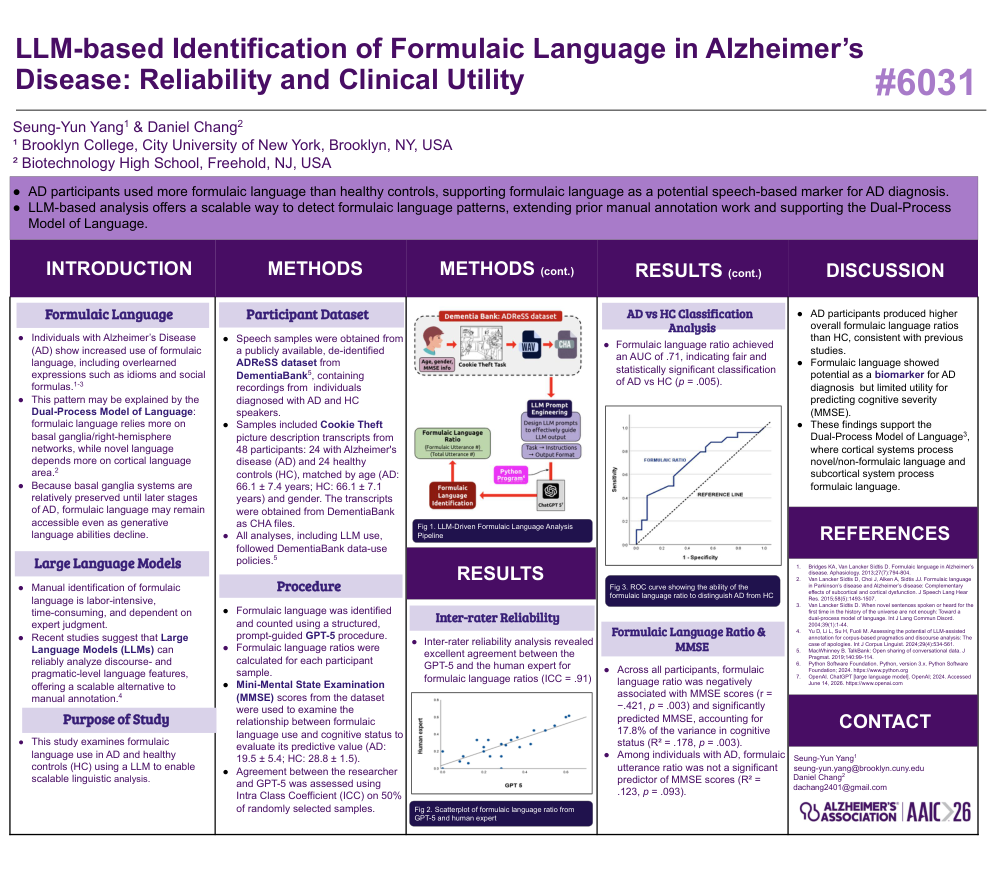
Formulaic language was identified and counted using a structured, prompt-guided GPT-5 procedure.
-
Formulaic language ratios were calculated for each participant sample.
-
Mini-Mental State Examination (MMSE) scores from the dataset were used to examine the relationship between formulaic language use and cognitive status to evaluate its predictive value (AD: 19.5 ± 5.4; HC: 28.8 ± 1.5).
-
Agreement between the researcher and GPT-5 was assessed using Intra Class Coefficient (ICC) on 50% of randomly selected samples.
-
Inter-rater reliability analysis revealed excellent agreement between the GPT-5 and the human expert for formulaic language ratios (ICC = .91)
-
Formulaic language ratio achieved an AUC of .71, indicating fair and statistically significant classification of AD vs HC (p = .005).
-
Across all participants, formulaic language ratio was negatively associated with MMSE scores (r = −.421, p = .003) and significantly predicted MMSE, accounting for 17.8% of the variance in cognitive status (R² = .178, p = .003).
-
Among individuals with AD, formulaic utterance ratio was not a significant predictor of MMSE scores (R² = .123, p = .093).
Discussion
-
AD participants produced higher overall formulaic language ratios than HC, consistent with previous studies.
-
Formulaic language showed potential as a biomarker for AD diagnosis but limited utility for predicting cognitive severity (MMSE).
-
These findings support the Dual-Process Model of Language3, where cortical systems process novel/non-formulaic language and subcortical system process formulaic language.
-
LLM-based analysis offers a scalable way to detect formulaic language patterns, extending prior manual annotation work and supporting the Dual-Process Model of Language.
-
Bridges KA, Van Lancker Sidtis D. Formulaic language in Alzheimer’s disease. Aphasiology. 2013;27(7):794-804.
-
Van Lancker Sidtis D, Choi J, Alken A, Sidtis JJ. Formulaic language in Parkinson’s disease and Alzheimer’s disease: Complementary effects of subcortical and cortical dysfunction. J Speech Lang Hear Res. 2015;58(5):1493-1507.
-
Van Lancker Sidtis D. When novel sentences spoken or heard for the first time in the history of the universe are not enough: Toward a dual-process model of language. Int J Lang Commun Disord. 2004;39(1):1-44.
-
Yu D, Li L, Su H, Fuoli M. Assessing the potential of LLM-assisted annotation for corpus-based pragmatics and discourse analysis: The case of apologies. Int J Corpus Linguist. 2024;29(4):534-561.
-
MacWhinney B. TalkBank: Open sharing of conversational data. J Pragmat. 2019;140:99-114.
-
Python Software Foundation. Python, version 3.x. Python Software Foundation; 2024. https://www.python.org
-
OpenAI. ChatGPT [large language model]. OpenAI; 2024. Accessed June 14, 2026. https://www.openai.com
Comments
Email is required but is not shown publicly.
Loading comments...