4,068 posters, 219 videos, 101 topics, 69 sessions, 14,365 authors, 6,128 institutions
ePostersLive by SciGen Technologies S.A. All rights reserved.
Alzheimer's Association International Conference 2026
July 12-15, 2026 | London, United Kingdom, and Online

6743
Associations Of Inflammatory Processes And White Matter Hyperintensities In Community-dwelling Older Adults
Poster Presenter
Authors
Rongxiang Tang, Tyler Bell, Tina Vo, Anna Chen, Randy Notestine, Robert Rissman, Lisa Eyler, Chandra Reynolds, Matthew Pannizon, Carol Franz, William Kremen
Affiliations
Department of Psychiatry, University of California San Diego, Alzheimer's Therapeutic Research Institute, University of Southern California, Department of Psychological & Brain Sciences, Texas A&M University, Computational and Applied Statistics Laboratory at SDSC, Institute for Behavioral Genetics and Department of Psychology & Neuroscience, University of Colorado Boulder
Part of Topic
Background
Inflammation has been implicated in ADRD and cerebrovascular pathology. Both peripheral inflammation and neuroinflammation as measured by blood-based biomarkers have been separately shown to be associated with white matter hyperintensities (WMH), which are linked to ADRD pathology. However, no studies have examined these two processes together or evaluated whether they have distinct contributions to white matter disease. Moreover, it remains unknown whether these inflammatory processes interact with APOE genotype to influence WMH.
Methods
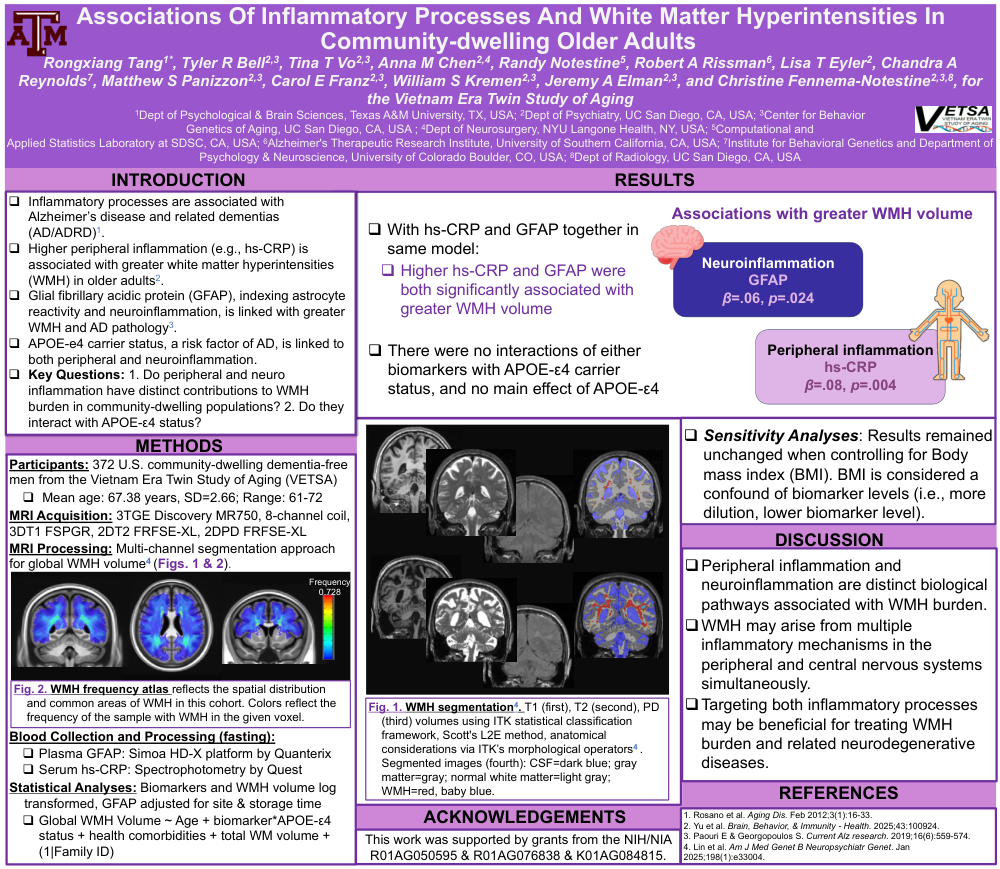
Participants were 372 community-dwelling older men (mean age=67.38 years, SD=2.66; range=61-72) from wave 3 of the Vietnam Era Twin Study of Aging. Structural T1-, T2-, and proton-density-weighted images were collected and global volume of WMH was derived using a multi-channel tissue segmentation approach. Peripheral inflammation was assessed via high-sensitivity C-Reactive Protein (hs-CRP) from serum (spectrophotometry; Quest Diagnostics) and neuroinflammation via glial fibrillary acidic protein (GFAP) from plasma (Simoa GFAP Discovery Kit; Quanterix Corporation). All biomarkers and WMH volumes were log transformed and values exceeding three times the interquartile range outside of the first and third quartiles after transformation were excluded from analyses. Linear mixed models were performed to assess associations between each inflammatory marker and WMH volume. Age, APOE genotype (ε4 positive or negative), health comorbidities (Charlson index), total WM volume, and twin pair ID were included as covariates.
Results
When examined separately, both higher levels of hs-CRP and GFAP were associated with greater WMH volume (hs-CRP: β=.06, p=.023; GFAP: β=.05, p=.045). When examined together in the same model, higher levels of hs-CRP and GFAP both remained significantly associated with greater WMH volume (hs-CRP: β=.08, p=.004; GFAP: β=.06, p=.024). No significant interaction effects were observed among hs-CRP, GFAP, and APOE genotype (ps>.05).
Conclusions
The associations of peripheral inflammation and neuroinflammation with WMH burden are independent of each other, suggesting distinct biological pathways associated with WMH burden. WMH may be linked to multiple inflammatory mechanisms in the peripheral and central nervous systems. Treatment aimed at reducing both inflammatory processes may in turn be beneficial for reducing WMH burden and related neurodegenerative diseases such as ADRD that is closely linked with WMH burden.
Comments
Email is required but is not shown publicly.
Loading comments...