4,068 posters, 219 videos, 101 topics, 69 sessions, 14,365 authors, 6,128 institutions
ePostersLive by SciGen Technologies S.A. All rights reserved.
Alzheimer's Association International Conference 2026
July 12-15, 2026 | London, United Kingdom, and Online

2402
Distinct Patterns Of Tau Deposition Associated With Alpha-synuclein Pathology
Poster Presenter
Authors
Part of Topic
Distinct Patterns of Tau Deposition Associated with Alpha-Synuclein Pathology
Introduction
Up to 50% of individuals diagnosed with Alzheimer’s disease (AD) during life have concomitant alpha-synuclein pathology at autopsy. Compared with individuals with AD pathology alone, those with mixed pathology exhibit more severe neuropsychiatric symptoms and accelerated decline. Alpha-synuclein is the pathological hallmark of dementia with Lewy bodies (DLB). Neuropathologic studies indicate that DLB is common but often misclassified during life; as a result, up to one-third of DLB cases are initially misdiagnosed, and many patients are clinically mismanaged for years. It remains unknown how alpha-synuclein pathology interacts with regional AD pathology to produce the clinical features of synucleinopathy.
Methods
In this cross-sectional study, we conducted voxel-wise analyses of tau burden using tau (18F-AV1451) positron emission tomography (PET), comparing alpha-synuclein–positive and alpha-synuclein–negative individuals while controlling for age, sex, and Aβ status. The analysis included 531 participants from the Alzheimer’s Disease Neuroimaging Initiative (mean age, 73.72±7.6 years; 277 females; 102 alpha-synuclein–positive). We then examined associations between regional tau burden (identified through whole-brain voxel-wise analyses) and Neuropsychiatric Inventory (NPI) total scores, controlling for age, sex, and Aβ status, in the subset of 400 participants who completed clinical and cognitive assessments (Table 1). Finally, we repeated the analyses in alpha-synuclein–positive and alpha-synuclein–negative groups. Multiple-comparison correction was applied using false discovery rate (FDR) procedures for both voxel-wise and partial correlation analyses.
Results
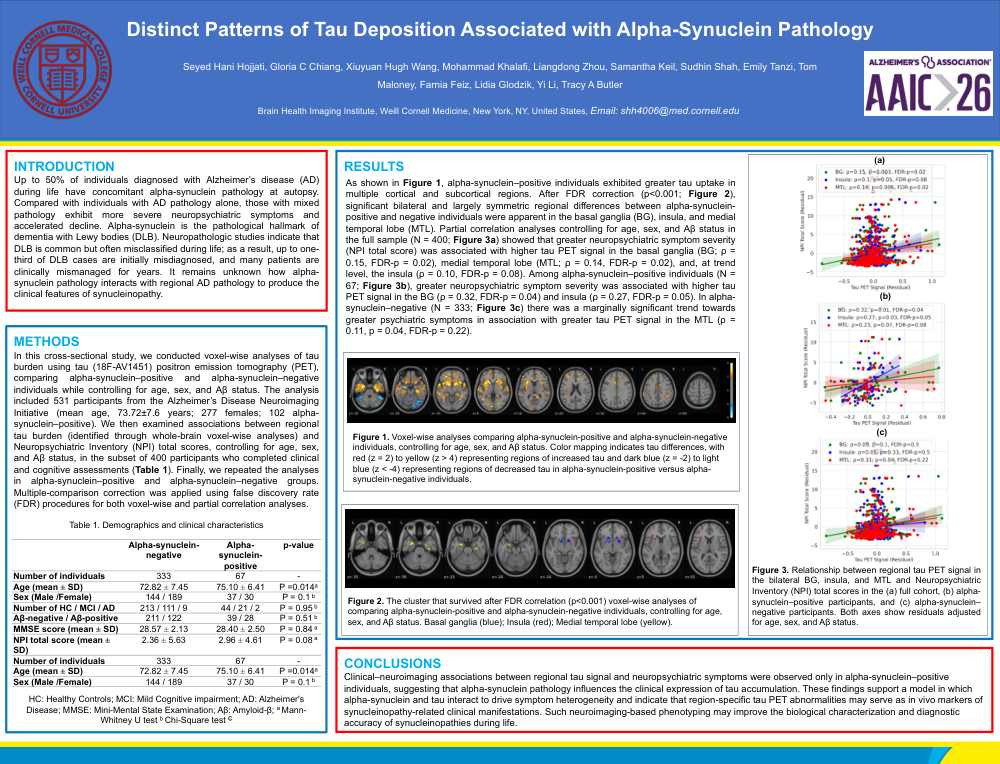
As shown in Figure 1, alpha-synuclein–positive individuals exhibited greater tau uptake in multiple cortical and subcortical regions. After FDR correction (p<0.001; Figure 2), significant bilateral and largely symmetric regional differences between alpha-synuclein-positive and negative individuals were apparent in the basal ganglia (BG), insula, and medial temporal lobe (MTL). Partial correlation analyses controlling for age, sex, and Aβ status in the full sample (N = 400; Figure 3a) showed that greater neuropsychiatric symptom severity (NPI total score) was associated with higher tau PET signal in the basal ganglia (BG; ρ = 0.15, FDR-p = 0.02), medial temporal lobe (MTL; ρ = 0.14, FDR-p = 0.02), and, at trend level, the insula (ρ = 0.10, FDR-p = 0.08). Among alpha-synuclein–positive individuals (N = 67; Figure 3b), greater neuropsychiatric symptom severity was associated with higher tau PET signal in the BG (ρ = 0.32, FDR-p = 0.04) and insula (ρ = 0.27, FDR-p = 0.05). In alpha-synuclein–negative (N = 333; Figure 3c), there was a marginally significant trend towards greater psychiatric symptoms in association with greater tau PET signal in the MTL (ρ = 0.11, p = 0.04, FDR-p = 0.22).
Conclusions
Clinical–neuroimaging associations between regional tau signal and neuropsychiatric symptoms were observed only in alpha-synuclein–positive individuals, suggesting that alpha-synuclein pathology influences the clinical expression of tau accumulation. These findings support a model in which alpha-synuclein and tau interact to drive symptom heterogeneity and indicate that region-specific tau PET abnormalities may serve as in vivo markers of synucleinopathy-related clinical manifestations. Such neuroimaging-based phenotyping may improve the biological characterization and diagnostic accuracy of synucleinopathies during life.
Comments
Email is required but is not shown publicly.
Loading comments...