4,068 posters, 219 videos, 101 topics, 69 sessions, 14,365 authors, 6,128 institutions
ePostersLive by SciGen Technologies S.A. All rights reserved.
Alzheimer's Association International Conference 2026
July 12-15, 2026 | London, United Kingdom, and Online

10382
Effects Of Age And Aging On Neuroanatomy In A Nonhuman Primate Model Of Alzheimer’s Disease
Poster Presenter
Authors
Part of Topic
Background
Regions of Interest: cerebrospinal fluid (CSF), cortical gray matter, deep gray matter, total gray matter, white matter, cerebellum, and brainstem
Statistical Approach: Linear mixed-effects models with main effect of age, main effect of longitudinal aging & interaction term: age-by-aging; ICV as a covariate in models to control for inter-individual variation in head size; Random effect: ID to control for repeated measures
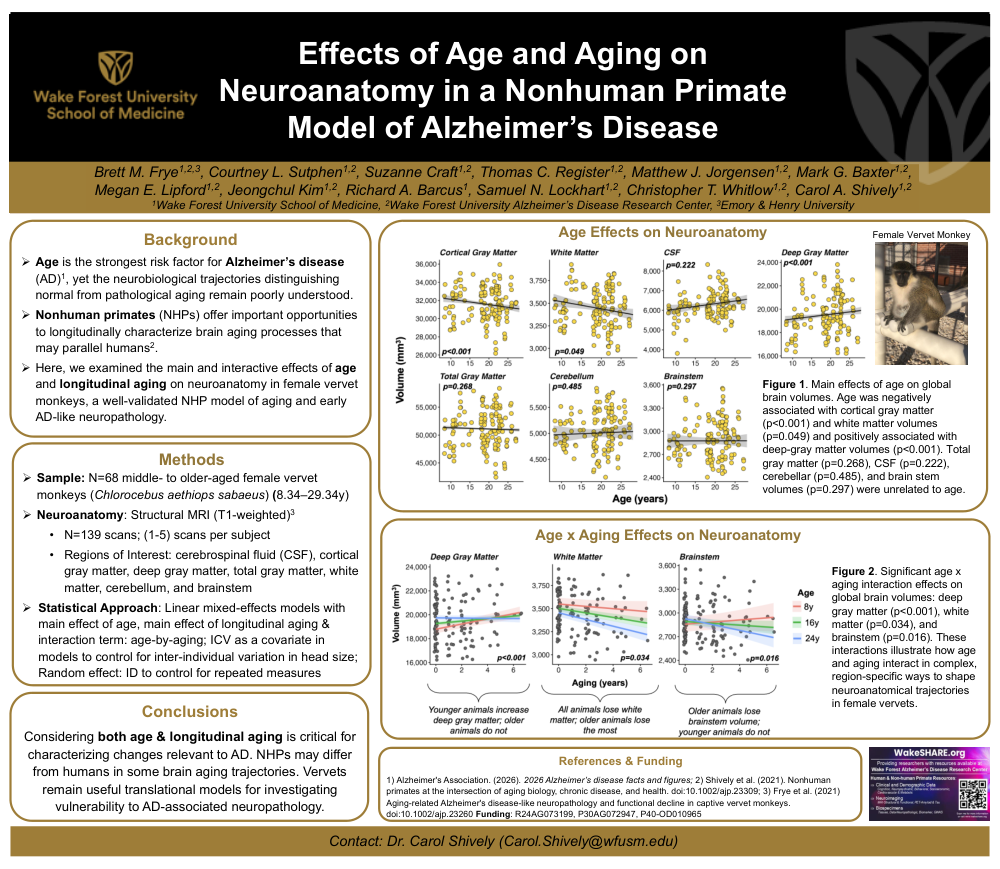
Figure 1. Main effects of age on global brain volumes. Age was negatively associated with cortical gray matter (p<0.001) and white matter volumes (p=0.049) and positively associated with deep-gray matter volumes (p<0.001). Total gray matter (p=0.268), CSF (p=0.222), cerebellar (p=0.485), and brain stem volumes (p=0.297) were unrelated to age.
Figure 2. Significant age x aging interaction effects on global brain volumes: deep gray matter (p<0.001), white matter (p=0.034), and brainstem (p=0.016). These interactions illustrate how age and aging interact in complex, region-specific ways to shape neuroanatomical trajectories in female vervets.
Conclusions:
Considering both age & longitudinal aging is critical for characterizing changes relevant to AD. NHPs may differ from humans in some brain aging trajectories. Vervets remain useful translational models for investigating vulnerability to AD-associated neuropathology.
Comments
Email is required but is not shown publicly.
Loading comments...