4,068 posters, 219 videos, 101 topics, 69 sessions, 14,365 authors, 6,128 institutions
ePostersLive by SciGen Technologies S.A. All rights reserved.
Alzheimer's Association International Conference 2026
July 12-15, 2026 | London, United Kingdom, and Online

3847
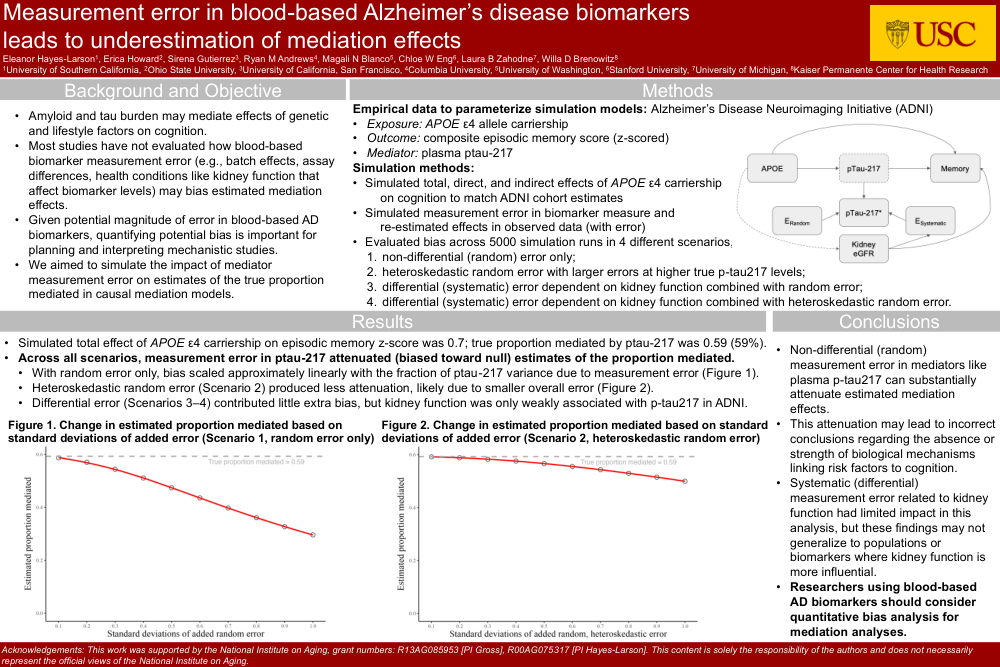
Measurement Error In Blood-based Alzheimer’S Disease Biomarkers Leads To Underestimation Of Mediation Effects
Poster Presenter
Authors
Eleanor Hayes-Larson, Erica Howard, Sirena Gutierrez, Ryan Andrews, Magali Blanco, Chloe Eng, Laura Zahodne, Willa Brenowitz
Affiliations
University of Michigan, University of Washington, University of California, San Francisco, Columbia University, University of Southern California, Stanford University, The Ohio State University, Kaiser Permanente Center for Health Research
Part of Topic
Background: Amyloid and tau burden may mediate effects of genetic and lifestyle factors on cognitive impairment, but most studies have not evaluated how biomarker measurement error may bias estimated mediation effects. Measurement error may arise from batch effects, assay differences, or health conditions affecting blood biomarker levels, such as impaired kidney function. Given the potential magnitude of error in blood-based AD biomarkers, quantifying potential bias is important for planning and interpreting mechanistic studies.
Methods: Using data from the Alzheimer’s Disease Neuroimaging Initiative (ADNI), we simulated the impact of mediator measurement error on estimates of the true proportion mediated in causal mediation models. APOE ε4 carriership was the exposure, episodic memory the outcome, and plasma p-tau217 the mediator. We ran 5000 simulations across four measurement error scenarios: (1) non-differential (random) error only; (2) heteroskedastic random error with larger errors at higher true p-tau217 levels; and differential (systematic) error dependent on kidney function combined with either (3) random or (4) heteroskedastic random error.
Results: In simulations, the total effect of ε4 carriership on cognition was −0.7, and the true proportion mediated by p-tau217 was 0.59. Across all scenarios, measurement error in p-tau217 attenuated estimates of the proportion mediated. With random error only (Scenario 1), attenuation scaled approximately linearly with the fraction of p-tau217 variance attributable to measurement error (Figure 1). Heteroskedastic random error (Scenario 2) produced less attenuation, likely due to smaller overall error (Figure 2). Because kidney function was only weakly associated with p-tau217 in ADNI, differential error in Scenarios 3–4 contributed little additional bias beyond random error.
Conclusions: Non-differential (random) measurement error in mediators like plasma p-tau217 can substantially attenuate estimated mediation effects, potentially leading to incorrect conclusions regarding the absence or strength of biological mechanisms linking risk factors to cognition. Systematic (differential) measurement error related to kidney function had limited impact in this analysis, but these findings may not generalize to populations or biomarkers where kidney function is more influential, where direction and magnitude of these biases in these settings are difficult to predict. Researchers using blood-based AD biomarkers should consider quantitative bias analysis for mediation analyses.
Comments
Email is required but is not shown publicly.
Loading comments...