4,068 posters, 219 videos, 101 topics, 69 sessions, 14,365 authors, 6,128 institutions
ePostersLive by SciGen Technologies S.A. All rights reserved.
Alzheimer's Association International Conference 2026
July 12-15, 2026 | London, United Kingdom, and Online

9254
Lexical And Acoustic Features In The AD Spectrum: A Korean Case Study
Part of Topic
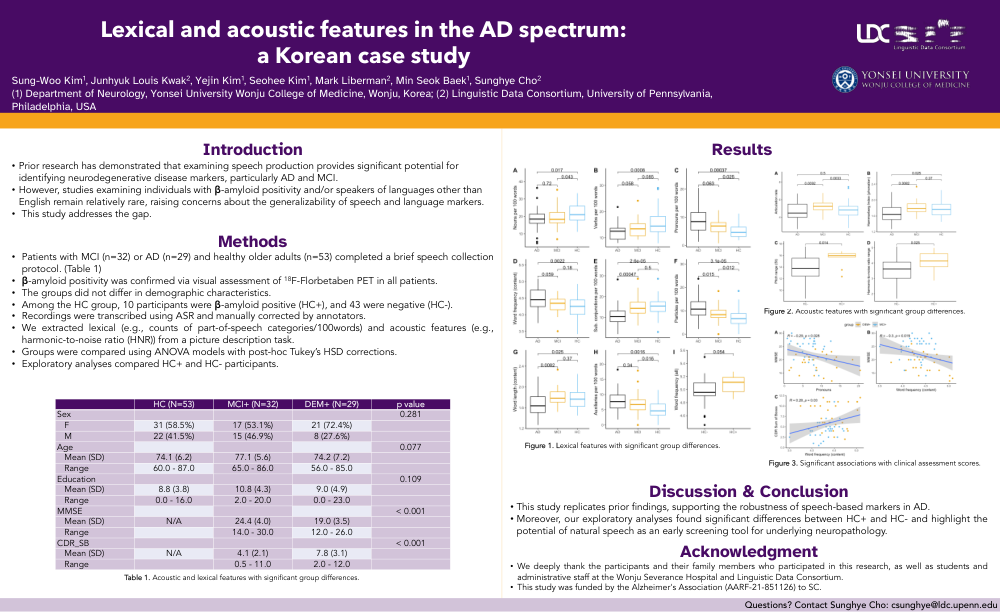
Background: Prior research has demonstrated that examining speech production provides significant potential for identifying neurodegenerative disease markers, particularly AD and MCI. However, studies examining individuals with β-amyloid positivity and/or speakers of languages other than English remain relatively rare, raising concerns about the generalizability of speech and language markers. This study addresses the gap.
Methods: Patients with MCI (n=31, 17F, age=77.4±5.8years, education=10.7±4.4years) or AD (n=28, 20F, age=74.5±7.5years, education=9.1±5years) and healthy older adults (n=53, 31F, age=74.4±6.2years, education=8.8±3.8years) completed a brief speech collection protocol. β-amyloid positivity was confirmed via visual assessment of 18F-Florbetaben PET in all patients. Among the HC group, 10 participants were β-amyloid positive (HC+), and 43 were negative (HC-). The groups did not differ in demographic characteristics. Recordings were transcribed using ASR and manually corrected by annotators. We extracted lexical (e.g., counts of part-of-speech categories/100words) and acoustic features (e.g., harmonic-to-noise ratio (HNR)) from a picture description task. Groups were compared using ANOVA models with post-hoc Tukey’s HSD corrections. Exploratory analyses compared HC+ and HC- participants.
Results: Individuals with AD produced fewer nouns (p=0.046), verbs (p=0.002), and more pronouns (p<0.001) with more frequent content words (p=0.005) than HC (Fig.1A-D). They also produced fewer subordinate conjunctions and particles with shorter content words than MCI (subordinate: p=0.002, particle: p=0.04, length: p=0.02) and HC participants (subordinate: p<0.001, particle: p<0.001, length: p=0.03; Fig.1E-G). Both patient groups produced fewer auxiliaries than HC (AD: p<0.001, MCI: p=0.038; Fig.1H). Additionally, HC+ participants produced more frequent words than HC- (p=0.039; Fig.1I). MCI patients spoke faster with increased articulatory movement and soft phonation than AD (rate: p=0.019, movement: p=0.02, phonation: p=0.046) and/or HC participants (rate: p=0.029, phonation: p=0.044; Fig.2A-C). HC+ participants exhibited a wider pitch range (p=0.003) with greater HNR variability (p=0.022) than HC- participants (Fig.2D-E). Patients’ lower MMSE scores were associated with increased pronouns (r=-0.29, p=0.029) and more frequent content words (r=-0.32, p=0.014), while higher CDR sum-of-boxes scores were correlated with more frequent content words (r=0.026, p=0.044).
Conclusion: This study replicates prior findings, supporting the robustness of speech-based markers in AD. Moreover, our exploratory analyses found significant differences between HC+ and HC- and highlight the potential of natural speech as an early screening tool for underlying neuropathology.
Comments
Email is required but is not shown publicly.
Loading comments...