4,068 posters, 219 videos, 101 topics, 69 sessions, 14,365 authors, 6,128 institutions
ePostersLive by SciGen Technologies S.A. All rights reserved.
Alzheimer's Association International Conference 2026
July 12-15, 2026 | London, United Kingdom, and Online

8982
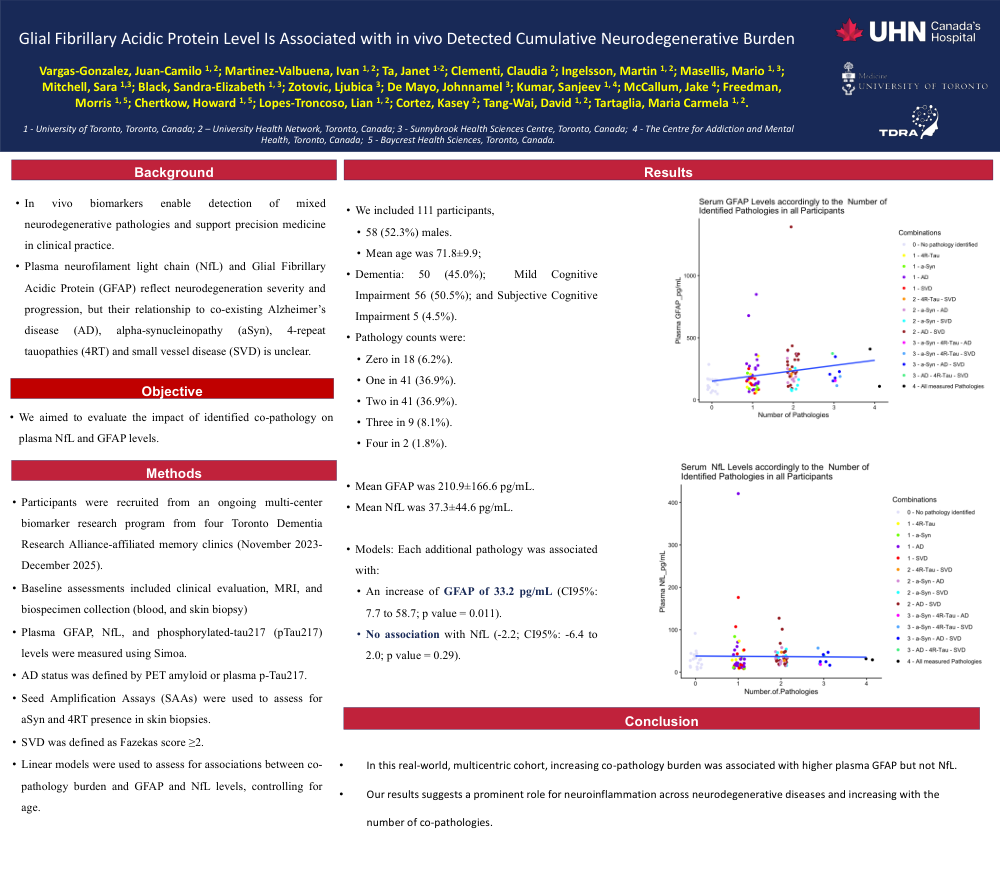
Glial Fibrillary Acidic Protein Level Is Associated With In Vivo Detected Cumulative Neurodegenerative Burden
Poster Presenter
Authors
Juan-Camilo Vargas-Gonzalez, Ivan Martinez-Valbuena, Ta Janet, Claudia Clementi, Martin Ingelsson, Mario Masellis, Sara Mitchell, Sandra-Elizabeth Black, Ljubica Zotovic, Johnnamel De Mayo, Sanjeev Kumar, Jake McCallum, Morris Freedman, Howard Chertkow, Lian Lopes-Troncoso, Cortez Kasey, David Tang-Wai, Carmela Tartaglia
Affiliations
University of Toronto, Toronto, Canada, University Health Network, Toronto, Canada, Sunnybrook Health Sciences Centre, Toronto, Canada, The Centre for Addiction and Mental Health, Toronto, Canada
Part of Topic
@font-face {font-family:"Cambria Math"; panose-1:2 4 5 3 5 4 6 3 2 4; mso-font-charset:0; mso-generic-font-family:roman; mso-font-pitch:variable; mso-font-signature:-536870145 1107305727 0 0 415 0;}@font-face {font-family:Aptos; panose-1:2 11 0 4 2 2 2 2 2 4; mso-font-charset:0; mso-generic-font-family:swiss; mso-font-pitch:variable; mso-font-signature:536871559 3 0 0 415 0;}p.MsoNormal, li.MsoNormal, div.MsoNormal {mso-style-unhide:no; mso-style-qformat:yes; mso-style-parent:""; margin-top:0cm; margin-right:0cm; margin-bottom:8.0pt; margin-left:0cm; line-height:115%; mso-pagination:widow-orphan; font-size:12.0pt; font-family:"Aptos",sans-serif; mso-ascii-font-family:Aptos; mso-ascii-theme-font:minor-latin; mso-fareast-font-family:Aptos; mso-fareast-theme-font:minor-latin; mso-hansi-font-family:Aptos; mso-hansi-theme-font:minor-latin; mso-bidi-font-family:"Times New Roman"; mso-bidi-theme-font:minor-bidi; mso-font-kerning:1.0pt; mso-ligatures:standardcontextual;}.MsoChpDefault {mso-style-type:export-only; mso-default-props:yes; font-family:"Aptos",sans-serif; mso-ascii-font-family:Aptos; mso-ascii-theme-font:minor-latin; mso-fareast-font-family:Aptos; mso-fareast-theme-font:minor-latin; mso-hansi-font-family:Aptos; mso-hansi-theme-font:minor-latin; mso-bidi-font-family:"Times New Roman"; mso-bidi-theme-font:minor-bidi;}.MsoPapDefault {mso-style-type:export-only; margin-bottom:8.0pt; line-height:115%;}div.WordSection1 {page:WordSection1;}
Background: In vivo biomarkers enable detection of mixed neurodegenerative pathologies and support precision medicine in clinical practice. Plasma neurofilament light chain (NfL) and Glial Fibrillary Acidic Protein (GFAP) reflect neurodegeneration severity and progression. Still, their relationship to co-existing Alzheimer’s disease (AD), alpha-synucleinopathy (aSyn), 4-repeat tauopathies (4RT) and small vessel disease (SVD) is unclear. We examined the impact of co-pathology burden on plasma NfL and GFAP.
Methods: Participants were recruited from an ongoing multi-center biomarker research program from four Toronto Dementia Research Alliance-affiliated memory clinics (November 2023-December 2025). Baseline assessments included clinical evaluation, MRI, and biospecimen collection (blood, skin biopsy, optional cerebrospinal fluid). Plasma GFAP, NfL, and phosphorylated-tau217 (pTau217) levels were measured using Simoa. AD status was defined by amyloid PET or p-Tau217. We used Seed Amplification Assays (SAAs) to assess aSyn and 4RTpresence in skin biopsies. SVD was defined as Fazekas score ≥2. Linear models assessed associations between the number of pathologies on GFAP and NfL levels, controlling for age.
Results: We included 111 participants, 58 (52.3%) males. Mean age was 71.8±9.9; 50 (45.0%) had dementia, 56 (50.5%) mild cognitive impairment, and 5 (4.5%) subjective cognitive impairment. Pathology counts were: zero in 18 (6.2%), one in 41 (36.9%), two in 41 (36.9%), three in 9 (8.1%), and four in 2(1.8%). Mean GFAP was 210.9±166.6 pg/mL, and mean NfL was 37.3±44.6 pg/mL.In our models, each additional pathology was associated with an increase of GFAP of 33.2 pg/mL (CI95%: 7.7 to 58.7; p value = 0.011), while there was no association with NfL (-2.2; CI95%: -6.4 to 2.0; p value = 0.29).
Conclusions: In this real-world, multicentric cohort, increasing co-pathology burden was associated with higher plasma GFAP but not NfL, suggesting a prominent role for neuroinflammation across neurodegenerative diseases.
Comments
Email is required but is not shown publicly.
Loading comments...