4,068 posters, 219 videos, 101 topics, 69 sessions, 14,365 authors, 6,128 institutions
ePostersLive by SciGen Technologies S.A. All rights reserved.
Alzheimer's Association International Conference 2026
July 12-15, 2026 | London, United Kingdom, and Online

10711
A Multi-modal Statistical And Machine Learning Framework For Differentiating Alzheimer’s, Parkinson’s, And Lewy Body Dementia
Poster Presenter
Authors
Soumya Bouchachi, Islem Bouchachi, Jessica Pommy, Douglas Scharre
Affiliations
null,
Part of Topic
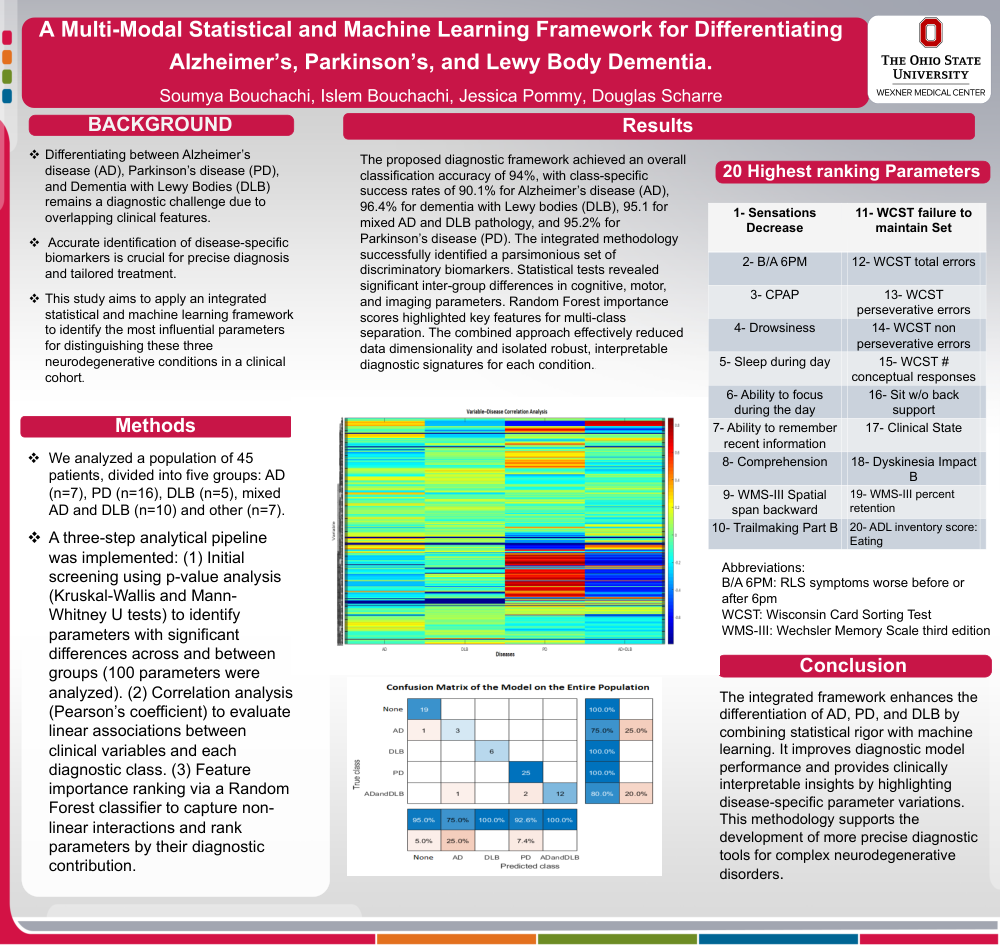
Background: Differentiating between Alzheimer’s disease (AD), Parkinson’s disease (PD), and Dementia with Lewy Bodies (DLB) remains a diagnostic challenge due to overlapping clinical features. Accurate identification of disease-specific biomarkers is crucial for precise diagnosis and tailored treatment. This study aims to apply an integrated statistical and machine learning framework to identify the most influential parameters for distinguishing these three neurodegenerative conditions in a clinical cohort.
Methods: We analyzed a population of 45 patients, divided into five groups: AD (n=7), PD (n=16), DLB (n=5), mixed AD and DLB (n=10) and other (n=7). A three-step analytical pipeline was implemented: (1) Initial screening using p-value analysis (Kruskal-Wallis and Mann-Whitney U tests) to identify parameters with significant differences across and between groups. (2) Correlation analysis (Pearson’s coefficient) to evaluate linear associations between clinical variables and each diagnostic class. (3) Feature importance ranking via a Random Forest classifier to capture non-linear interactions and rank parameters by their diagnostic contribution.
Results: The proposed diagnostic framework achieved an overall classification accuracy of 94%, with class-specific success rates of 90.1% for Alzheimer’s disease (AD), 96.4% for dementia with Lewy bodies (DLB), 95.1 for mixed AD and DLB pathology, and 95.2% for Parkinson’s disease (PD). The integrated methodology successfully identified a parsimonious set of discriminatory biomarkers. Statistical tests revealed significant inter-group differences in cognitive, motor, and imaging parameters. Random Forest importance scores highlighted key features for multi-class separation. The combined approach effectively reduced data dimensionality and isolated robust, interpretable diagnostic signatures for each condition.
Conclusions: The integrated framework enhances the differentiation of AD, PD, and DLB by combining statistical rigor with machine learning. It improves diagnostic model performance and provides clinically interpretable insights by highlighting disease-specific parameter variations. This methodology supports the development of more precise diagnostic tools for complex neurodegenerative disorders.
Comments
Email is required but is not shown publicly.
Loading comments...