4,068 posters, 219 videos, 101 topics, 69 sessions, 14,365 authors, 6,128 institutions
ePostersLive by SciGen Technologies S.A. All rights reserved.
Alzheimer's Association International Conference 2026
July 12-15, 2026 | London, United Kingdom, and Online

4933
Orexin Signalling, Neurodegeneration And Neuroinflammation In Down’s Syndrome
Poster Presenter
Authors
Part of Topic
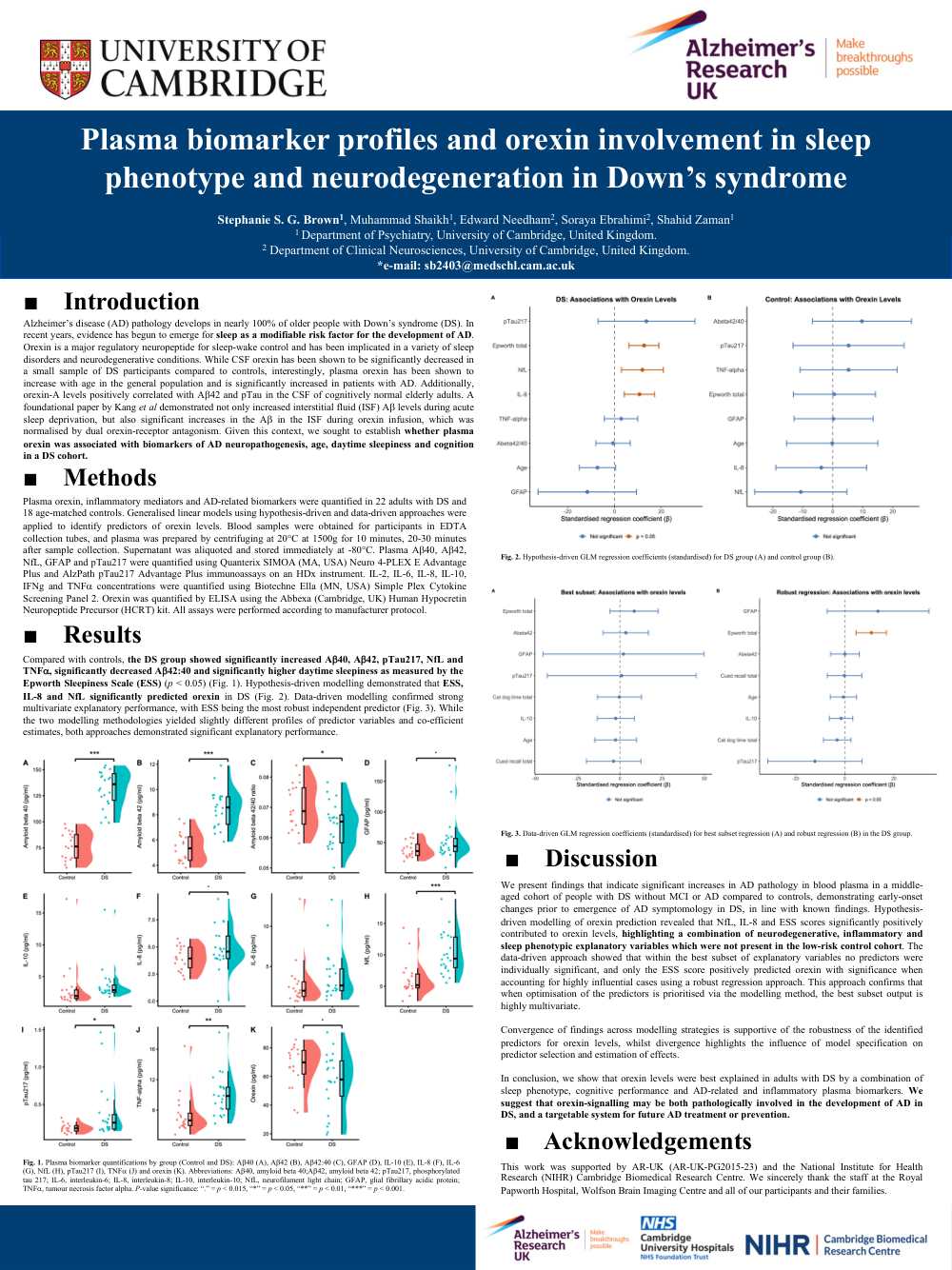
Introduction: In recent years, evidence has begun to emerge for sleep as a modifiable risk factor in the development of Alzheimer’s disease (AD). Individuals with Down’s syndrome (DS) are particularly prone to sleep problems and are reported to have orexin dysregulation linking to AD neuropathology. Orexin is a major regulatory neuropeptide for sleep-wake control and has been implicated in a variety of sleep disorders and neurodegenerative conditions. Findings are suggestive of a significant role for orexin in amyloidosis development and AD severity, although translational research assessing in-depth relationships of orexin to age, sleep quality, cognition and neuropathological biomarkers in DS is scarce.
Methods: We modelled plasma orexin levels in 22 adults with DS, integrating demographic, clinical, and biomarker data including Aβ42:40, pTau217, neurofilament light (NfL), glial fibrillary acidic protein (GFAP), interleukins, and the Epworth Sleepiness Scale (ESS). Both hypothesis-driven and data-driven statistical general linear models were applied to identify key predictors and mechanistic pathways linking sleep regulation, inflammation, and AD processes.
Results: We show that ESS score, NfL, and IL-8 are significant predictors of plasma orexin. Higher levels of orexin in the DS group are associated with a higher incidence of daytime sleepiness, higher levels of NfL, higher levels of inflammatory IL-8, and a tentative trend of higher levels of pTau217. Data-driven modelling revealed core predictors emerging consistently across models were IL-8 and ESS score. Expanded models incorporating NfL, pTau217, GFAP and Aβ42:40 improved explanatory power, highlighting progressive coupling between inflammation, neurodegeneration, and orexin levels.
Conclusion: These results demonstrate that higher levels of orexin are linked to neurodegenerative processes, inflammation and excessive daytime sleepiness in DS. We highlight an interplay between sleep regulation, neurodegeneration, and inflammation, positioning orexin as a promising biomarker and potential preventative therapeutic target in groups at high-risk for AD development.
Comments
Email is required but is not shown publicly.
Loading comments...