4,068 posters, 219 videos, 101 topics, 69 sessions, 14,365 authors, 6,128 institutions
ePostersLive by SciGen Technologies S.A. All rights reserved.
Alzheimer's Association International Conference 2026
July 12-15, 2026 | London, United Kingdom, and Online

13525
Evaluating Feasibility And Utility Of Smartphone-based Gps Activity Metrics In Cognitively Unimpaired Adults
Poster Presenter
Part of Topic
Title
Evaluating Feasibility and Utility of Smartphone-based GPS Activity Metrics in Cognitively Unimpaired Adults
Background
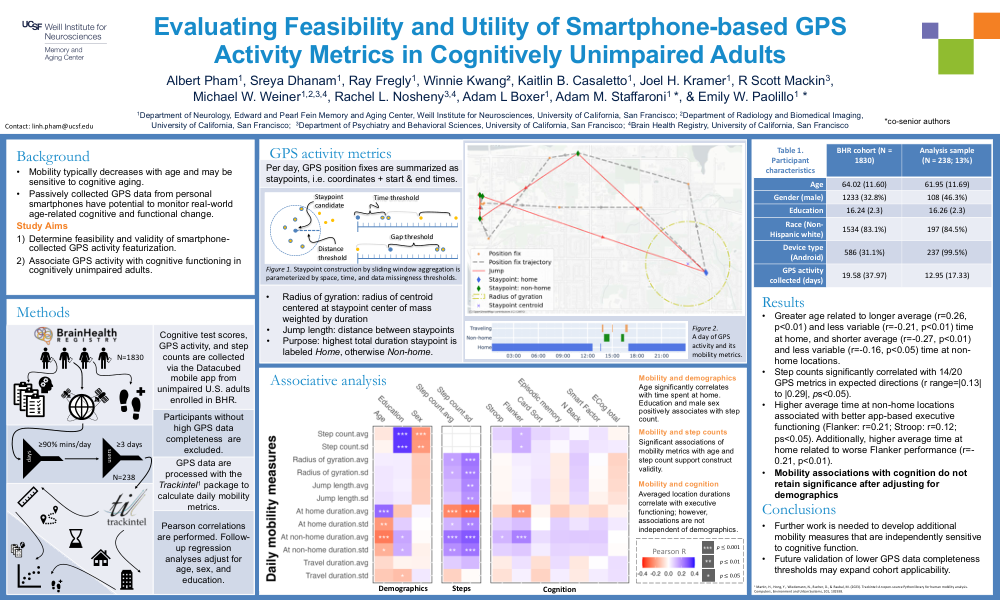
Passively collected GPS data from personal smartphones have potential to monitor real-world age-related cognitive and functional change. This study evaluated: 1) feasibility and validity of smartphone-collected GPS data and 2) association of GPS activity with cognitive functioning in cognitively unimpaired adults.
Methods
Using the Datacubed Health App on personal smartphones, participants from the UCSF Brain Health Registry (BHR) completed cognitive testing and consented to contribute passive GPS and step count data (N=1830; mean age=64.02 years, SD=11.60; 83.14% White; 66.82% female; 31% Android users). For this preliminary validation study, the analytic sample (N=238) included participants with high GPS data completeness (≥3 days with ≥90% of minutes/day). GPS data were processed with the “Trackintel” package to calculate 10 GPS activity metrics, including daily average and interday variability (SD) of: radius of gyration (range of travel), jump length (trip distance), time at home, time at non-home locations, and time in transit. Pearson correlations evaluated associations between GPS activity and age, step counts, and App cognitive performance. Follow-up regression analyses adjusted for age, sex, and education.
Results
Compared to all 1830 BHR participants, the subsample with 90% complete GPS data (N=238; 13%) was comparable by age (mean=61.95 years, SD=11.69), but had more men (53.21% female), White participants (87.95%), and Android users (99.5%; ps<0.01). Greater age related to longer average (r=0.26, p<0.01) and less variable (r=-0.21, p<0.01) time at home, and shorter average (r=-0.27, p<0.01) and less variable (r=-0.16, p<0.05) time at non-home locations. Step counts correlated with 6/10 GPS metrics in expected directions (r range=|0.13| to |0.29|, ps<0.05). Higher average time at non-home locations associated with better app-based executive functioning (Flanker: r=0.21; Stroop: r=0.12; ps<0.05). Additionally, higher average time at home related to worse Flanker performance (r=-0.21, p<0.01). Adjusting for demographics, none of the associations between the GPS metrics and cognitive functioning retained statistical significance (ps>0.05).
Conclusions:
Significant associations of GPS metrics with age and step count support construct validity. Some GPS metrics correlated with executive functioning; however, associations were not independent of demographics. Further work is needed to validate lower GPS data completeness thresholds and develop metrics that are independently sensitive to cognitive function.
Comments
Email is required but is not shown publicly.
Loading comments...