4,068 posters, 219 videos, 101 topics, 69 sessions, 14,365 authors, 6,128 institutions
ePostersLive by SciGen Technologies S.A. All rights reserved.
Alzheimer's Association International Conference 2026
July 12-15, 2026 | London, United Kingdom, and Online

9239
Associations Between Cerebrospinal Fluid Cytokines and Cognitive Performance in Brazilian Older Adults.
Part of Topic
Associations between cerebrospinal fluid cytokines and cognitive performance in Brazilian older adults
Ivonne Carolina Bolaños Burgosa,b,d, Júlia de Almeida Barretof,d, Caio Mendes Ribeirof,d, Pedro Henrique Oliveira Aquinof,d, Gabriela Tomé Oliveira Engelmanna,h, Andréa Teixeira Carvalhoj, Igor Nunes Lannac, Giovanna Correia Pereira Moroa,f, Rafaela Teixeira de Ávilaa, Jonas Jardim de Paulaa,k, Alfredo Ramirez Zunigag, Aloisio Joaquim Freitas Ribeiroi, Lourdes Coral Contreras Montenegroi, Débora Marques de Mirandad,h, Marco Aurélio Romano-Silvad,h, Luiz Armando Cunha de Marcod,h, Maria Aparecida Camargos Bicalho a,b,c,d,h,l and Bernardo de Mattos Vianaa,d,e,h,k
a Cog-aging Research Group – Reference Center for the Elderly, University Hospital of the Universidade Federal de Minas Gerais (UFMG), Room 231, 190 Professor Alfredo Balena Avenue, Santa Efigênia, Postal Code 30130-100, Belo Horizonte, Minas Gerais Brazil.
b Sciences Applied to Adult Health Postgraduate Program, Faculty of Medicine, Universidade Federal de Minas Gerais (UFMG), Room 503, 190 Professor Alfredo Balena Avenue, Santa Efigênia, Postal Code 30130-100, Belo Horizonte, Minas Gerais, Brazil.
c Jenny de Andrade Faria Institute – Reference Center for the Elderly, Universidade Federal de Minas Gerais (UFMG), Room 222, 190 Professor Alfredo Balena Avenue, Santa Efigênia, Postal Code 30130-100, Belo Horizonte, Minas Gerais, Brazil.
d Neurotec R National Institute of Science and Technology (INCT-Neurotec R), Faculty of Medicine, Universidade Federal de Minas Gerais (UFMG), Room 114, 190 Professor Alfredo Balena Avenue, Santa Efigênia, Postal Code 30130-100, Belo Horizonte, Minas Gerais, Brazil.
e Older Adult Psychiatry and Psychology Extension Program (PROEPSI), Faculty of Medicine, Universidade Federal de Minas Gerais (UFMG), Room 235, 190 Professor Alfredo Balena Avenue, Santa Efigênia, Postal Code 30130-100, Belo Horizonte, Minas Gerais, Brazil.
f Undergraduate Medicine, Faculty of Medicine, Universidade Federal de Minas Gerais (UFMG), Room 114, 190 Professor Alfredo Balena Avenue, Santa Efigênia, Postal Code 30130-100, Belo Horizonte, Minas Gerais, Brazil.
g The Department of Psychiatry, Faculty of Medicine, University of Cologne, Building 31, Room 3.026, 62 Kerpener Street, Lindenthal, Postal Code 50931, Cologne, North Rhine–Westphalia, Germany
h Molecular Medicine Postgraduate Program, Faculty of Medicine, Universidade Federal de Minas Gerais (UFMG), Room 503, 190 Professor Alfredo Balena Avenue, Santa Efigênia, Postal Code 30130-100, Belo Horizonte, Minas Gerais, Brazil.
i Department of Statistics, Institute of Exact Sciences, Universidade Federal de Minas Gerais (UFMG), Room 4054, 6627 Presidente Antônio Carlos Avenue, Pampulha, Postal Code 31270-901, Belo Horizonte, Minas Gerais, Brazil.
j René Rachou Institute, Oswaldo Cruz Foundation (Fiocruz), Room 115, 1715 Augusto de Lima Avenue, Barro Preto, Postal Code 30190-002, Belo Horizonte, Minas Gerais, Brazil.
k Department of Psychiatry, Faculty of Medicine, Universidade Federal de Minas Gerais (UFMG), Room 235, 190 Professor Alfredo Balena Avenue, Santa Efigênia, Postal Code 30130-100, Belo Horizonte, Minas Gerais, Brazil.
l Department of Clinical Medicine, Faculty of Medicine, Universidade Federal de Minas Gerais (UFMG), Room 246, 190 Professor Alfredo Balena Avenue, Santa Efigênia, Postal Code 30130-100, Belo Horizonte, Minas Gerais, Brazil.
Corresponding author: Bernardo de Mattos Viana, MD, PhD. Professor of Psychogeriatrics. Vice-Chair of The Department of Psychiatry, School of Medicine, UFMG
Head of the Older Adult’s Psychiatry and Psychology Extension Program. bernardomviana@yahoo.com .
Abstract
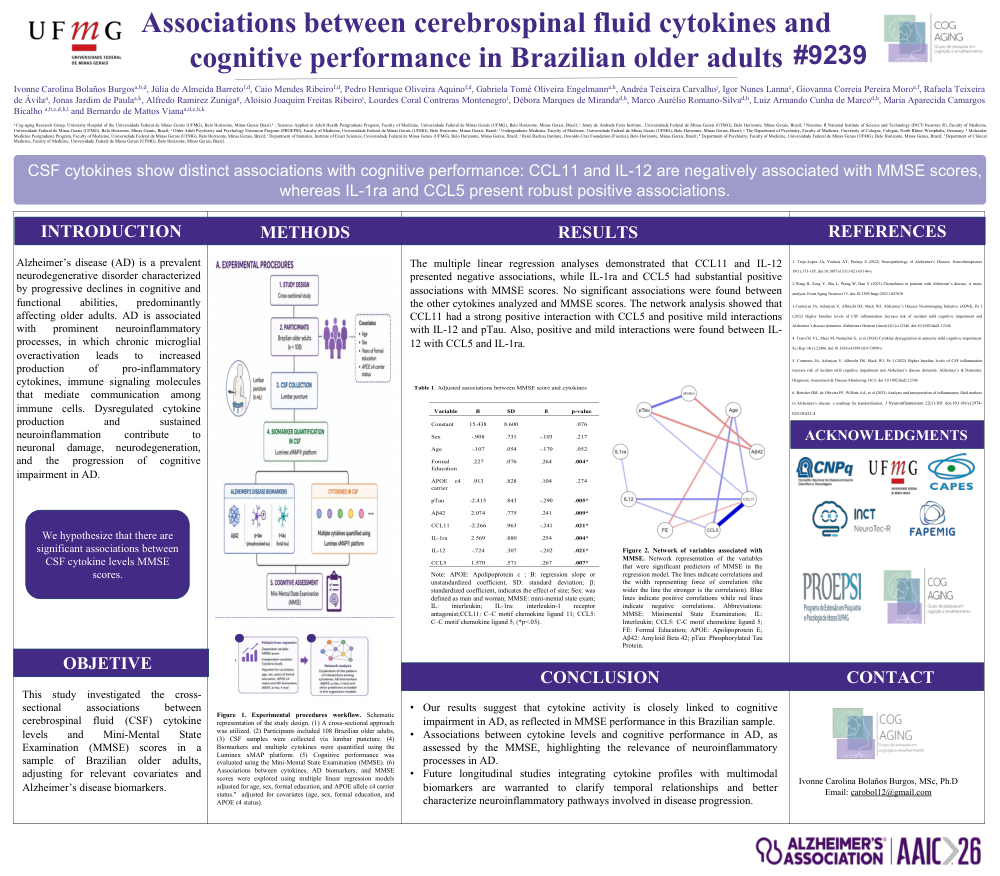
BACKGROUND: Alzheimer’s disease (AD) is a prevalent neurodegenerative disorder characterized by progressive declines in cognitive and functional abilities, predominantly affecting older adults. AD is associated with prominent neuroinflammatory processes, in which chronic microglial overactivation leads to increased production of pro-inflammatory cytokines, immune signaling molecules that mediate communication among immune cells. Dysregulated cytokine production and sustained neuroinflammation contribute to neuronal damage, neurodegeneration, and the progression of cognitive impairment in AD. OBJECTIVE: This study investigated the cross-sectional associations between cerebrospinal fluid (CSF) cytokine levels and Mini-Mental State Examination (MMSE) scores in a sample of Brazilian older adults, adjusting for relevant covariates and Alzheimer’s disease biomarkers. METHODS: A total of 108 Brazilian older adults were recruited for this study. CSF AD biomarkers Aβ42, phosphorylated tau (p-tau), and total tau (t-tau), as well as cytokine levels were quantified using the Luminex xMAP® platform. Associations between cytokines, AD biomarkers, and MMSE scores were explored using multiple linear regression models adjusted for age, sex, formal education, and APOE allele ε4 carrier status. In addition, network analysis was conducted to explore the pattern of interactions among cytokines, AD biomarkers, and other predictors included in the regression models. RESULTS: the multiple linear regression analyses demonstrated that CCL11 and IL-12 presented negative associations, while IL-1ra and CCL5 had substantial positive associations with MMSE scores. No significant associations were found between the other cytokines analyzed and MMSE scores. The network analysis showed that CCL11 had a strong positive interaction with CCL5 and positive mild interactions with IL-12 and pTau. Also, positive and mild interactions were found between IL-12 with CCL5 and IL-1ra. CONCLUSION: these findings indicate an association between cytokine levels and cognitive performance in AD, as assessed by the MMSE, highlighting the relevance of neuroinflammatory processes in AD. Future longitudinal studies integrating cytokine profiles with multimodal biomarkers are warranted to clarify temporal relationships and better characterize neuroinflammatory pathways involved in disease progression.
Keywords: Alzheimer’s disease, Cerebrospinal fluid, Cytokine, Cognitive impairment, Neuroinflammation, Biomarkers, Mini Mental State examination.
Comments
Email is required but is not shown publicly.
Loading comments...