4,068 posters, 219 videos, 101 topics, 69 sessions, 14,365 authors, 6,128 institutions
ePostersLive by SciGen Technologies S.A. All rights reserved.
Alzheimer's Association International Conference 2026
July 12-15, 2026 | London, United Kingdom, and Online

13727
CT-based Amyloid Pet Suvr Generation Using A Reproducible Flywheel Workflow
Poster Presenter
Authors
Terry Ward, Tobey Betthauser, Nathaniel Chin, Sterling Johnson
Affiliations
Part of Topic
Biomarkers -> Neuroimaging -> Novel imaging methods
Introduction
Hypothesis
Implementing a standardized
Flywheel workflow that automatically converts PET/CT data into motioncorrected, smoothed, cerebellarnormalized SUVR images and presents them within a predefined viewer
protocol will provide a consistent, efficient, and reproducible method of amyloid PET visual interpretation. This will provide a consistent method
that can be accessed from a single platform from multiple sites providing a consistence set of tools available to multiple sites.
Amyloid PET quantification typically relies on MRI for anatomical
registration and spatial normalization.
However, MRI availability is limited in
clinical and multi-site research settings, constraining scalability, and MR-free techniques do not always perform
reliably. Computed tomography (CT), routinely acquired during PET/CT, provides a practical alternative structural modality. We developed and
validated a CT-based workflow for
amyloid PET SUVR generation that eliminates MRI dependency.
Methods Results
Acknowledgments
This research is supported by the
generous funding through the NIH National Institute on Aging
(U01AG082350).
We are grateful to the study participants
whose time and commitment make this
work possible.
We thank the ADRC Consortium and the
invaluable support of our national infrastructure partners:
CT-based Amyloid PET SUVR Generation Using a
Reproducible Flywheel Workflow
Terry Ward, Tobey Betthauser, Nathaniel C. Chin, Sterling Johnson
Geriatrics, University of Wisconsin, Madison, WI, USA
For this proof-of-concept study, n=35
amyloid PET exams acquired 50-70
minutes post-injection were analyzed.
PET/CT studies were processed using an
automated Flywheel workflow. CT images were converted from DICOM to
NIfTI format and intensity normalized
prior to registration to the MNI152
template using rigid, affine, and
nonlinear (SyN) transformations implemented in ANTs. The cerebellar
gray matter reference region was transformed from template space into native image space for subsequent quantification.
Dynamic PET data were converted to NIfTI format, decay-corrected using DICOM-derived frame-specific correction factors, and motion
corrected using rigid-body registration.
Frames were summed to generate a static PET image and smoothed with a 7-mm full-width-at-half-maximum
Gaussian kernel.
SUVR images were generated by normalizing voxel intensities to the mean uptake within a cerebellar gray matter reference region. Processed SUVR images automatically loaded into a Flywheel viewer protocol enabled
amyloid visual assessment (amyloid
positive or negative). This workflow provided an end-to-end pipeline from
PET/CT acquisition through quantitative processing and visual interpretation.
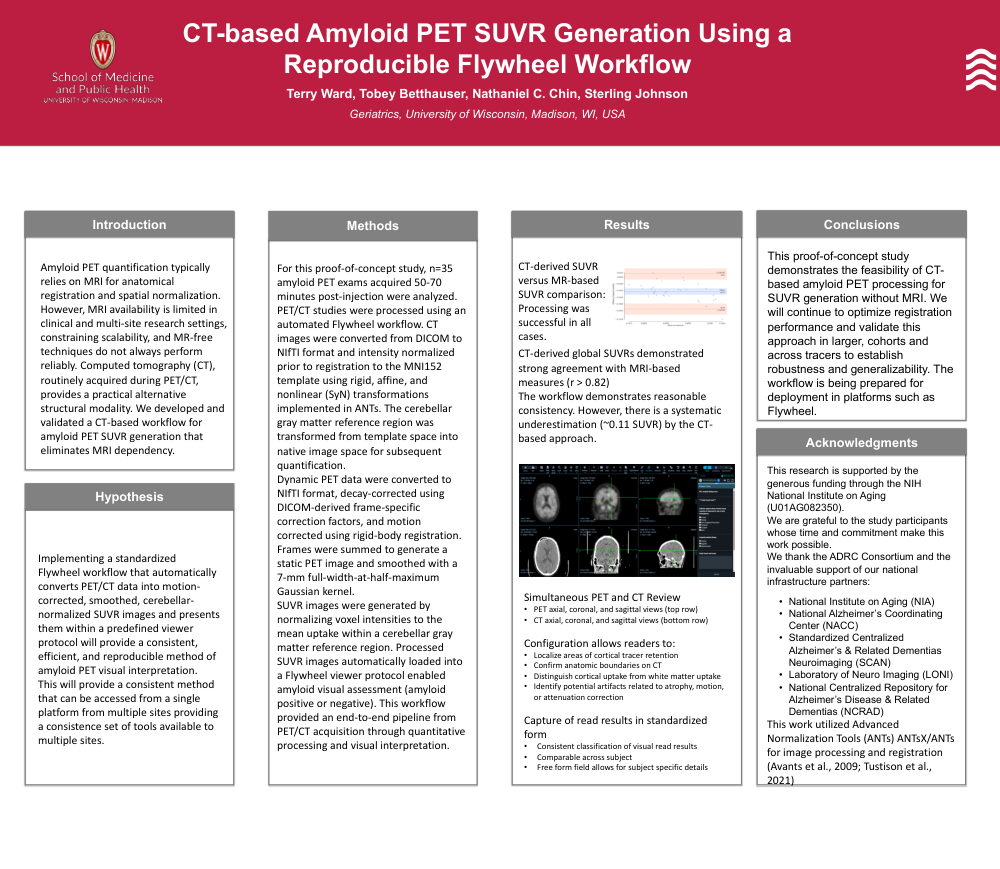
CT-derived SUVR versus MR-based
SUVR comparison:
Processing was
successful in all
cases. Simultaneous PET and CT Review
• PET axial, coronal, and sagittal views (top row)
• CT axial, coronal, and sagittal views (bottom row)
Configuration allows readers to:
• Localize areas of cortical tracer retention
• Confirm anatomic boundaries on CT
• Distinguish cortical uptake from white matter uptake
• Identify potential artifacts related to atrophy, motion, or attenuation correction
Capture of read results in standardized
form
• Consistent classification of visual read results
• Comparable across subject • Free form field allows for subject specific details
Conclusions
This proof-of-concept study demonstrates the feasibility of CTbased amyloid PET processing for SUVR generation without MRI. We
will continue to optimize registration
performance and validate this approach in larger, cohorts and
across tracers to establish
robustness and generalizability. The
workflow is being prepared for deployment in platforms such as Flywheel.
CT-derived global SUVRs demonstrated
strong agreement with MRI-based
measures (r > 0.82) The workflow demonstrates reasonable consistency. However, there is a systematic underestimation (~0.11 SUVR) by the CTbased approach.
• National Institute on Aging (NIA)
• National Alzheimer’s Coordinating
Center (NACC)
• Standardized Centralized
Alzheimer’s & Related Dementias
Neuroimaging (SCAN)
• Laboratory of Neuro Imaging (LONI)
• National Centralized Repository for
Alzheimer’s Disease & Related
Dementias (NCRAD)
This work utilized Advanced
Normalization Tools (ANTs) ANTsX/ANTs
for image processing and registration
(Avants et al., 2009; Tustison et al., 2021)
Comments
Email is required but is not shown publicly.
Loading comments...