4,068 posters, 219 videos, 101 topics, 69 sessions, 14,365 authors, 6,128 institutions
ePostersLive by SciGen Technologies S.A. All rights reserved.
Alzheimer's Association International Conference 2026
July 12-15, 2026 | London, United Kingdom, and Online

11808
Temporal Progression Of Sleep Microstructural Eeg Alterations In Dementia Development
Poster Presenter
Part of Topic
Biomarkers -> Neuroimaging -> Longitudinal brain aging
Background: Sleep electroencephalogram (EEG) microstructural alterations are increasingly implicated in dementia, but their temporal ordering across the course of dementia remains poorly understood. Characterizing the sequence may provide insight into the evolving neurobiological processes and help identify early sleep signatures relevant to dementia progression.
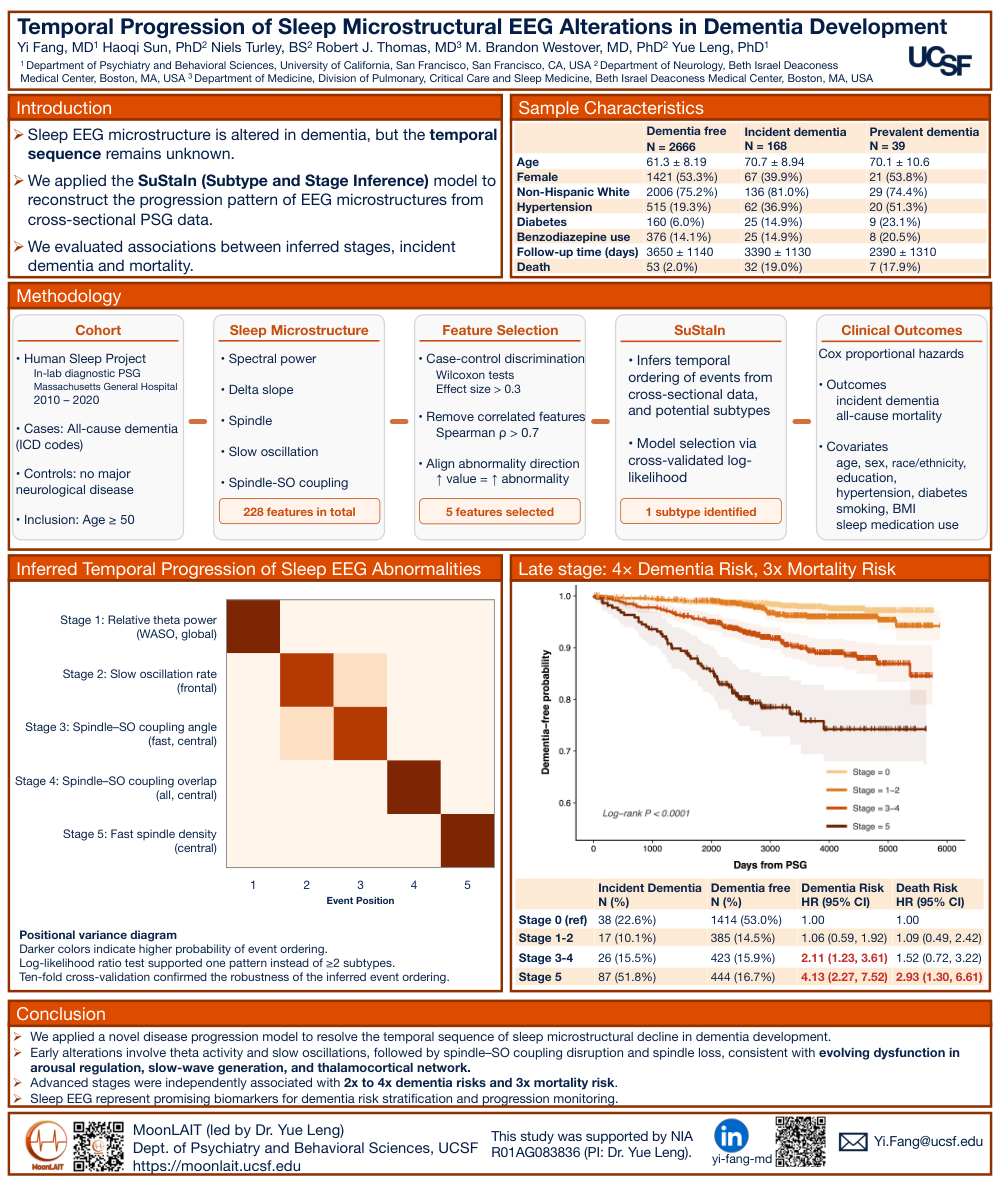
Methods: We studied adults aged ≥50 years who underwent in-laboratory polysomnography (PSG) at Massachusetts General Hospital (2010-2020) as part of the Human Sleep Project. Dementia was identified using ICD-codes, excluding major neurological disorders. PSG microstructural features included stage-specific spectral power, oscillatory dynamics, spindle characteristics, and spindle–slow oscillation coupling across frontal, central, and occipital regions. Features were selected if they differed between dementia and controls (Wilcoxon–Mann–Whitney tests effect size >0.3), were not highly correlated (Spearman ρ > 0.7), and were sign-aligned so that higher values reflected greater abnormality. Selected features were entered into a kernel density estimation–based Subtype and Stage Inference (SuStaIn) machine learning model to infer temporal evolution patterns. Associations with dementia and mortality were examined using Cox regression, adjusting for demographics, comorbidity, smoking, body mass index, and sleep medication use.
Results: Among 2873 participants (age 62.0±8.60), 39 had prevalent dementia, and 168 developed incident dementia over a mean follow-up of 9.9±3.2 years. Five microstructural features met screening criteria and were included in the SuStaIn model. The inferred progression began with increased theta activity during wake after sleep onset (stage 1), followed by reduced slow oscillation rate (stage 2). Subsequent changes were disrupted spindle–slow oscillation coupling, reflected by altered coupling phase (stage 3) and reduced coupling overlap (stage 4). The final stage was decreased fast spindle density (stage 5). Among individuals without baseline dementia, reaching stage 3-4 (HR = 2.11, 95% CI 1.23–3.61) or stage 5 (HR = 4.13, 2.27–7.52) was associated with increased dementia risk. Stage 5 was also associated with higher all-cause mortality (HR = 2.93, 1.30–6.61).
Discussion: Sleep microstructural abnormalities may follow a staged progression in dementia development, with early arousal-related changes preceding thalamocortical dysregulation. Later-stage alterations are strongly associated with dementia and mortality, highlighting the translational potential of sleep microstructure for early risk stratification.
Comments
Email is required but is not shown publicly.
Loading comments...