4,068 posters, 219 videos, 101 topics, 69 sessions, 14,365 authors, 6,128 institutions
ePostersLive by SciGen Technologies S.A. All rights reserved.
Alzheimer's Association International Conference 2026
July 12-15, 2026 | London, United Kingdom, and Online

13279
Real-life Amateur Soccer Heading And Acute Elevations In Blood-based P-tau217 And S100B
Poster Presenter
Authors
Marloes Hoppen, Marsh Königs, Charlotte Teunissen, Inge Verberk, Jos Twisk, Jaap Oosterlaan, Everard Vijverberg
Affiliations
Emma Children’s Hospital, Amsterdam UMC, Location University of Amsterdam, Follow-Me program & Emma Neuroscience Group, Amsterdam, the Netherlands, Neurochemistry Laboratory, Department of Laboratory Medicine, Neurodegeneration, Amsterdam Neuroscience, Amsterdam UMC, Vrije Universiteit, Amsterdam, the Netherlands, Departmentof EpidemiologyandData Science, LocationVrije Universiteit Amsterdam, Amsterdam UMC, Amsterdam, the Netherlands, Emma Children’sHospital, Amsterdam UMC, LocationUniversity of Amsterdam, Follow-Me program & Emma Neuroscience Group, Amsterdam, the Netherlands, Alzheimer Center Amsterdam, Neurology, Amsterdam UMC, Location Vrije Universiteit Amsterdam, Amsterdam, the Netherlands
Part of Topic
Biomarkers -> Biomarkers (non-neuroimaging) -> Fluid biomarkers
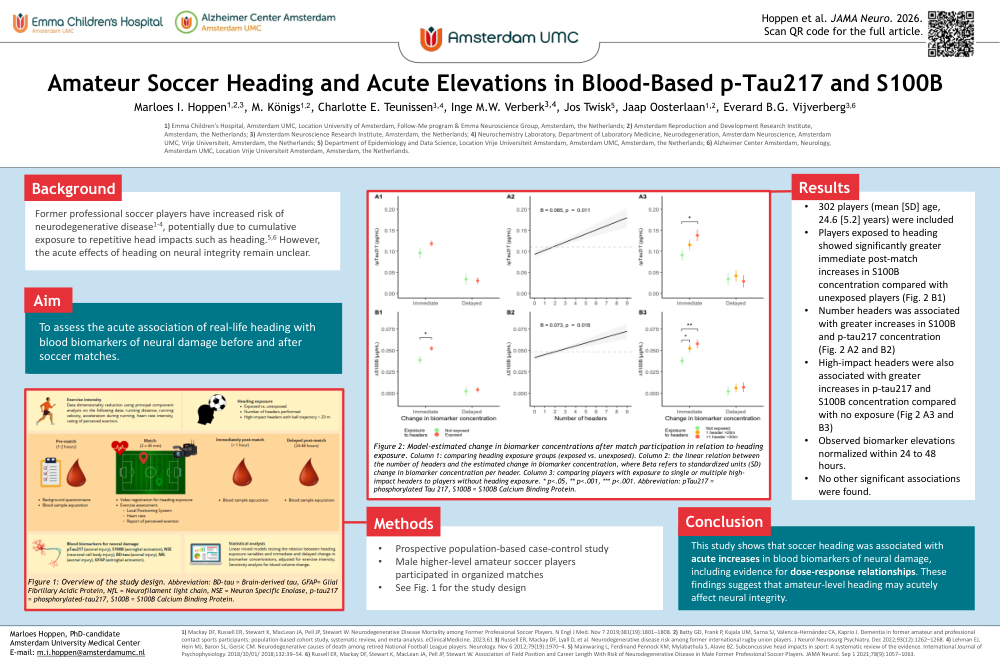
Background: Former professional soccer players have increased risk of neurodegenerative disease, potentially due to cumulative exposure to repetitive head impacts such as heading. However, the acute effects of heading on neural integrity remain unclear. The aim of this study was to assess acute effects of real-life heading on blood biomarkers of neural damage pre-post soccer matches.
Method: In this prospective case-control study, male higher-level amateur soccer players participated in organized matches (August-December 2025). Blood samples were collected pre-match, immediately post-match and delayed at 24–48 hours post-match. Video analysis quantified heading exposure, including frequency and intensity. Six blood biomarkers of neural damage were measured: p-Tau217, S100B, NSE, BD-tau, NfL and GFAP. Exercise intensity was objectively monitored using local position monitoring and heart rate analysis. The main outcome was the association between heading exposure and change in biomarker concentration, assessed with linear mixed models while correcting for exercise intensity.
Results: Among the 302 players participating in one of the 11 matches (mean age: 24.6), 72% had heading exposure, mean exposure was 2.0 headers/player/match and 48% had high-impact heading exposure (ball trajectories >20m). Players exposed to heading showed significantly greater immediate post-match increases in S100B concentration (n=299, p=.03, Cohen’s d=0.29, Figure 1B) compared to unexposed players. Exposure to more headers was associated with greater increases in S100B (n=299, p=.02, d=.07 per header, Figure 2B) and p-Tau217 concentration (n=296, p=.01, d = .09 per header, Figure 2A). High-impact headers were also related to greater increases in p-Tau217 (n=148, p=.03, d=.40, Figure 3A) and S100B concentration (n=149, p=.02, d=.43, Figure 3B) compared to no exposure. Observed biomarker elevations normalized within 24–48 hours. No other significant associations were found. Results were robust to sensitivity analysis adjusting for blood volume.
Conclusion: This study indicates that soccer heading is related to acute increases in blood biomarkers of neural damage, including dose-response relationships. These findings suggest that amateur-level heading may acutely affect neural integrity.
Key words: Soccer; Heading; Biomarkers; Neural damage
Comments
Email is required but is not shown publicly.
Loading comments...