4,068 posters, 219 videos, 101 topics, 69 sessions, 14,365 authors, 6,128 institutions
ePostersLive by SciGen Technologies S.A. All rights reserved.
Alzheimer's Association International Conference 2026
July 12-15, 2026 | London, United Kingdom, and Online

9821
Alterations In The UFMylation Pathway Track With Pathological Tau Burden
Poster Presenter
Authors
Tingxiang Yan, Melissa E. Murray, Dennis W. Dickson, Wolfdieter Springer, Fabienne C. Fiesel
Affiliations
Part of Topic
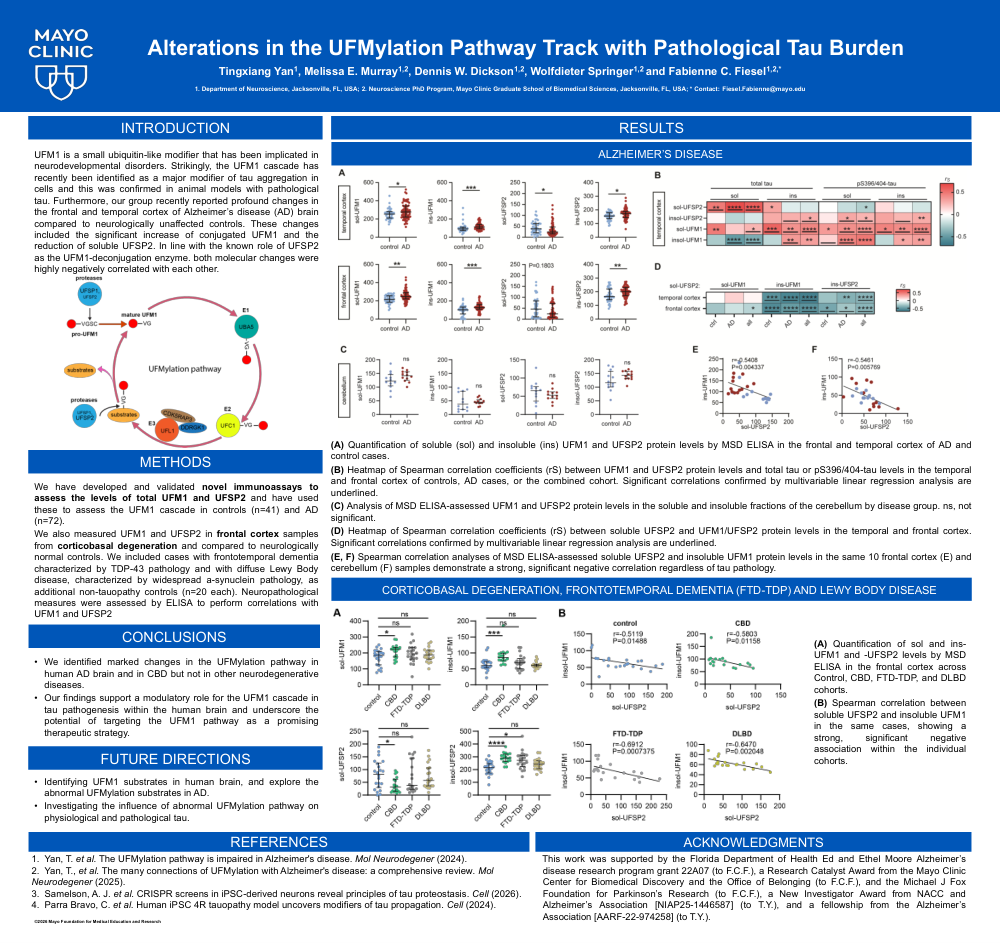
Alterations in the UFMylation Pathway Track with Pathological Tau Burden
Tingxiang Yan, Melissa E. Murray, Dennis W. Dickson, Wolfdieter Springer, and Fabienne C. Fiesel
Background:
UFM1 is a ubiquitin-like modifier conjugated to lysine residues of substrate proteins through a dedicated enzymatic cascade (UFMylation). Components of this pathway have recently emerged as strong modifiers of tau aggregation in cell-based screens. We previously reported alterations in the UFMylation pathway in human Alzheimer’s disease (AD) brain; however, it remains unclear whether these changes represent a specific and consistent feature of tauopathies or a broader phenomenon across neurodegenerative diseases.
Methods:
We developed and validated novel immunoassays to quantify total UFM1 and the UFM1-specific protease UFSP2 in human brain tissue. These assays were applied to frontal cortex samples from controls (n=42), AD (n=73), corticobasal degeneration (CBD), frontotemporal dementia with TDP-43 pathology (FTD-TDP), and diffuse Lewy body disease (DLB) as non-tauopathy disease controls. Neuropathological measures were assessed for correlation analyses.
Results:
Consistent with our findings in AD, we observed significantly elevated total UFM1 levels and reduced soluble UFSP2 in CBD, with strong correlations to pathological tau burden. In contrast, alterations in the UFMylation cascade were largely absent in FTD-TDP and DLB without tau co-pathology.
Conclusions:
Our findings demonstrate marked and disease-specific alterations of the UFMylation pathway in human tauopathies, including AD and CBD, but not in other major neurodegenerative diseases. The strong association with pathological tau supports the concept that dysregulated UFMylation is a defining feature of tauopathies and suggests a functional role for UFM1 in modifying tau pathology in the human brain. The consistent reduction of soluble UFSP2 further highlights restoration of UFSP2 activity as a potential therapeutic strategy to mitigate abnormal UFMylation in tau-driven neurodegeneration.
Comments
Email is required but is not shown publicly.
Loading comments...