4,068 posters, 219 videos, 101 topics, 69 sessions, 14,365 authors, 6,128 institutions
ePostersLive by SciGen Technologies S.A. All rights reserved.
Alzheimer's Association International Conference 2026
July 12-15, 2026 | London, United Kingdom, and Online

13162
Development Of Sotp™ Model For Evaluating Therapeutics Against Spread Of Tau Pathology
Poster Presenter
Authors
Dhruv Patel, Patricia Lopez, Kevin Callahan, Eliot Davidowitz, James Moe
Affiliations
Part of Topic
Biomarkers -> Neuroimaging -> Preclinical animal models
POSTER ABSTRACT
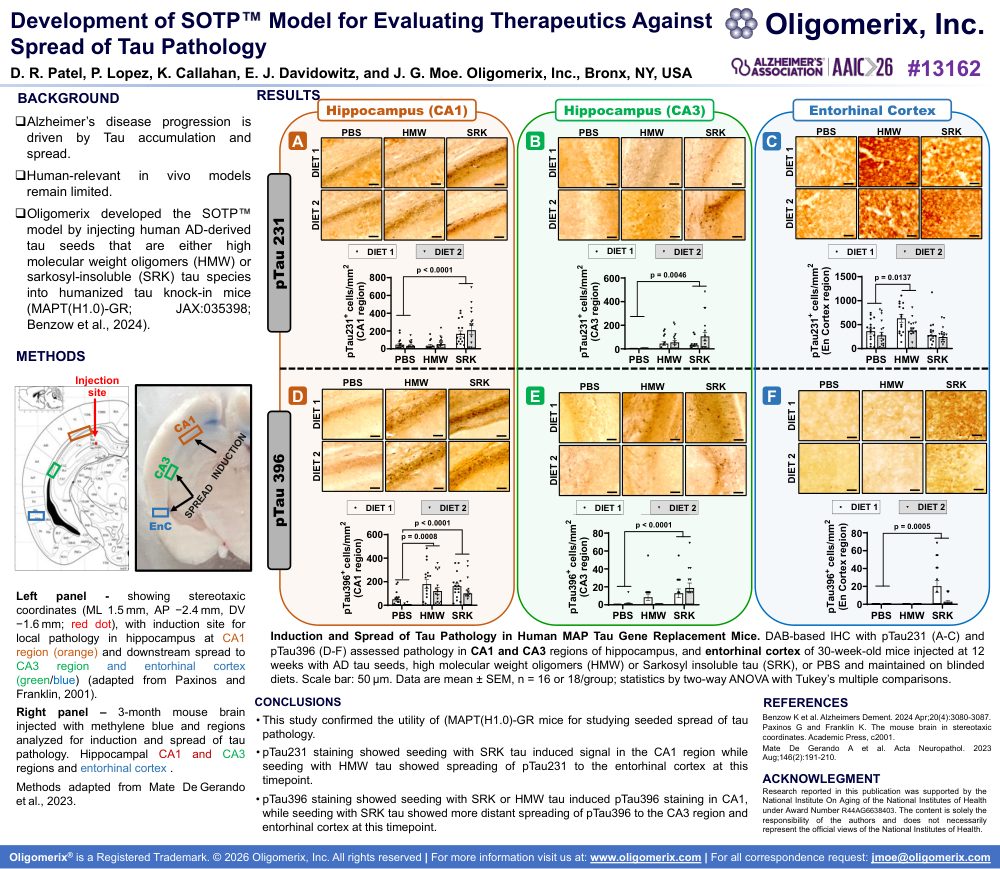
Background: Alzheimer’s disease progression is partly driven by tau accumulation and its pathological spread in the brain. Despite extensive development of anti-tau therapeutics, human-relevant in vivo models to evaluate effects on Tau propagation are lacking. Oligomerix established the Spread of tau Pathology (SOTP™) model, which assesses therapeutic efficacy by injecting human AD‑derived Tau seeds into humanized tau knock‑in mice [MAPT(H1.0)-GR] that recapitulate Tau phosphorylation, a key disease feature. This study evaluates the efficacy of a small‑molecule therapeutic candidate (OLX-07010) in reducing tau pathology spread toward validating the SOTP™ model for screening therapeutics.
Methods: The SOTP™ model was established in-house using 3 months‑old MAPT(H1.0)-GR mice (Jackson Laboratory) that underwent stereotaxic intrahippocampal inoculation of human AD‑derived tau seeds using a published protocol (Mate De Gerando et al., 2023; PMID: 37341831). High‑molecular‑weight oligomeric (HMW) and Sarkosyl‑insoluble tau species were isolated from human hippocampal tissue, quantified, and injected in the CA1 region of hippocampus. Eighty mice (40 male, 40 female) were randomized to receive vehicle or OLX-07010 via oral feed for three months following baseline behavior and intrahippocampal injection either with tau seeds or PBS vehicle. All procedures, behavioral, and immunohistochemical (IHC) analyses were conducted blindly for treatment.
Results: Compared with PBS-seeded controls, preliminary qualitative IHC analyses using Phospho-Tau (Ser396) showed increased pathology at the CA1 injection site with spread to anatomically connected hippocampal subfields in AD tau-seeded mice. This circuit-dependent propagation was more evident with the Sarkosyl-insoluble tau. Post-treatment cognitive behavior testing and brain tissue processing has been completed, and comparative functional and quantitative IHC analyses are ongoing.
Conclusion: Initial IHC results qualify the in vivo SOTP™ assay and support its use for therapeutic efficacy studies aimed at slowing or halting Tau propagation by providing a reproducible, human Tau-expressing platform that supports AD-derived Tau seeding and spread. Ongoing analyses
Comments
Email is required but is not shown publicly.
Loading comments...