4,068 posters, 219 videos, 101 topics, 69 sessions, 14,365 authors, 6,128 institutions
ePostersLive by SciGen Technologies S.A. All rights reserved.
Alzheimer's Association International Conference 2026
July 12-15, 2026 | London, United Kingdom, and Online

9128
Longitudinal CBF Changes Associated With ARIA Development In Alzheimer Disease Following Amyloid-targeted Therapies
Poster Presenter
Authors
Part of Topic
Biomarkers -> Neuroimaging -> Evaluating treatments
Purpose: Amyloid-targeting therapies for Alzheimer disease (AD) are associated with amyloid-related imaging abnormalities (ARIA), a frequent (~20%) and treatment-limiting (~6%) adverse effect. Conventional MRI is insensitive to early ARIA and to cerebral amyloid angiopathy (CAA), a major ARIA risk factor. Arterial spin labeling (ASL) MRI enables noninvasive assessment of cerebral blood flow (CBF), which could be used to detect early physiological changes after treatment. We investigated whether early longitudinal regional CBF changes predict subsequent ARIA following donanemab therapy.
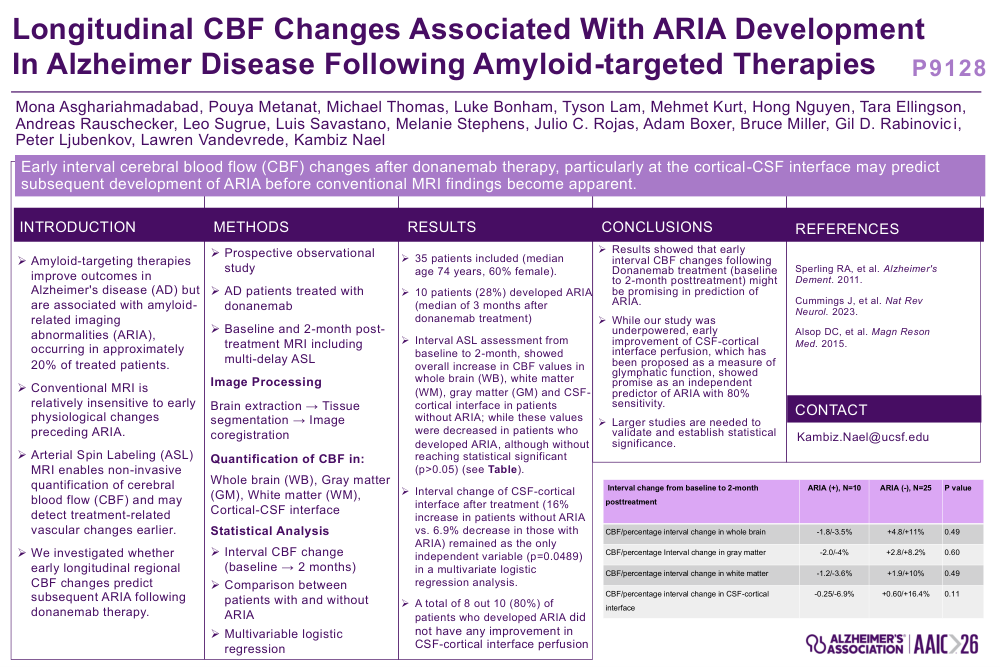
Methods: In this prospective study, inclusion criteria were AD patients who received donanemab and had pretreatment and 2-month posttreatment MRIs that included multi-delay ASL. An imaging pipeline was developed using T1 weighted and ASL CBF maps. Following brain extraction, tissue segmentation, and image coregistration, CBF quantification was performed globally for whole brain (WB), gray matter (GM), and white matter (WM), as well as cortical-CSF interface as a measure of CSF water transport and indirect function of glymphatic pathway. Interval changes from baseline to 2-month posttreatment scans were calculated and comparative analysis and multivariable logistic regression was performed among patients with and without ARIA.
Results: Thirty-five patients were included (median age 74 years, 60% female). Ten patients (28.6%) developed ARIA (ARIA-H = 4, ARIA-E = 2, both = 4) within a median of 3 months after donanemab treatment. From baseline to 2 months, CBF increased in WB, GM, WM, and the CSF–cortical interface in patients without ARIA, but decreased in those who developed ARIA, although without reaching statistical significance (p > 0.05) (see Table). Change in CSF–cortical interface CBF (16% increase in patients without ARIA vs. 6.9% decrease in those with ARIA) was the only independent predictor in multivariable logistic regression (p = 0.0489). Eight of ten patients (80%) who developed ARIA showed no improvement in CSF–cortical interface CBF.
Conclusion: Early interval CBF changes following donanemab treatment (baseline to 2 months) may predict ARIA development. Although underpowered, improvement in CSF–cortical interface CBF, a proposed marker of glymphatic function, emerged as an independent ARIA predictor with 80% sensitivity, warranting validation in larger cohorts.
Comments
Email is required but is not shown publicly.
Loading comments...