4,068 posters, 219 videos, 101 topics, 69 sessions, 14,365 authors, 6,128 institutions
ePostersLive by SciGen Technologies S.A. All rights reserved.
Alzheimer's Association International Conference 2026
July 12-15, 2026 | London, United Kingdom, and Online

1355
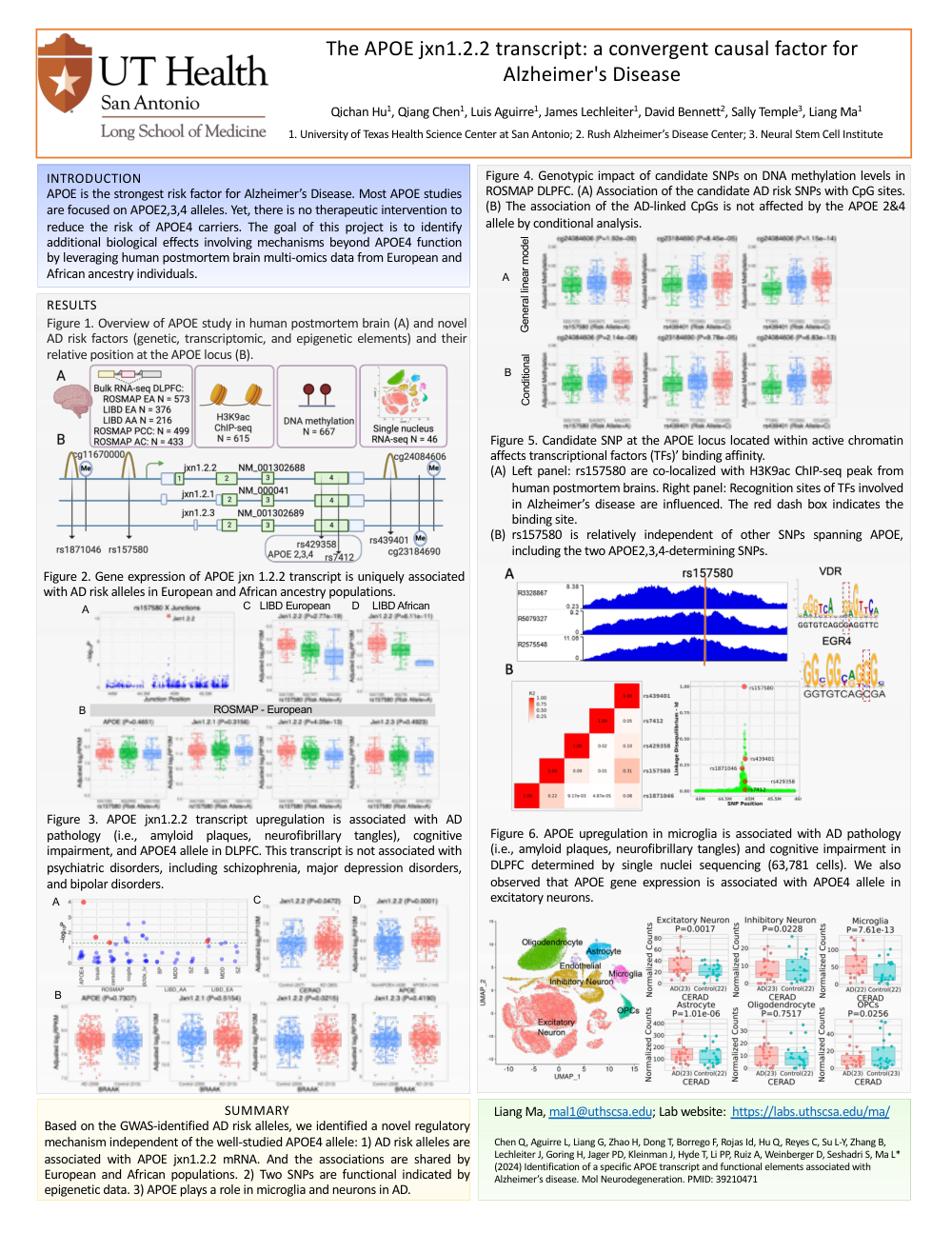
The Apoe Jxn1.2.2 Transcript: A Convergent Causal Factor For Alzheimer's Disease
Poster Presenter
Part of Topic
Background: While the APOE locus is the most significant genetic risk factor for late-onset Alzheimer’s disease (AD), the traditional focus on APOE2, 3, and 4 protein isoforms fails to fully account for the risk associated with numerous non-coding variants identified by genome-wide association studies (GWAS). We hypothesized that transcript-specific regulatory mechanisms, rather than global gene expression, drive AD susceptibility and that these signals are frequently masked in traditional gene-level analyses.
Methods: We integrated multi-omics data from 2,179 RNA-seq samples across three brain regions (DLPFC, PCC, and AC), DNA methylation data, and H3K9ac ChIP-seq peaks from the ROSMAP and LIBD cohorts. Our analysis included both European and African ancestry populations. We utilized exon-exon junction analysis to identify alternative transcripts and analyzed the developmental trajectory of APOE from prenatal to adult stages.
Results: We identified a novel AD-linked APOE transcript, jxn1.2.2 (tagging NM_001302688), which is significantly associated with amyloid-β burden (CERAD), neurofibrillary tangles (Braak), and cognitive impairment in the dorsolateral prefrontal cortex. Crucially, jxn1.2.2 expression is genetically independent of the APOE4 status, though both risk factors converge to influence this specific transcript. We prioritized two functional SNPs, rs157580 and rs439401, which reside in active chromatin regions and influence DNA methylation and the binding of transcription factors such as EGR4 and SOX2. The jxn1.2.2 transcript is translatable into a stable ~38 kDa protein featuring 26 additional amino acids at the N-terminus. Single-nucleus RNA-seq further revealed that APOE is significantly dysregulated in the microglia of AD patients, identifying a key cellular driver of neuronal dysfunction.
Conclusions: The discovery of the jxn1.2.2 transcript identifies it as a convergent causal factor where independent genetic risks (rs157580 and APOE4) meet to drive AD pathogenesis. This mechanism is shared across European and African ancestries, highlighting its importance for inclusive therapeutic development. To establish the causal impact of the jxn1.2.2 transcript, we are currently generating isogenic hiPSC lines to be differentiated into 3D cerebral organoids. Future efforts will utilize long-read target mRNA sequencing (IsoSeq) to define the full transcript repertoire and Ca2+ imaging to evaluate the functional consequences of transcript dysregulation on neural activity.
Comments
Email is required but is not shown publicly.
Loading comments...