4,068 posters, 219 videos, 101 topics, 69 sessions, 14,365 authors, 6,128 institutions
ePostersLive by SciGen Technologies S.A. All rights reserved.
Alzheimer's Association International Conference 2026
July 12-15, 2026 | London, United Kingdom, and Online

4748
APOE Genotype Modifies Within-Individual Associations Of The Carbohydrate-to-Fat Ratio With Cognition
Poster Presenter
Part of Topic
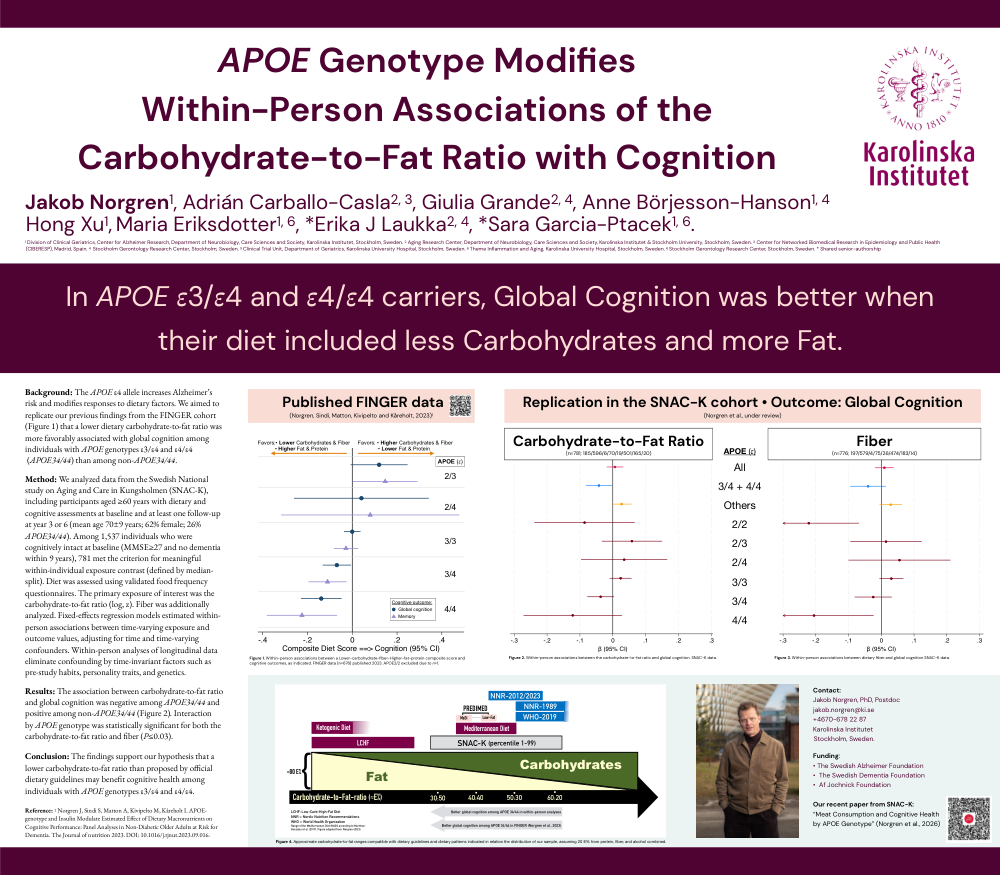
Background: The APOE ε4 allele increases Alzheimer’s risk and modifies responses to dietary factors. We aimed to replicate our previous findings from the FINGER cohort (Figure 1)1 that a lower dietary carbohydrate-to-fat ratio was more favorably associated with global cognition among individuals with APOE genotypes ε3/ε4 and ε4/ε4 (APOE34/44) than among non-APOE34/44.
Method: We analyzed data from the Swedish National study on Aging and Care in Kungsholmen (SNAC-K), including participants aged ≥60 years with dietary and cognitive assessments at baseline and at least one follow-up at year 3 or 6 (mean age 70±9 years; 62% female; 26% APOE34/44). Among 1,537 individuals who were cognitively intact at baseline (MMSE≥27 and no dementia within 9 years), 781 met the criterion for meaningful within-individual exposure contrast (defined by median-split). Diet was assessed using validated food frequency questionnaires. The primary exposure of interest was the carbohydrate-to-fat ratio (log, z). Fiber was additionally analyzed. Fixed-effects regression models estimated within-person associations between time-varying exposure and outcome values, adjusting for time and time-varying confounders. Within-person analyses of longitudinal data eliminate confounding by time-invariant factors such as pre-study habits, personality traits, and genetics.
Results: The association between carbohydrate-to-fat ratio and global cognition was negative among APOE34/44 and positive among non-APOE34/44 (Figure 2). Interaction by APOE genotype was statistically significant for both the carbohydrate-to-fat ratio and fiber (P≤0.03).
Conclusion: The findings support our hypothesis that a lower carbohydrate-to-fat ratio than proposed by official dietary guidelines may benefit cognitive health among individuals with APOE genotypes ε3/ε4 and ε4/ε4.
Reference: 1 Norgren J, Sindi S, Matton A, Kivipelto M, Kåreholt I. APOE-genotype and Insulin Modulate Estimated Effect of Dietary Macronutrients on Cognitive Performance: Panel Analyses in Non-Diabetic Older Adults at Risk for Dementia. The Journal of nutrition 2023. DOI: 10.1016/j.tjnut.2023.09.016.
Comments
Email is required but is not shown publicly.
Loading comments...