4,068 posters, 219 videos, 101 topics, 69 sessions, 14,365 authors, 6,128 institutions
ePostersLive by SciGen Technologies S.A. All rights reserved.
Alzheimer's Association International Conference 2026
July 12-15, 2026 | London, United Kingdom, and Online

10157
Clinical Utility Of Plasma Biomarkers Of Alzheimer’S Disease
Poster Presenter
Part of Topic
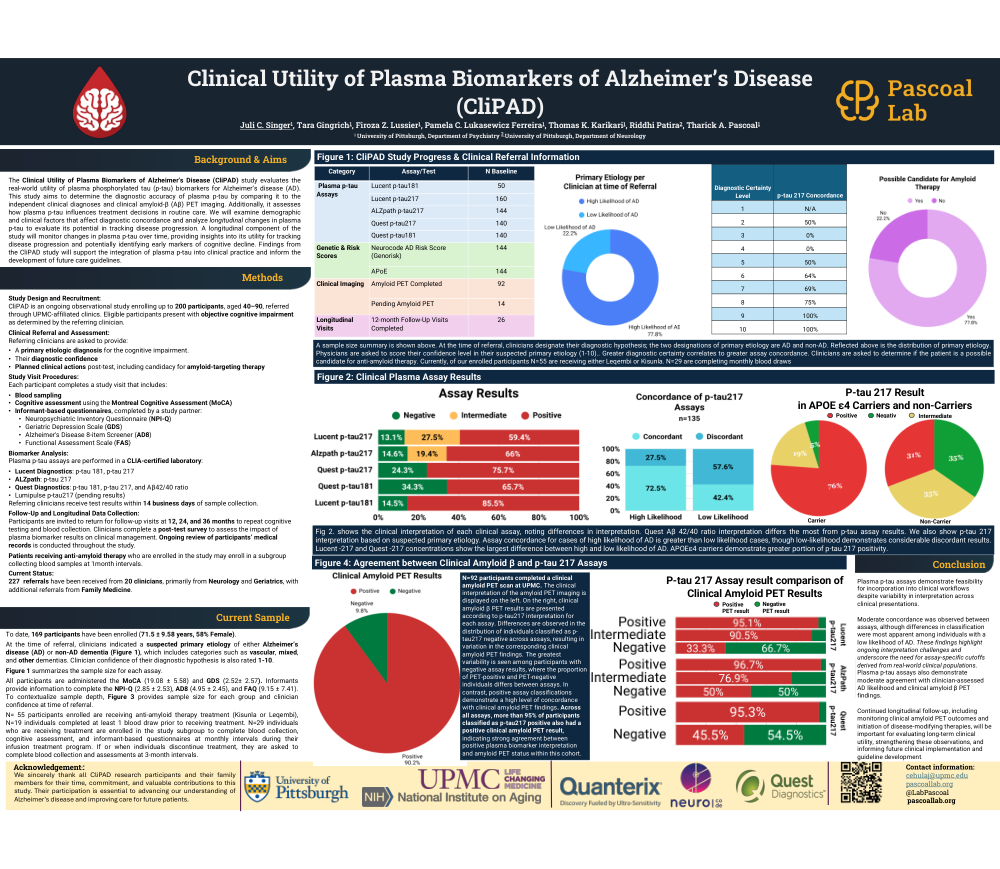
Background and Aims: The Clinical Utility of Plasma Biomarkers of Alzheimer’s Disease (CliPAD) study evaluates the real-world utility of plasma phosphorylated tau (p-tau) biomarkers for Alzheimer’s disease (AD). This study aims to determine the diagnostic accuracy of plasma p-tau by comparing it to the independent clinical diagnoses and clinical amyloid-β (Aβ) PET imaging. Additionally, it assesses how plasma p-tau influences treatment decisions in routine care. We will examine demographic and clinical factors that affect diagnostic concordance and analyze longitudinal changes in plasma p-tau to evaluate its potential in tracking disease progression. A longitudinal component of the study will monitor changes in plasma p-tau over time, providing insights into its utility for tracking disease progression and potentially identifying early markers of cognitive decline. Findings from the CliPAD study will support the integration of plasma p-tau into clinical practice and inform the development of future care guidelines.
Study Design and Recruitment:
CliPAD is an ongoing observational study enrolling up to 200 participants, aged 40–90, referred through UPMC-affiliated clinics. Eligible participants present with objective cognitive impairment as determined by the referring clinician.
Clinical Referral and Assessment:
Referring clinicians are asked to provide:
Study Visit Procedures:
Each participant completes a study visit that includes:
Biomarker Analysis:
Plasma p-tau assays are performed in a CLIA-certified laboratory:
Referring clinicians receive test results within 14 business days of sample collection.
Follow-Up and Longitudinal Data Collection:
Participants are invited to return for follow-up visits at 12, 24, and 36 monthsto repeat cognitive testing and blood collection. Clinicians complete a post-test survey to assess the impact of plasma biomarker results on clinical management. Ongoing review of participants’ medical records is conducted throughout the study.
Patients receiving anti-amyloid therapy who are enrolled in the study may enroll in a subgroup collecting blood samples at 1month intervals.
Current Status:
227 referrals have been received from 20 clinicians, primarily from Neurology and Geriatrics, with additional referrals from Family Medicine.
To date, 169 participants have been enrolled (71.5 ± 9.58 years, 58% Female).
At the time of referral, clinicians indicated a suspected primary etiology of either Alzheimer’s disease (AD) or non-AD dementia (Figure 1), which includes categories such as vascular, mixed, and other dementias. Clinician confidence of their diagnostic hypothesis is also rated 1-10.
Figure 1 summarizes the sample size for each assay.
All participants are administered the MoCA (19.08 ± 5.58) and GDS (2.52± 2.57). Informants provide information to complete the NPI-Q (2.85 ± 2.53), AD8 (4.95 ± 2.45), and FAQ (9.15 ± 7.41). To contextualize sample depth, Figure 3 provides sample size for each group and clinician confidence at time of referral.
N= 55 participants enrolled are receiving anti-amyloid therapy treatment (Kisunla or Leqembi), N=19 individuals completed at least 1 blood draw prior to receiving treatment. N=29 individuals who are receiving treatment are enrolled in the study subgroup to complete blood collection, cognitive assessment, and informant-based questionnaires at monthly intervals during their infusion treatment program. If or when individuals discontinue treatment, they are asked to complete blood collection and assessments at 3-month intervals.
Comments
Email is required but is not shown publicly.
Loading comments...