4,068 posters, 219 videos, 101 topics, 69 sessions, 14,365 authors, 6,128 institutions
ePostersLive by SciGen Technologies S.A. All rights reserved.
Alzheimer's Association International Conference 2026
July 12-15, 2026 | London, United Kingdom, and Online

5251
Governance And Stakeholder Strategies For Implementation Readiness In Peru National Dementia Plan
Poster Presenter
Authors
Kelly Tello-Lizarraga, Lee White, Luciana Inciso-Chavez, Christopher R Butler, Maria Sofia Cuba-Fuentes
Affiliations
Centro de Investigación en Atención Primaria de Salud, Facultad de Medicina, Universidad Peruana Cayetano Heredia, Lima, Perú, CRONICAS Center of Excellence in Chronic Diseases, Universidad Peruana Cayetano Heredia, Lima, Peru., School of Public Health, Imperial College London, UK 2. Department of Brain Sciences, Imperial College London, UK, School of Public Health, Imperial College London, UK
Part of Topic
Title:Governance and Stakeholder Pathways to Implementation Readiness in Peru’s National Dementia Plan: Evidence-Informed Policy Action from a Public Health Research Project
Author:
Kelly Tello-Lizarraga; Lee White; Luciana Inciso; Matias Vega; Don Carlos; Chris Buttler; Sofia Cuba.
Background
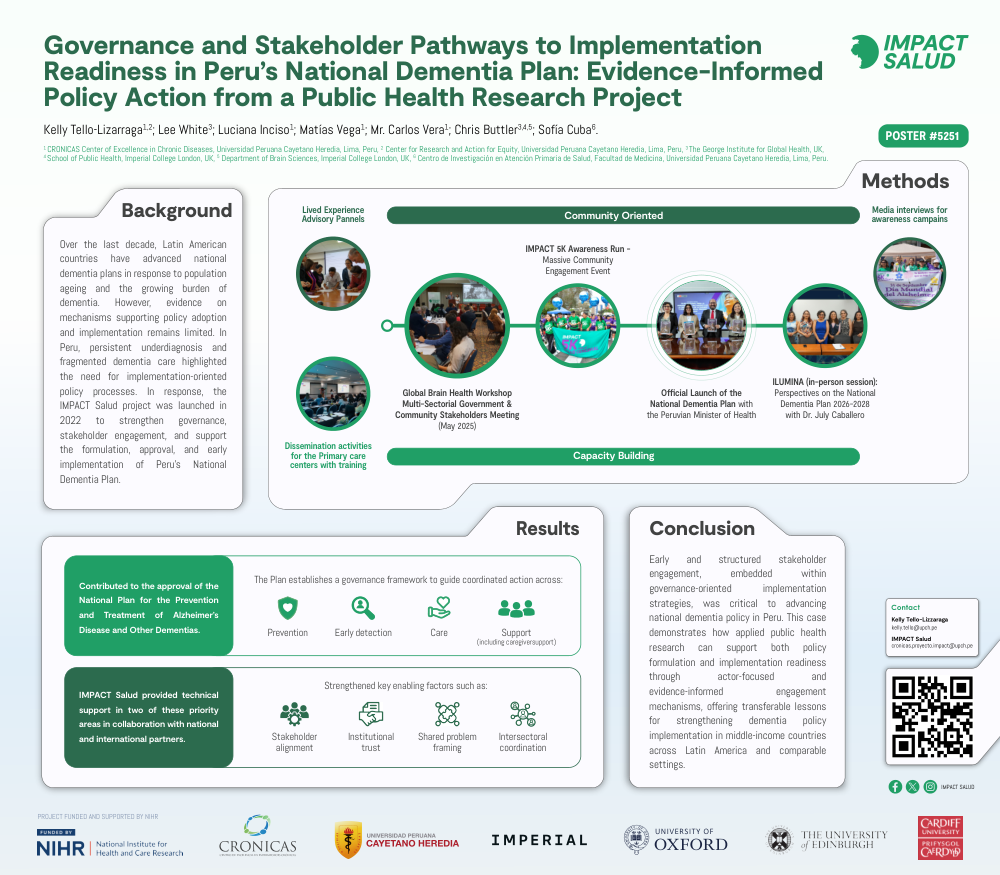
Over the past decade, Latin America has advanced the development of national dementia plans in response to population ageing, the increasing burden of dementia, and the need for more coordinated health system responses. While several middle-income countries have adopted such strategies, evidence on the mechanisms supporting effective policy adoption and implementation readiness remains limited. In Peru, dementia-related healthcare utilization increased by 20% between 2023 and 2025, despite persistent underdiagnosis linked to a fragmented and still emerging dementia care infrastructure. This gap highlighted the need not only for policy development, but for policy processes explicitly designed to support implementation. In this context, the IMPACT Salud project was launched in 2022 as an implementation-oriented applied public health research initiative embedding evidence generation within policy-relevant action to strengthen governance and stakeholder pathways and support the formulation, approval, and early implementation readiness of Peru’s National Dementia Plan.
Methods
The project aimed to contribute to the enactment of Peru’s National Dementia Plan by strengthening coordination, collaboration, and visibility among dementia-related actors across multiple levels of the health system. Implementation-oriented activities included structured stakeholder mapping and a project launch, capacity-building for frontline primary healthcare staff, participatory workshops with dementia-related actors, and a second multisectoral workshop intentionally engaging government sectors beyond health. Additional components comprised technical exchanges with international brain health institutions, a public awareness walk and run supported by public sector, civil society, and academic actors, and technical support for the co-development of shared problem trees and policy-relevant analytical inputs informing normative and strategic documents related to the Plan.
Results
The stakeholder-driven and governance-oriented activities implemented through the community engagement component contributed to the approval of the National Plan for the Prevention and Treatment of Alzheimer’s Disease and Other Dementias. The Plan establishes a governance framework to guide coordinated action across prevention, early detection, care, and support, and incorporates implementation-relevant priority domains, including strengthened timely diagnosis, integration of dementia care into primary healthcare, and structured support for caregivers. IMPACT Salud provided technical support in two of these priority areas in collaboration with national and international partners. From an implementation science perspective, the process strengthened key enabling factors such as stakeholder alignment, institutional trust, shared problem framing, and intersectoral coordination, enhancing policy readiness and conditions for early uptake and sustained implementation.
Conclusions
Early and structured stakeholder engagement, embedded within governance-oriented implementation strategies, was critical to advancing national dementia policy in Peru. This case demonstrates how applied public health research can support both policy formulation and implementation readiness through actor-focused and evidence-informed engagement mechanisms, offering transferable lessons for strengthening dementia policy implementation in middle-income countries across Latin America and comparable settings.
Comments
Email is required but is not shown publicly.
Loading comments...