4,068 posters, 219 videos, 101 topics, 69 sessions, 14,365 authors, 6,128 institutions
ePostersLive by SciGen Technologies S.A. All rights reserved.
Alzheimer's Association International Conference 2026
July 12-15, 2026 | London, United Kingdom, and Online

3009
Impact Of Physical And Dietary Interventions On Alzheimer's Disease Progression: A Systematic Review And Meta-analysis
Poster Presenter
Authors
Affiliations
Xuanwu Hospital Capital Medical University, Harbin Medical University
Part of Topic
Background: The escalating burden of Alzheimer's disease (AD), combined with the lack of a definitive cure, underscores the importance of preventive approaches to slow its progression. Although non-pharmacological interventions are widely recommended and easily implemented in daily life, their comparative effectiveness across the AD continuum remain insufficiently established.
Methods: We conducted a systematic review of randomized controlled trials in adults across the AD continuum. Physical and dietary interventions were compared with usual care or placebo. Outcomes were synthesized using pairwise and network meta-analyses, with intervention ranking. Dose-response relationships between exercise exposure and cognitive outcomes were also examined.
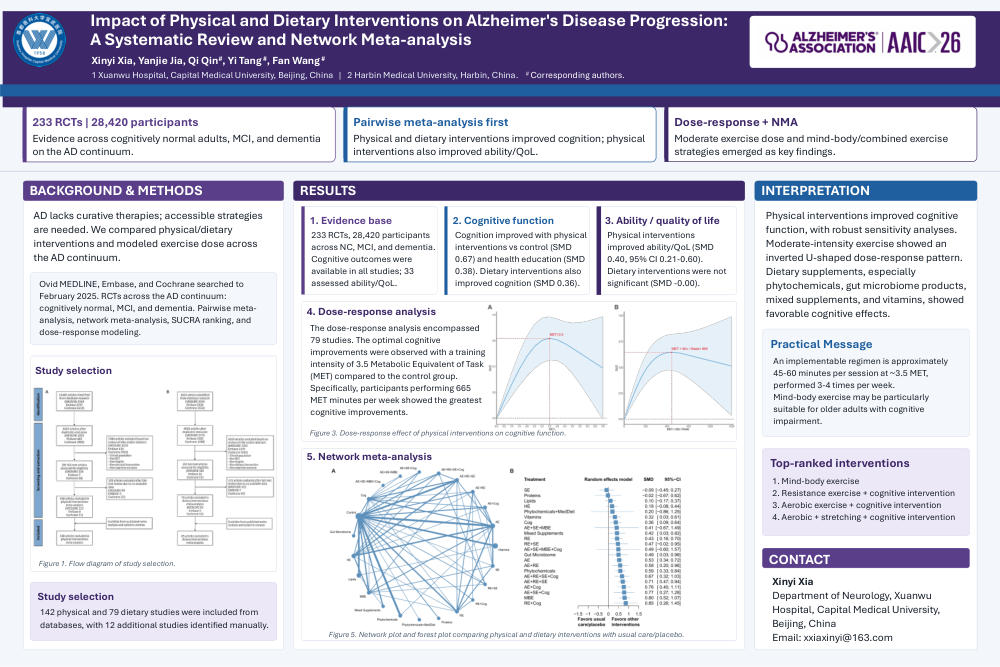
Results: In this study, 233 randomized controlled trials (n = 28,420 participants) were analyzed to evaluate the efficacy of physical and dietary interventions in AD patients. Both physical (SMD = 0.67, 95% CI = 0.49-0.84) and dietary interventions (SMD = 0.36, 95% CI = 0.22-0.51) significantly improved cognitive function. Notably, exercise at 3.5 MET and 665 MET min/week offered the greatest benefits. Mind-body exercises and combined exercise regimen with cognitive interventions were the most effective types of non-pharmacological interventions. Exercise alone, dietary supplements (phytochemicals, gut microbiome, mixed supplements, vitamins), and cognitive interventions also showed significant benefits for cognitive function.
Conclusions: These findings suggest that regular exercise, dietary supplements, and cognitive enhancing activities should be incorporated into treatment strategies to mitigate AD progression. This study unveils and quantifies several adaptive approaches that are within reach of AD patients, inside and outside the clinic.
Comments
Email is required but is not shown publicly.
Loading comments...