4,068 posters, 219 videos, 101 topics, 69 sessions, 14,365 authors, 6,128 institutions
ePostersLive by SciGen Technologies S.A. All rights reserved.
Alzheimer's Association International Conference 2026
July 12-15, 2026 | London, United Kingdom, and Online

5489
Chemistry Of Dementia Risk Factors Class & Community Based Prevention Strategies
Poster Presenter
Authors
Taylor Tomlinson, Patrice Rhodes, Laura Ogburn, Rita Axelroth-Hodges, Cory Bowman, Ira Harkavy, Elizabeth Rhoades
Affiliations
null,
Part of Topic
Intergenerational Learning as a Model to Translate Dementia Science into Community Action
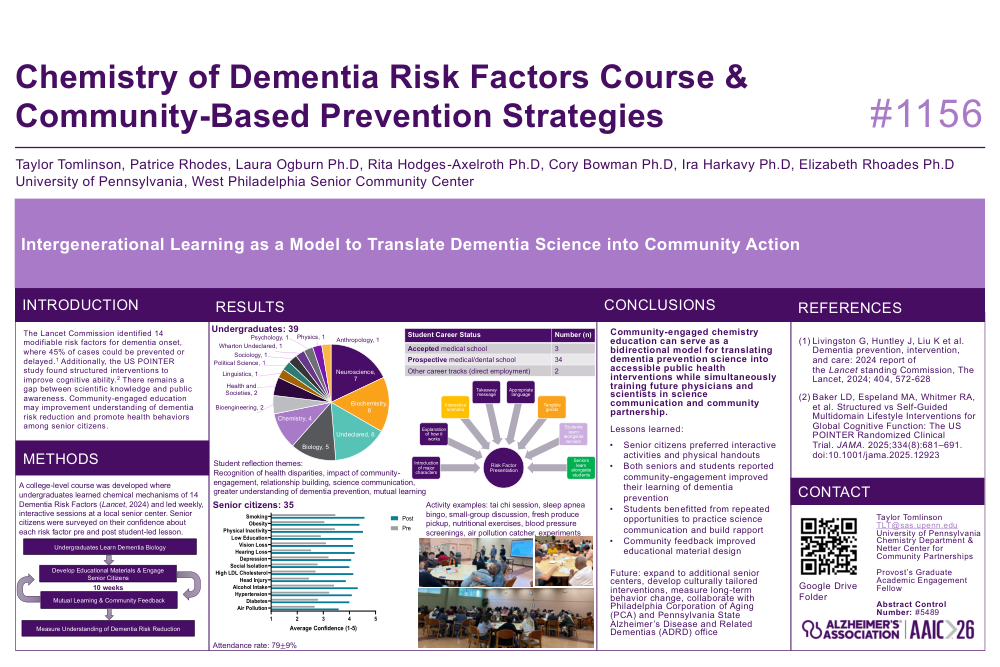
The Lancet Commission identified 14 modifiable risk factors for dementia onset, where 45% of cases could be prevented or delayed.1 Additionally, the US POINTER study found structured interventions to improve cognitive ability.2 There remains a gap between scientific knowledge and public awareness. Community-engaged education may improvement understanding of dementia risk reduction and promote health behaviors among senior citizens.
A college-level course was developed where undergraduates learned chemical mechanisms of 14 Dementia Risk Factors (Lancet, 2024) and led weekly, interactive sessions at a local senior center. Senior citizens were surveyed on their confidence about each risk factor pre and post student-led lesson.
Student reflection themes:
Recognition of health disparities, impact of community-engagement, relationship building, science communication, greater understanding of dementia
Activity examples: tai chi session, sleep apnea bingo, small-group discussion, fresh produce pickup, nutritional exercises, blood pressure screenings, air pollution catcher, experiments
Community-engaged chemistry education can serve as a bidirectional model for translating dementia prevention science into accessible public health interventions while simultaneously training future physicians and scientists in science communication and community partnership.
Lessons learned:
Taylor Tomlinson
TLT@sas.upenn.edu
University of Pennsylvania Chemistry Department & Netter Center for Community Partnerships
Provost’s Graduate Academic Engagement Fellow
Abstract Control
Future: expand to additional senior centers, develop culturally tailored interventions, measure long-term behavior change, collaborate with Philadelphia Corporation of Aging (PCA) and Pennsylvania State Alzheimer’s Disease and Related Dementias (ADRD) office
Comments
Email is required but is not shown publicly.
Loading comments...