4,068 posters, 219 videos, 101 topics, 69 sessions, 14,365 authors, 6,128 institutions
ePostersLive by SciGen Technologies S.A. All rights reserved.
Alzheimer's Association International Conference 2026
July 12-15, 2026 | London, United Kingdom, and Online

10198
Does Allostatic Load Modify The Neuroprotective Effects Of Lifestyle Activity Behaviours In Midlife? Evidence From The Uk Biobank
Poster Presenter
Authors
Maya Caon, Guilherme Moraes Balbim, Nárlon C. Boa Sorte Silva
Affiliations
Department of Health, Kinesiology, and Applied Physiology, Faculty of Arts and Science, Concordia University, Montréal, QC, Canada, Department of Physical Therapy, The University of British Columbia, Vancouver, British Columbia, Canada; Djavad Mowafaghian Centre for Brain Health, The University of British Columbia, Vancouver, British Columbia, Canada ; Centre for Aging SMART at Vancouver Coastal Health, Vancouver Coastal Health Research Institute, Vancouver, British Columbia, Canada
Part of Topic
Background and Objectives
Lifestyle activity behaviours, including physical activity, sedentary behaviour, and sleep, are linked to brain health. Allostatic load reflects cumulative physiological stress and may influence brain structure. However, it is unclear whether allostatic load changes the relationship between daily lifestyle behaviours and brain outcomes in midlife.
Our objective was to examine whether allostatic load modifies associations between lifestyle activity behaviours and brain structure, specifically cortical thickness, in midlife.
Methods
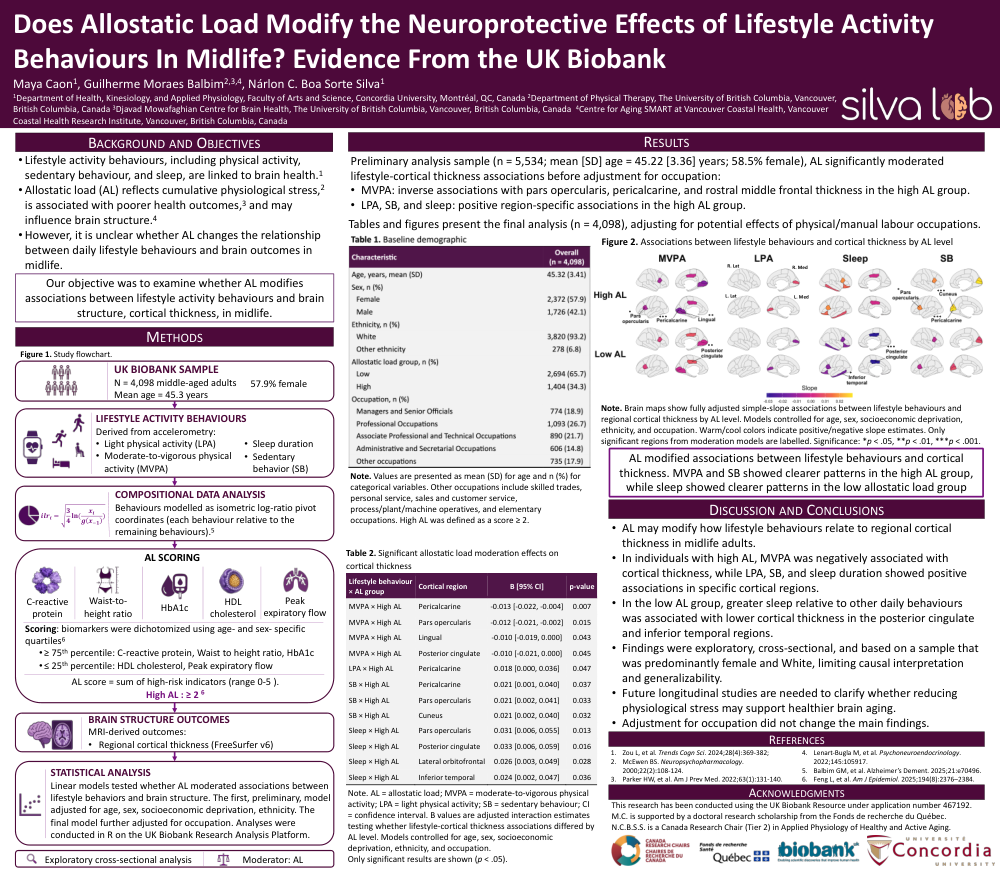
This exploratory cross-sectional analysis included 4,098 middle-aged adults from the UK Biobank. Lifestyle activity behaviours were derived from accelerometry and included light physical activity, moderate-to-vigorous physical activity, sleep duration, and sedentary behaviour. Behaviours were modelled using compositional data analysis.
Allostatic load was scored using C-reactive protein, waist-to-height ratio, HbA1c, HDL cholesterol, and peak expiratory flow. High allostatic load was defined as a score of 2 or higher.
Brain structure outcomes included MRI-derived regional cortical thickness. Linear models tested whether allostatic load moderated associations between lifestyle behaviours and cortical thickness. Models adjusted for age, sex, socioeconomic deprivation, ethnicity, and occupation.
Results
Allostatic load modified associations between lifestyle behaviours and cortical thickness. MVPA and sedentary behaviour showed clearer patterns in the high allostatic load group, while sleep showed clearer patterns in the low allostatic load group.
In individuals with high allostatic load, MVPA was negatively associated with cortical thickness, while LPA, sedentary behaviour, and sleep duration showed positive associations in specific cortical regions.
In the low allostatic load group, greater sleep relative to other daily behaviours was associated with lower cortical thickness in the posterior cingulate and inferior temporal regions.
Discussion and Conclusions
Allostatic load may modify how lifestyle behaviours relate to regional cortical thickness in midlife adults. Findings were exploratory, cross-sectional, and based on a sample that was predominantly female and White, limiting causal interpretation and generalizability. Future longitudinal studies are needed to clarify whether reducing physiological stress may support healthier brain aging. Adjustment for occupation did not change the main findings.
Comments
Email is required but is not shown publicly.
Loading comments...