4,068 posters, 219 videos, 101 topics, 69 sessions, 14,365 authors, 6,128 institutions
ePostersLive by SciGen Technologies S.A. All rights reserved.
Alzheimer's Association International Conference 2026
July 12-15, 2026 | London, United Kingdom, and Online

1081
The Association Between Annual Wellness Visit And The Cognitive Function Trajectories: Analysis Of The NHATS And Medicare Linkage Data
Poster Presenter
Authors
Part of Topic
Introduction:
• Cognitive decline and subsequent dementia threaten independence and quality of life among older adults.
• Tracking cognitive trajectories may support early detection of cognitive decline and onset of Alzheimer’s disease and related dementias (ADRD).
• Medicare Annual Wellness Visits (AWVs) include no-cost routine cognitive assessment and may promote brain-protective behaviors, including mental stimulation, physical activity, social engagement, and healthy sleep.
• Despite these potential benefits, AWV utilization remains low, and longitudinal data comparing cognitive trajectories among AWV recipients and non-recipients are limited.
• Awareness of cognitive decline may motivate brain-protective actions that could slow decline.
• To compare 5-year cognitive trajectories among AWV recipients vs non-recipients.
Method:
• Data source: 2012–2019 National Health and Aging Trends Study (NHATS) linked with Medicare claims
• Final matched sample: 3,042 beneficiaries, including AWV recipients and matched non-recipients
• Cognitive outcomes: memory (0–20), orientation (0–8), and executive function (0–5) scores, with higher scores indicating better cognition
• Exposure: receipt of an AWV
• Matching: beneficiaries were matched 1:1 matched on sociodemographic and clinical characteristics
• Analytic approach: intent-to-treat, per-protocol, and time-dependent exposure models
• Statistical models: linear mixed models for memory and negative binomial GLMMs for orientation/executive function estimated annual cognitive change using time, AWV, and the AWV × time interaction, with random effects
Conclusion:
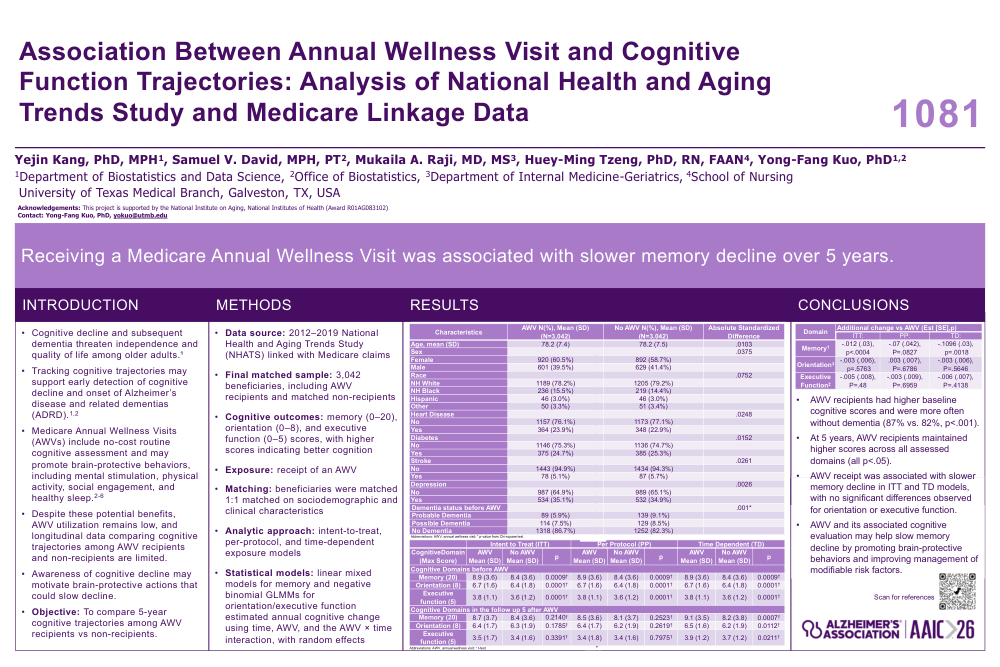
• AWV recipients had higher baseline cognitive scores and were more often without dementia (87% vs. 82%, p<.001).
• At 5 years, AWV recipients maintained higher scores across all assessed domains (all p<.05).
• AWV receipt was associated with slower memory decline in ITT and TD models, with no significant differences observed for orientation or executive function.
• AWV and its associated cognitive evaluation may help slow memory decline by promoting brain-protective behaviors and improving management of modifiable risk factors.
Comments
Email is required but is not shown publicly.
Loading comments...