4,068 posters, 219 videos, 101 topics, 69 sessions, 14,365 authors, 6,128 institutions
ePostersLive by SciGen Technologies S.A. All rights reserved.
Alzheimer's Association International Conference 2026
July 12-15, 2026 | London, United Kingdom, and Online

4656
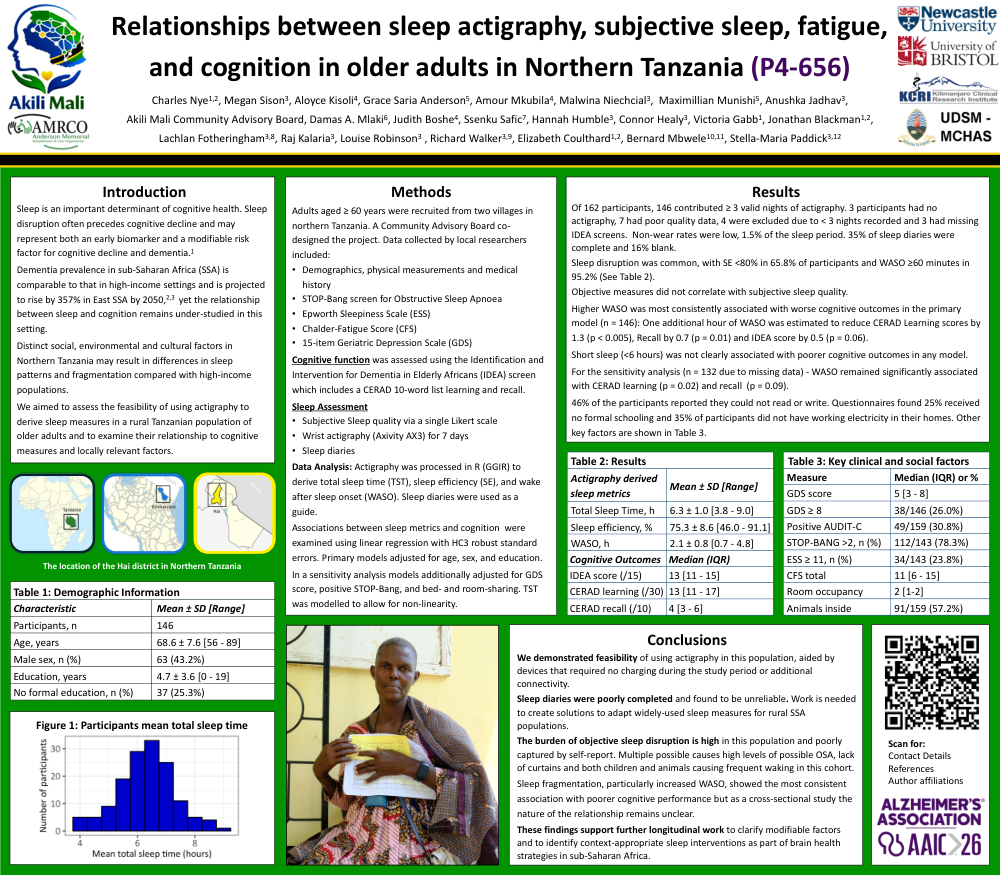
Relationships Between Sleep Actigraphy, Subjective Sleep, Fatigue, And Cognition In Older Adults In Norther Tanzania
Poster Presenter
Authors
Charles Nye, Megan Sison, Aloyce Kisoli, Grace Saria Anderson, Amour Mkubila, Malwina Niechcial, Maximillian Munishi, Anushka Jadhav, Sabas Rite, Aurelia Malya, Sabinus Mtenga, Hadija Ulomi, Edward Mbowe, Damas Mlaki, Judith Boshe, Ssenku Safic, Hannah Humble, Connor Healy, Victoria Gabb, Jonathan Blackman, Lachlan Fotheringham, Raj Kalaria, Louise Robinson, Richard Walker, Elizabeth Coulthard, Bernard Mbwele, Stella-Maria Paddick
Affiliations
Kilimanjaro Clinical Research Institute, Moshi, Tanzania, University of Dar es Salaam-Mbeya College of Health Sciences, Mbeya, Tanzania, University of Bristol, Bristol, UK, Anderson Memorial Rehabilitation and Care Organisation (AMRCO), Tanzania, Newcastle University, Newcastle upon Tyne, UK, Akili Mali Community Advisory Board, Kilimanjaro, Tanzania, Mirembe National Psychiatric Hospital, Dodoma, Tanzania, Fight Dementia and Care Organisation, Tanzania, Cumbria, Northumberland, Tyne and Wear NHS Foundation Trust, Newcastle upon Tyne, UK, Newcastle University, Newcastle upon Tyne, UK and Gateshead Health NHS Foundation Trust, Gateshead, UK, University of Bristol, Bristol, UK and North Bristol NHS Trust, Northumbria Healthcare NHS Foundation Trust, Tyne and Wear, UK and Newcastle University, Newcastle upon Tyne, UK
Part of Topic
Introduction:
Sleep is an important determinant of cognitive health. Sleep disruption often precedes cognitive decline and may represent both an early biomarker and a modifiable risk factor for cognitive decline and dementia.1
Dementia prevalence in sub-Saharan Africa (SSA) is comparable to that in high-income settings and is projected to rise by 357% in East SSA by 2050,2,3 yet the relationship between sleep and cognition remains under-studied in this setting.
Distinct social, environmental and cultural factors in Northern Tanzania may result in differences in sleep patterns and fragmentation compared with high-income populations.
We aimed to assess the feasibility of using actigraphy to derive sleep measures in a rural Tanzanian population of older adults and to examine their relationship to cognitive measures and locally relevant factors.
Methods:
Adults aged ≥ 60 years were recruited from two villages in northern Tanzania. A Community Advisory Board co-designed the project. Data collected by local researchers included:
Cognitive function was assessed using the Identification and Intervention for Dementia in Elderly Africans (IDEA) screen which includes a CERAD 10-word list learning and recall.
Sleep Assessment
Data Analysis: Actigraphy was processed in R (GGIR) to derive total sleep time (TST), sleep efficiency (SE), and wake after sleep onset (WASO). Sleep diaries were used as a guide.
Associations between sleep metrics and cognition were examined using linear regression with HC3 robust standard errors. Primary models adjusted for age, sex, and education.
In a sensitivity analysis models additionally adjusted for GDS score, positive STOP-Bang, and bed- and room-sharing. TST was modelled to allow for non-linearity.
Results:
Of 162 participants, 146 contributed ≥ 3 valid nights of actigraphy. 3 participants had no actigraphy, 7 had poor quality data, 4 were excluded due to < 3 nights recorded and 3 had missing IDEA screens. Non-wear rates were low, 1.5% of the sleep period. 35% of sleep diaries were complete and 16% blank.
Sleep disruption was common, with SE <80% in 65.8% of participants and WASO ≥60 minutes in 95.2% (See Table 2).
Objective measures did not correlate with subjective sleep quality.
Higher WASO was most consistently associated with worse cognitive outcomes in the primary model (n = 146): One additional hour of WASO was estimated to reduce CERAD Learning scores by 1.3 (p < 0.005), Recall by 0.7 (p = 0.01) and IDEA score by 0.5 (p = 0.06).
Short sleep (<6 hours) was not clearly associated with poorer cognitive outcomes in any model.
For the sensitivity analysis (n = 132 due to missing data) - WASO remained significantly associated with CERAD learning (p = 0.02) and recall (p = 0.09).
46% of the participants reported they could not read or write. Questionnaires found 25% received no formal schooling and 35% of participants did not have working electricity in their homes. Other key factors are shown in Table 3.
Conclusions:
We demonstrated feasibility of using actigraphy in this population, aided by devices that required no charging during the study period or additional connectivity.
Sleep diaries were poorly completed and found to be unreliable. Work is needed to create solutions to adapt widely-used sleep measures for rural SSA populations.
The burden of objective sleep disruption is high in this population and poorly captured by self-report. Multiple possible causes high levels of possible OSA, lack of curtains and both children and animals causing frequent waking in this cohort.
Sleep fragmentation, particularly increased WASO, showed the most consistent association with poorer cognitive performance but as a cross-sectional study the nature of the relationship remains unclear.
These findings support further longitudinal work to clarify modifiable factors and to identify context-appropriate sleep interventions as part of brain health strategies in sub-Saharan Africa.
Comments
Email is required but is not shown publicly.
Loading comments...