4,068 posters, 219 videos, 101 topics, 69 sessions, 14,365 authors, 6,128 institutions
ePostersLive by SciGen Technologies S.A. All rights reserved.
Alzheimer's Association International Conference 2026
July 12-15, 2026 | London, United Kingdom, and Online

3737
Prevalence Of Burden In Caregivers Of Mexican Patients With Dementia In Urban And Rural Areas
Poster Presenter
Authors
Affiliations
Part of Topic
Control/Tracking Number: 2026-A-3737-AAIC Activity: Abstract
Prevalence Of Burden In Caregivers Of Mexican Patients With Dementia In Urban And Rural Areas
Author Block: Erika Avelina Rodríguez Jáuregui1, Gilberto Isaac Acosta Castillo1, Erika Mariana Longoria Ibarrola1, Ana Luisa Sosa Ortiz2.
1Dementia, National Institute of Neurology and Neurosurgery, Mexico City, Mexico, 2
Abstract:
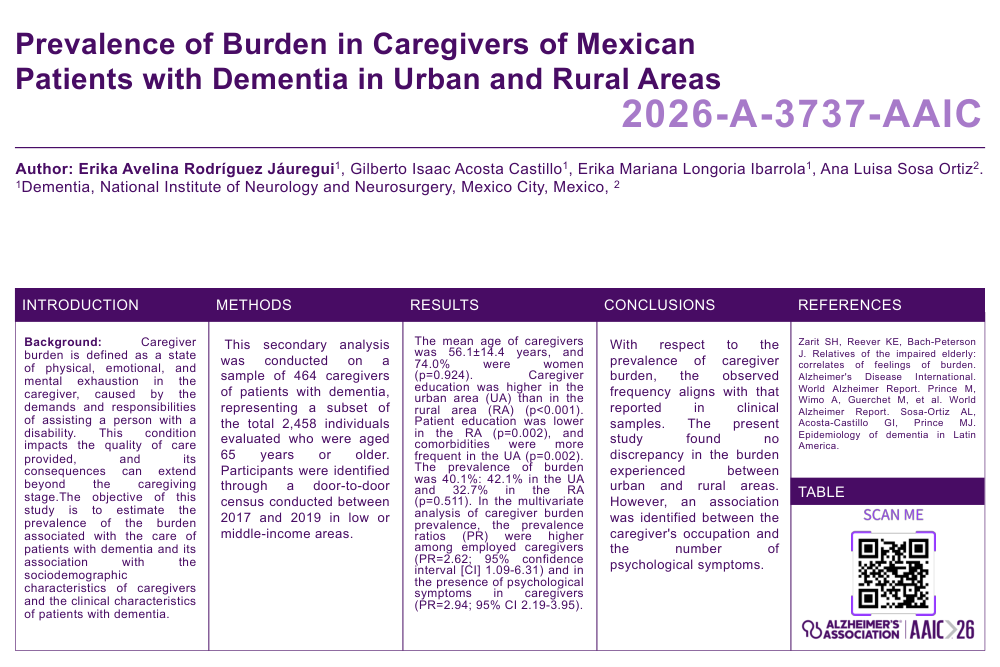
Background: Caregiver burden is defined as a state of physical, emotional, and mental exhaustion in the caregiver, caused by the demands and responsibilities of assisting a person with a disability. This condition impacts the quality of care provided, and its consequences can extend beyond the caregiving stage.The objective of this study is to estimate the prevalence of the burden associated with the care of patients with dementia and its association with the sociodemographic characteristics of caregivers and the clinical characteristics of patients with dementia.
Methods: This secondary analysis was conducted on a sample of 464 caregivers of patients with dementia, representing a subset of the total 2,458 individuals evaluated who were aged 65 years or older. Participants were identified through a door-to-door census conducted between 2017 and 2019 in low or middle-income areas.
Results: The mean age of caregivers was 56.1±14.4 years, and 74.0% were women (p=0.924). Caregiver education was higher in the urban area (UA) than in the rural area (RA) (p<0.001). Patient education was lower in the RA (p=0.002), and comorbidities were more frequent in the UA (p=0.002). The prevalence of burden was 40.1%: 42.1% in the UA and 32.7% in the RA (p=0.511). In the multivariate analysis of caregiver burden prevalence, the prevalence ratios (PR) were higher among employed caregivers (PR=2.62; 95% confidence interval [CI] 1.09-6.31) and in the presence of psychological symptoms in caregivers (PR=2.94; 95% CI 2.19-3.95).
Conclusion: With respect to the prevalence of caregiver burden, the observed frequency aligns with that reported in clinical samples. The present study found no discrepancy in the burden experienced between urban and rural areas. However, an association was identified between the caregiver's occupation and the number of psychological symptoms.
Comments
Email is required but is not shown publicly.
Loading comments...