4,068 posters, 219 videos, 101 topics, 69 sessions, 14,365 authors, 6,128 institutions
ePostersLive by SciGen Technologies S.A. All rights reserved.
Alzheimer's Association International Conference 2026
July 12-15, 2026 | London, United Kingdom, and Online

6190
Alzheimer’s Disease In The Era Of Climate Change: Could Carbon Reduction Strategies Become A Public Health Tool For Dementia Prevention?
Poster Presenter
Authors
Diogo Haddad Santos, Carolina Braga Moura, Amanda Carneiro Rodrigues, Gabriella Chinaglia Zanin, Ana Carolina Gomes, Sephora Almeida, Anderson Matheus Pereira Silva, Yngrid Dieguez Ferreira
Affiliations
Faculdade de Ciências Médicas da Santa Casa de São Paulo, São Paulo, Brazil, Cognitive and Behavioral Neurology, Irmandade da Santa Casa de Misericórdia de São Paulo, São Paulo, Brazil, Physiology and Pharmacology, Federal University of Pernambuco, Recife, Brazil
Part of Topic
Background
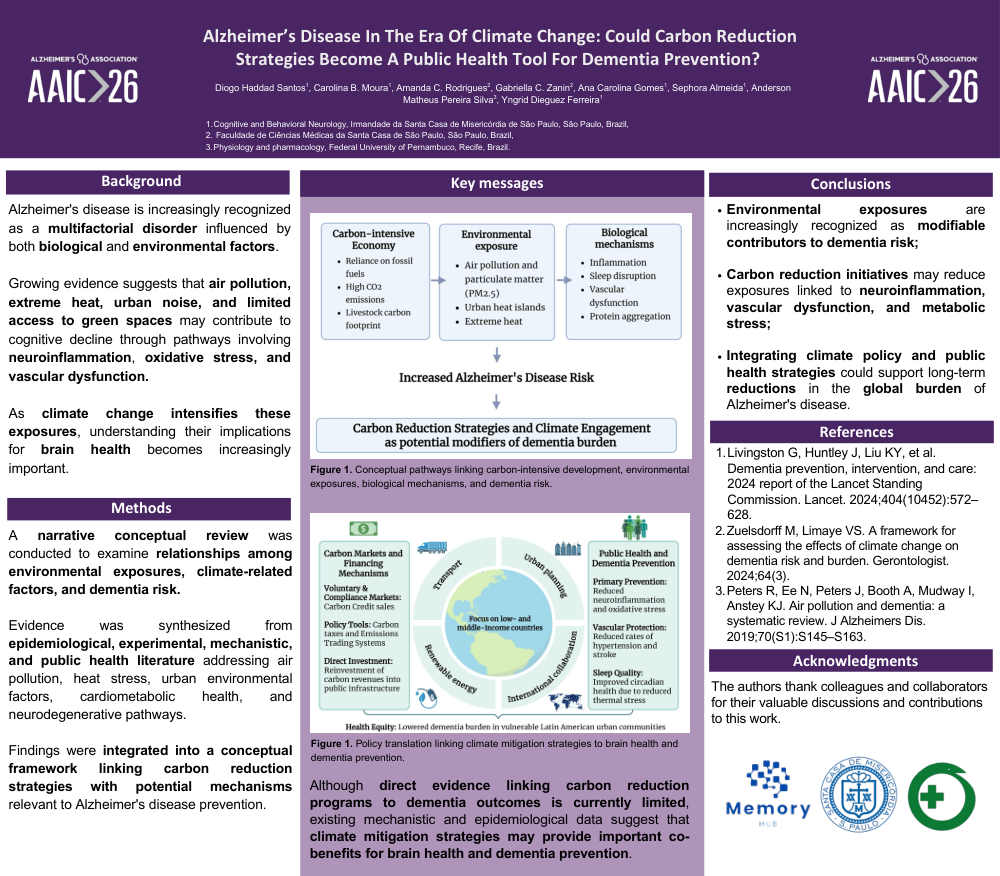
Alzheimer's disease is increasingly recognized as a multifactorial disorder influenced by both biological and environmental factors. Growing evidence suggests that air pollution, extreme heat, urban noise, and limited access to green spaces may contribute to cognitive decline through pathways involving neuroinflammation, oxidative stress, and vascular dysfunction. As climate change intensifies these exposures, understanding their implications for brain health becomes increasingly important.
Methods
A narrative conceptual review was conducted to examine relationships among environmental exposures, climate-related factors, and dementia risk. Evidence was synthesized from epidemiological, experimental, mechanistic, and public health literature addressing air pollution, heat stress, urban environmental factors, cardiometabolic health, and neurodegenerative pathways. Findings were integrated into a conceptual framework linking carbon reduction strategies with potential mechanisms relevant to Alzheimer's disease prevention.
Results and Discussion
Although direct evidence linking carbon reduction programs to dementia outcomes is currently limited, existing mechanistic and epidemiological data suggest that climate mitigation strategies may provide important co-benefits for brain health and dementia prevention.
Conclusions
Environmental exposures are increasingly recognized as modifiable contributors to dementia risk. Carbon reduction initiatives may reduce exposures linked to neuroinflammation, vascular dysfunction, and metabolic stress. Integrating climate policy and public health strategies could support long-term reductions in the global burden of Alzheimer's disease.
References
- Livingston G, Huntley J, Liu KY, et al. Dementia prevention, intervention, and care: 2024 report of the Lancet Standing Commission. Lancet. 2024;404(10452):572–628.
- Zuelsdorff M, Limaye VS. A framework for assessing the effects of climate change on dementia risk and burden. Gerontologist. 2024;64(3).
- Peters R, Ee N, Peters J, Booth A, Mudway I, Anstey KJ. Air pollution and dementia: a systematic review. J Alzheimers Dis. 2019;70(S1):S145–S163.
Comments
Email is required but is not shown publicly.
Loading comments...