4,068 posters, 219 videos, 101 topics, 69 sessions, 14,365 authors, 6,128 institutions
ePostersLive by SciGen Technologies S.A. All rights reserved.
Alzheimer's Association International Conference 2026
July 12-15, 2026 | London, United Kingdom, and Online

1923
Age Specification Matters? A Multi-cohort Evaluation In The Performance Of Mid-life Dementia Risk Scores
Poster Presenter
Authors
Affiliations
Part of Topic
Abstract
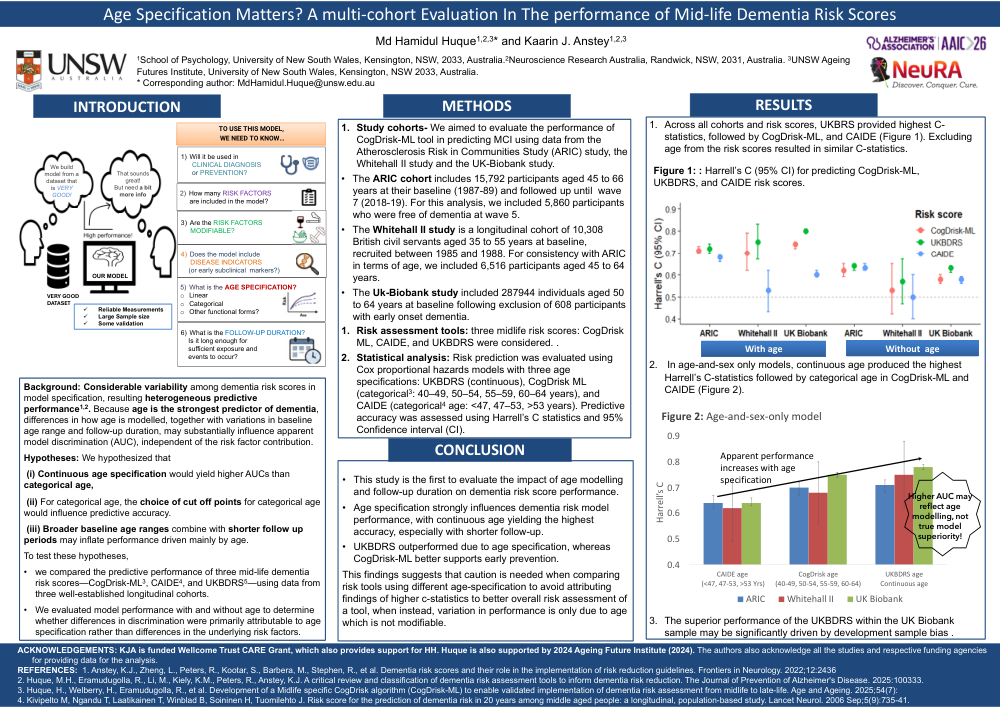
Background: The heterogeneous performance of dementia and Alzheimer’s disease risk scores makes it difficult to identify tools suitable for supporting risk reduction and prevention strategies. Although multiple factors may contribute, we hypothesized that differences in age specification and study design are the primary contributors to this variability.
Objective: To evaluate how age specification and length of follow-up affect the performance of three midlife risk scores: CogDrisk-ML, CAIDE, and UKBDRS.
Methods: Longitudinal data were drawn from the ARIC, UK Biobank, and Whitehall II cohorts. Participants free of dementia at baseline were included. Baseline variables were used to calculate each risk score. Risk prediction was evaluated using Cox proportional hazards models with three age specifications: UKBDRS (continuous), CogDrisk-ML (categorical: 40–49, 50–54, 55–59, 60–64 years), and CAIDE (categorical age: <47, 47–53, >53 years). Predictive accuracy was assessed using Harrell’s C-statistics and 95% confidence intervals (CIs).
Results: Across all cohorts and risk scores, excluding age from risk scores resulted in similar C-statistics. In age- and sex-only models, continuous age produced the highest Harrell’s C-statistics (95% CI) [ARIC: 0.71 (0.68, 0.73); UK Biobank: 0.78 (0.77, 0.79), and Whitehall II: 0.75 (0.62, 0.88)], followed by categorical age specifications in CogDrisk-ML and CAIDE. Compared with continuous age, categorical specifications reduced C-statistics, with the largest reduction for CAIDE. Shorter follow-up yielded higher but less precise C-statistics.
Conclusions: Age specification strongly influences dementia risk model performance, with continuous age yielding the highest accuracy, especially with shorter follow-up. UKBDRS performance was largely driven by its age specification, whereas CogDrisk-ML better supports early prevention.
Key words: Risk tool, dementia risk prediction, role of age, comparative performance, Alzheimer’s disease.
Comments
Email is required but is not shown publicly.
Loading comments...