4,068 posters, 219 videos, 101 topics, 69 sessions, 14,365 authors, 6,128 institutions
ePostersLive by SciGen Technologies S.A. All rights reserved.
Alzheimer's Association International Conference 2026
July 12-15, 2026 | London, United Kingdom, and Online

5051
A Plasma Proteomic Signature For Stratifying Dementia Risk In Patients With Cardiometabolic Diseases
Part of Topic
Title: A Plasma Proteomic Signature for Stratifying Dementia Risk in Patients with Cardiometabolic Diseases
Yu WANG1#, Haoyang CHENG2#, Qida HE1#, Linyan LI1,2*.
1.Department of Infectious Diseases and Public Health, City University of Hong Kong, Hong Kong SAR
2.Department of Data Science, City University of Hong Kong, Hong Kong SAR
*Correspondence: Linyan Li (linyanli@cityu.edu.hk)
#These authors contributed equally to this work.
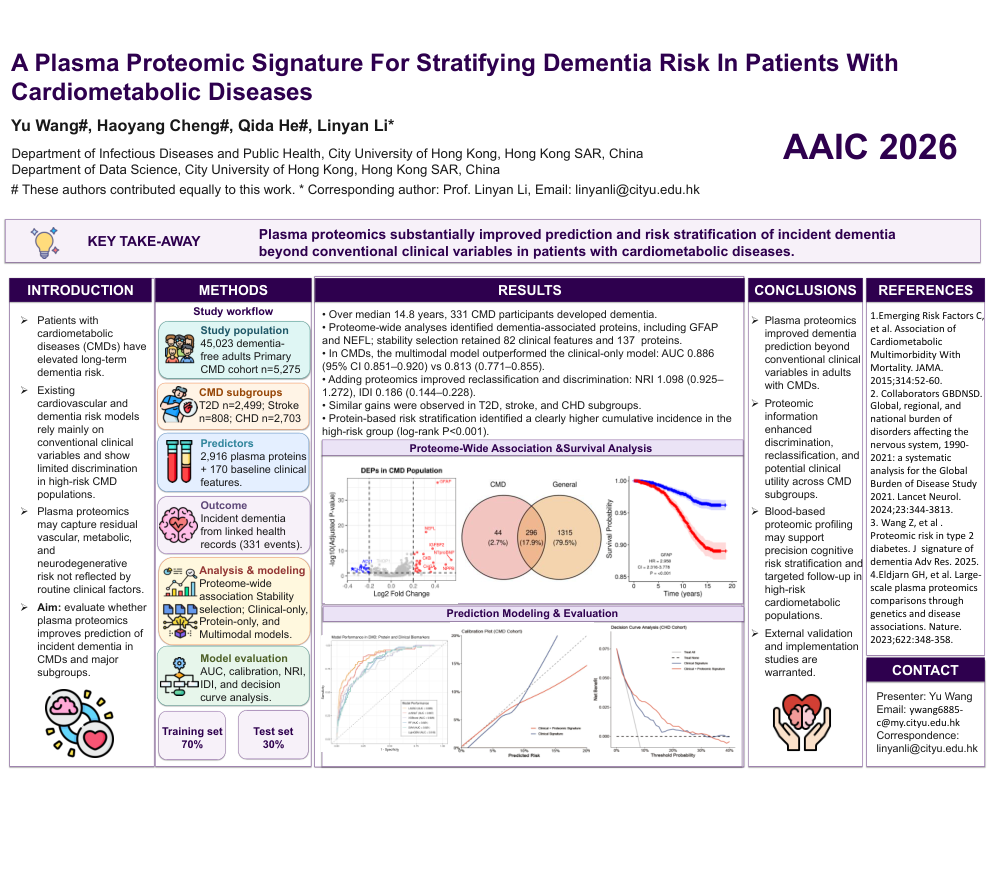
Background: Individuals with cardiometabolic diseases (CMD) are at elevated risk for dementia. Current risk prediction models, largely derived from general populations, demonstrate limited sensitivity in this high-risk group, and the underlying molecular mechanisms remain unclear. This study aimed to (1) identify a CMD-specific plasma proteomic signature for dementia, (2) elucidate its associated biological pathways, and (3) construct an integrated model to improve dementia risk prediction in CMD.
Methods: We analyzed baseline plasma proteomic data (Olink) and longitudinal follow-up (median 14.6 years) from 5,275 UK Biobank participants with CMD (type 2 diabetes, coronary heart disease, or stroke). Dementia risk-associated proteins were identified through differential expression and interaction analyses with CMD status. Functional enrichment (GO, KEGG) and protein-protein interaction network analyses were performed on prioritized proteins. Machine learning models were developed to predict dementia in CMD patients.
Results: Differential expression analysis identified 44 proteins specifically associated with dementia risk in the CMD cohort. GFAP (HR=2.96, 95% CI: 2.32–3.78) and NEFL (HR=3.19, 95% CI: 2.50–4.07) were the strongest individual markers. Interaction analysis revealed 758 proteins whose association with dementia risk was modulated by CMD status (e.g., TGFBR1 HR increased from 1.63 to 2.67 in CMD). These CMD-specific signatures were enriched in Axon Guidance (FDR=0.001) and PI3K-AKT Signaling (FDR=0.006). The multi-modal model (LASSO-selected proteins + clinical variables) achieved an AUC of 0.886 in the CMD cohort, outperforming protein-only (AUC=0.876) and clinical-only (AUC=0.815) models. Top proteomic drivers (GFAP, NEFL, MENT) mapped to synaptic regulation and humoral immune response.
Conclusions: This study identifies a distinct plasma proteomic signature that differentiates dementia risk in individuals with CMD. Integrating proteomics with clinical data significantly enhances prediction accuracy. The signature provides a powerful tool for risk stratification and reveals novel biological pathways linking CMD to dementia pathogenesis.
Comments
Email is required but is not shown publicly.
Loading comments...