4,068 posters, 219 videos, 101 topics, 69 sessions, 14,365 authors, 6,128 institutions
ePostersLive by SciGen Technologies S.A. All rights reserved.
Alzheimer's Association International Conference 2026
July 12-15, 2026 | London, United Kingdom, and Online

1634
Barriers and Enablers of Hypertension Control in Nepalese Older Adults: Implications for Dementia Prevention
Poster Presenter
Authors
Prabha Shrestha, Biraj Man Karmacharya, Yunika Acharya, Indu Poudel, Jennifer Merrilees, Victor Valcour
Affiliations
1. Kathmandu University School of Medical Sciences, 2. Global Brain Health Institute, 1. Kathmandu University School of Medical Sciences, 3. Department of research and Development, Dhulikhel Hospital, 3. Department of research and Development, Dhulikhel Hospital, Memory and Aging Center, Department of Neurology, University of California San Francisco, USA
Part of Topic
Barriers and Enablers of Hypertension Control in Nepalese Older Adults: Implications for Dementia Prevention
Prabha Shrestha, MNS, MA, Biraj Man Karmacharya, MPH, PhD, Yunika Acharya, MSc PH, Indu Poudel, BNS, Jennifer Merrilees PhD, Victor Valcour, MD, PhD
Background
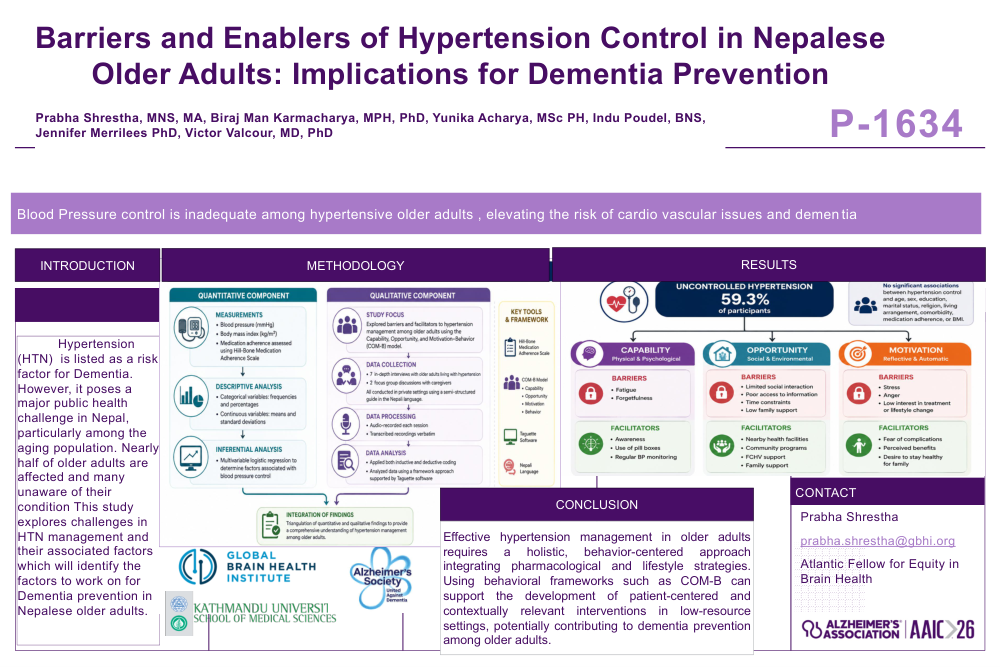
Hypertension poses a major public health challenge in Nepal, particularly among the aging population, with nearly half of older adults affected and many unaware of their condition. This study explores barriers and facilitators of hypertension management among hypertensive older adults in Nepal.
Method
We conducted a parallel mixed-method study. We assessed blood pressure control status among 197 hypertensive older adults. We measured blood pressure (mmHg), BMI (kg/m²), and assessed medication adherence using the Hill-Bone Medication Adherence Scale. We explored barriers and facilitators of hypertension management among hypertensive older adults using the Capability, Opportunity and Motivation (COM-B) model. Trained researchers conducted seven In-Depth Interviews (IDIs) and 2 Focus Group Discussion (FGDs) among older hypertensive patients and caretakers, respectively. Interviews and FGDs were held in private settings using a semi-structured guideline in the Nepali language. We audio-recorded all sessions, transcribed into verbatim, and applied both inductive and deductive coding. We then analyzed the data using a framework approach with Taguette software.
Result
Over half of participants (59.3%) had uncontrolled blood pressure. No associations were found between hypertension control status and age, sex, education level, marital status, religion, living arrangement, presence of comorbidity, medication adherence or BMI. When explored through the lens of the COM-B model, a range of behavioral determinants emerged as critical to understanding hypertension management. These include limited physical and cognitive capability (fatigue, forgetfulness), lack of opportunity (limited social interaction, time constraints, poor access to information, and low family support), and reduced motivation (low interest in treatment or lifestyle changes, stress, and anger). On the other hand, several facilitators played a positive role in promoting blood pressure control such as improved capability through awareness, use of pill boxes, and regular BP monitoring. Other facilitators included enhanced opportunity via nearby health facilities, community programs, and FCHV and family support. Strong motivation driven by fear of complications, perceived benefits, and the desire to stay healthy for family were also identified as facilitators.
Conclusion
The findings highlight the need for a holistic, behavior-centered approach to hypertension management in older adults, integrating both pharmacological and non-pharmacological strategies. Incorporating behavioral frameworks like COM-B support the development of patient-centered interventions that are sustainable and contextually relevant in low-resource settings like Nepal to minimize the risk of dementia in this population.
Key words: Hypertension, older adults, barriers, facilitators, blood pressure control, Nepal, dementia
Comments
Email is required but is not shown publicly.
Loading comments...