4,068 posters, 219 videos, 101 topics, 69 sessions, 14,365 authors, 6,128 institutions
ePostersLive by SciGen Technologies S.A. All rights reserved.
Alzheimer's Association International Conference 2026
July 12-15, 2026 | London, United Kingdom, and Online

4794
Community Based - Prioritised Dementia Risk Reduction In Rungwe District, Mbeya, Tanzania: Insights From The Akili Mali Project
Poster Presenter
Authors
Part of Topic
Community Based - Prioritised Dementia Risk Reduction in Rungwe District, Mbeya, Tanzania: Insights from the Akili Mali Project
Mbwele B*1,2, Wright L3, Kisoli. A4. Mwahi, B.G. 1,2, Ilaza F. 1,2, Leonard L. P. 2, Thomas Alon2, Young T.3, Mahinnyila, O 1,2, Kalaria, R. 3, Walker R. W. 5, Paddick, S-M* 3
1. University of Dar es Salaam, Mbeya College of Health Sciences, Tanzania
2. Vijiji Tanzania, Block T, Mbeya, Tanzania
3. Newcastle University, United Kingdom
4. Kilimanjaro Clinical Research Institute, Tanzania
5. Northumbria Healthcare NHS Foundation Trust, United Kingdom
* Developed the idea and the settings definition of the research project
Abstract
Background: It is estimated that 55 million people are living with Dementia, with sub-Saharan Africa more affected by associated societal burdens. The topmost risk factors for Dementia in rural Tanzania have not been thoroughly documented. We aimed to identify the most common and top risk factors for guiding policymakers and governments in their response to the prevention of dementia in Tanzania.
Methods: In September 2024, a cross-sectional study approved by the local IRB and national health research committee. The community ranked opinions on Dementia risk factors in Urban, semi-Urban and Rural wards of Rungwe district, Mbeya, Tanzania. Community engagement was done by Vijiji Tanzania, a non-profit organisation in Mbeya, Tanzania, which mapped wards and villages with more elderly people. Participants included healthcare workers, community leaders and regular community members aged >60 years. A special app to rank the priorities, "Vijiji App”, was used after adapting the James Lind Alliance methodology. The 14 modifiable dementia risk factors from the 2024 Lancet Commission report were discussed and ranked alongside additional factors identified by the community.
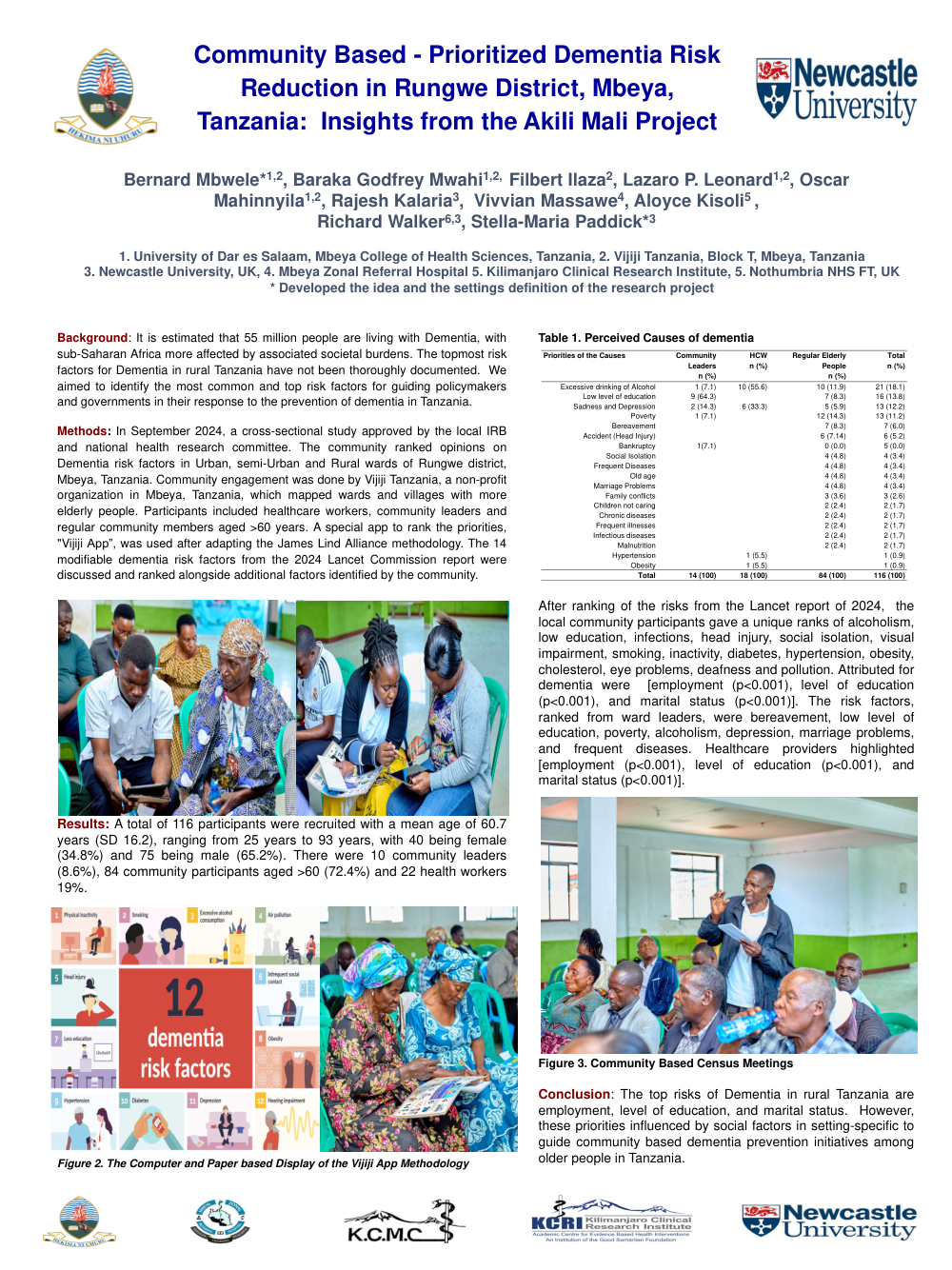
Results: A total of 116 participants were recruited with a mean age of 60.7 years (SD 16.2), ranging from 25 years to 93 years, with 40 being female (34.8%) and 75 being male (65.2%). There were 10 community leaders (8.6%), 84 community participants aged >60 (72.4%) and 22 health workers 19%. After ranking of the risks from the Lancet report of 2024, the local community participannts gave a unique ranks of alcoholism, low education, infections, head injury, social isolation, visual impairment, smoking, inactivity, diabetes, hypertension, obesity, cholesterol, eye problems, deafness and pollution. Atributed for dementia were [employment (p<0.001), level of education (p<0.001), and marital status (p<0.001)]. The risk factors, ranked from ward leaders, were bereavement, low level of education, poverty, alcoholism, depression, marriage problems, and frequent diseases. Healthcare providers highlighted [employment (p<0.001), level of education (p<0.001), and marital status (p<0.001)].
Conclusion: The top risks of Dementia in rural Tanzania are employment, level of education, and marital status. However, these priorities influenced by social factors in setting-specific to guide community based dementia prevention initiatives among older people in Tanzania.
Comments
Email is required but is not shown publicly.
Loading comments...