4,068 posters, 219 videos, 101 topics, 69 sessions, 14,365 authors, 6,128 institutions
ePostersLive by SciGen Technologies S.A. All rights reserved.
Alzheimer's Association International Conference 2026
July 12-15, 2026 | London, United Kingdom, and Online

8947
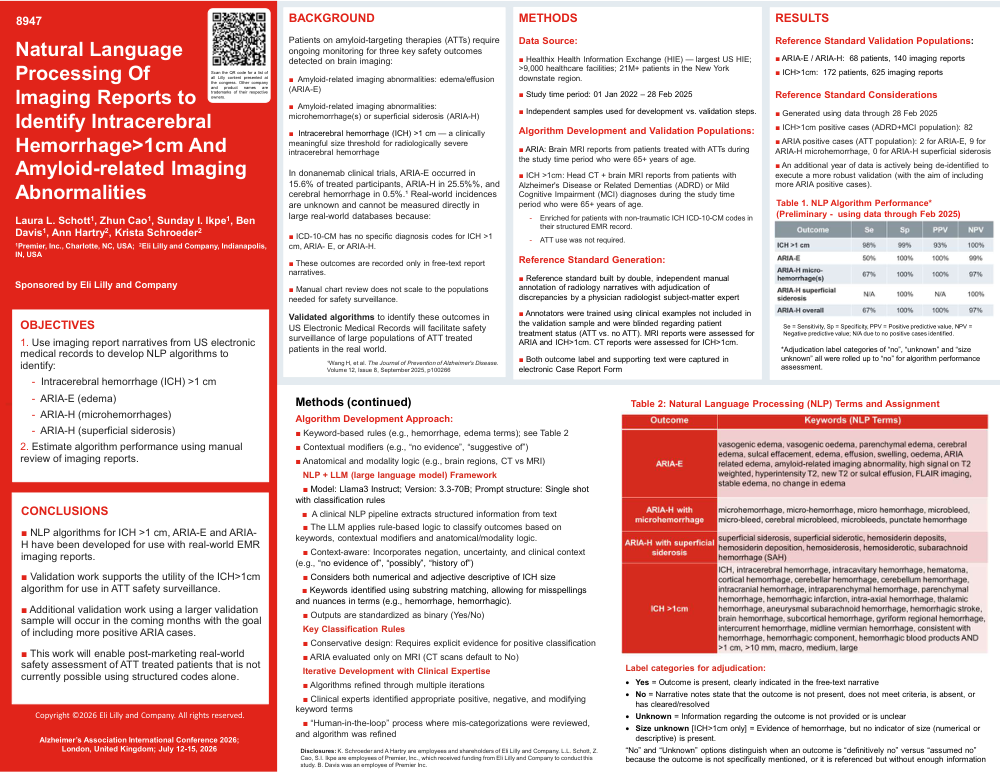
Natural Language Processing Of Imaging Reports To Identify Intracerebral Hemorrhage>1cm And Amyloid-related Imaging Abnormalities
Poster Presenter
Authors
Laura Schott, Zhun Cao, Sunday Ikpe, Ben Davis, Ann Hartry, Krista Schroeder
Affiliations
Part of Topic
OBJECTIVES
1. Use imaging report narratives from US electronic medical records to develop NLP algorithms to identify:
- Intracerebral hemorrhage (ICH) >1 cm
- ARIA-E (edema)
- ARIA-H (microhemorrhages)
- ARIA-H (superficial siderosis)
2. Estimate algorithm performance using manual review of imaging reports.
BACKGROUND
Patients on amyloid-targeting therapies (ATTs) require ongoing monitoring for three key safety outcomes detected on brain imaging:
■ Amyloid-related imaging abnormalities: edema/effusion (ARIA-E)
■ Amyloid-related imaging abnormalities: microhemorrhage(s) or superficial siderosis (ARIA-H)
■ Intracerebral hemorrhage (ICH) >1 cm — a clinically meaningful size threshold for radiologically severe intracerebral hemorrhage
In donanemab clinical trials, ARIA-E occurred in 15.6% of treated participants, ARIA-H in 25.5%%, and cerebral hemorrhage in 0.5%.¹ Real-world incidences are unknown and cannot be measured directly in large real-world databases because:
■ ICD-10-CM has no specific diagnosis codes for ICH >1 cm, ARIA- E, or ARIA-H.
■ These outcomes are recorded only in free-text report narratives.
■ Manual chart review does not scale to the populations needed for safety surveillance.
Validated algorithms to identify these outcomes in US Electronic Medical Records will facilitate safety surveillance of large populations of ATT treated patients in the real world.
METHODS
Data Source:
■ Healthix Health Information Exchange (HIE) — largest US HIE; >9,000 healthcare facilities; 21M+ patients in the New York downstate region.
■ Study time period: 01 Jan 2022 – 28 Feb 2025
■ Independent samples used for development vs. validation steps.
Algorithm Development and Validation Populations:
■ ARIA: Brain MRI reports from patients treated with ATTs during the study time period who were 65+ years of age.
■ ICH >1cm: Head CT + brain MRI reports from patients with Alzheimer's Disease or Related Dementias (ADRD) or Mild Cognitive Impairment (MCI) diagnoses during the study time period who were 65+ years of age.
Reference Standard Generation:
■ Reference standard built by double, independent manual annotation of radiology narratives with adjudication of discrepancies by a physician radiologist subject-matter expert
■ Annotators were trained using clinical examples not included in the validation sample and were blinded regarding patient treatment status (ATT vs. no ATT). MRI reports were assessed for ARIA and ICH>1cm. CT reports were assessed for ICH>1cm.
■ Both outcome label and supporting text were captured in electronic Case Report Form
RESULTS
Reference Standard Validation Populations:
■ ARIA-E / ARIA-H: 68 patients, 140 imaging reports
■ ICH>1cm: 172 patients, 625 imaging reports
Reference Standard Considerations
■ Generated using data through 28 Feb 2025
■ ICH>1cm positive cases (ADRD+MCI population): 82
■ ARIA positive cases (ATT population): 2 for ARIA-E, 9 for ARIA-H microhemorrhage, 0 for ARIA-H superficial siderosis
■ An additional year of data is actively being de-identified to execute a more robust validation (with the aim of including more ARIA positive cases).
Methods (continued)
Algorithm Development Approach:
■ Keyword-based rules (e.g., hemorrhage, edema terms); see Table 2
■ Contextual modifiers (e.g., “no evidence”, “suggestive of”)
■ Anatomical and modality logic (e.g., brain regions, CT vs MRI)
NLP + LLM (large language model) Framework
■ Model: Llama3 Instruct; Version: 3.3-70B; Prompt structure: Single shot with classification rules
■ A clinical NLP pipeline extracts structured information from text
■ The LLM applies rule-based logic to classify outcomes based on keywords, contextual modifiers and anatomical/modality logic.
■ Context-aware: Incorporates negation, uncertainty, and clinical context (e.g., “no evidence of”, “possibly”, “history of”)
■ Considers both numerical and adjective descriptive of ICH size
■ Keywords identified using substring matching, allowing for misspellings and nuances in terms (e.g., hemorrhage, hemorrhagic).
■ Outputs are standardized as binary (Yes/No)
Key Classification Rules
■ Conservative design: Requires explicit evidence for positive classification
■ ARIA evaluated only on MRI (CT scans default to No)
Iterative Development with Clinical Expertise
■ Algorithms refined through multiple iterations
■ Clinical experts identified appropriate positive, negative, and modifying keyword terms
■ “Human-in-the-loop” process where mis-categorizations were reviewed, and algorithm was refined
CONCLUSIONS
■ NLP algorithms for ICH >1 cm, ARIA-E and ARIA-H have been developed for use with real-world EMR imaging reports.
■ Validation work supports the utility of the ICH>1cm algorithm for use in ATT safety surveillance.
■ Additional validation work using a larger validation sample will occur in the coming months with the goal of including more positive ARIA cases.
■ This work will enable post-marketing real-world safety assessment of ATT treated patients that is not currently possible using structured codes alone.
Comments
Email is required but is not shown publicly.
Loading comments...