4,068 posters, 219 videos, 101 topics, 69 sessions, 14,365 authors, 6,128 institutions
ePostersLive by SciGen Technologies S.A. All rights reserved.
Alzheimer's Association International Conference 2026
July 12-15, 2026 | London, United Kingdom, and Online

9410
Exploring associations between preventative lifestyle factors and cognition: A search for plasma and CSF protein signatures of cognitive reserve in SAMS
Poster Presenter
Authors
Affiliations
Part of Topic
Background
An estimated 45% of dementia cases may be attributed to modifiable risk factors, presenting an avenue for prevention or delay of the onset of dementia. The mechanisms underlying the effects of healthy lifestyle on cognition remain inadequately explored. Physical, social, and cognitive activities have the potential to modulate circulating proteins. Lifestyle-protein associations may reveal biological outcomes in future non-pharmacological clinical trials and hold promise as future therapeutic targets. Identifying lifestyle-associated proteins could inform the selection of biological outcomes in non-pharmacological clinical trials and highlight potential therapeutic targets. This study aims to systematically identify cerebrospinal fluid (CSF) and plasma proteins that mediate and moderate the relationship between preventative lifestyle factors and cognition.
Methods
173 cognitively unimpaired older adults (69.0 ± 6.4 years) completed a CHAMPS questionnaire regarding frequency and hours per week of 29 physical, 7 social, and 5 cognitively engaging activities. Plasma and CSF samples were quantified for >7000 plasma proteins and >5000 CSF proteins using the SomaScan assay After harmonization, 158 individuals had complete data across plasma proteomics, lifestyle measures, and covariates and were included in the analysis. (See Table 1). Linear regression models adjusted for age, sex, education, and APOE genotype were used to assess associations. To identify protein moderators of the activity-cognition association, interaction models incorporating a protein × activity term were used. Mediation of the activity-cognition association by individual plasma proteins was evaluated using the Sobel test, with the indirect effect (a×b) representing the protein-mediated pathway. Pathway enrichment analyses were conducted using the Gene Ontology (GO) database.
Results
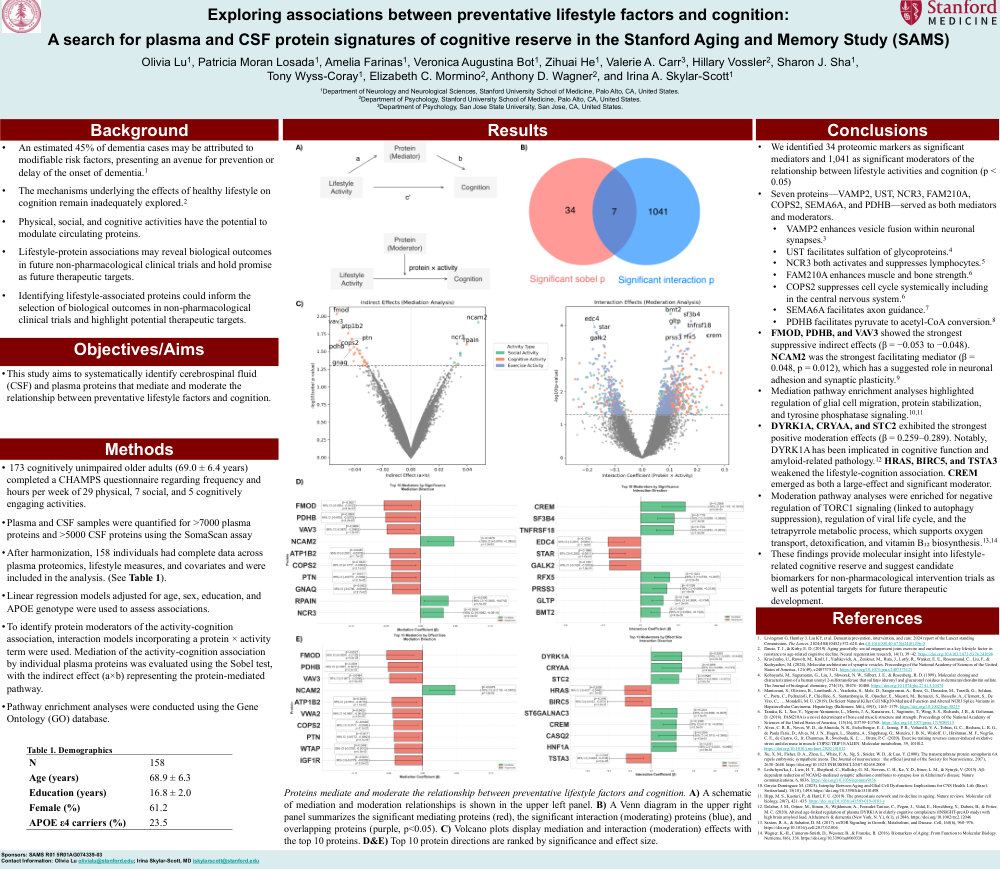
Proteins mediate and moderate the relationship between preventative lifestyle factors and cognition. We identified 34 proteomic markers as significant mediators and 1,041 as significant moderators of the relationship between lifestyle activities and cognition (p < 0.05). Seven proteins—VAMP2, UST, NCR3, FAM210A, COPS2, SEMA6A, and PDHB—served as both mediators and moderators. Mediation pathway enrichment analyses highlighted regulation of glial cell migration, protein stabilization, and tyrosine phosphatase signaling. Moderation pathway analyses were enriched for negative regulation of TORC1 signaling (linked to autophagy suppression), regulation of viral life cycle, and the tetrapyrrole metabolic process, which supports oxygen transport, detoxification, and vitamin B₁₂ biosynthesis.
Conclusion
These findings provide molecular insight into lifestyle-related cognitive reserve and suggest candidate biomarkers for non-pharmacological intervention trials as well as potential targets for future therapeutic development.
Comments
Email is required but is not shown publicly.
Loading comments...