4,068 posters, 219 videos, 101 topics, 69 sessions, 14,365 authors, 6,128 institutions
ePostersLive by SciGen Technologies S.A. All rights reserved.
Alzheimer's Association International Conference 2026
July 12-15, 2026 | London, United Kingdom, and Online

10062
Reconsidering Allostatic Load Measurement: Longitudinal Biomarker-Cognition Associations In Black And White Americans
Poster Presenter
Authors
Affiliations
Part of Topic
Reconsidering Allostatic Load Measurement: Longitudinal Biomarker-Cognition Associations In Black And White Americans
Abstract:
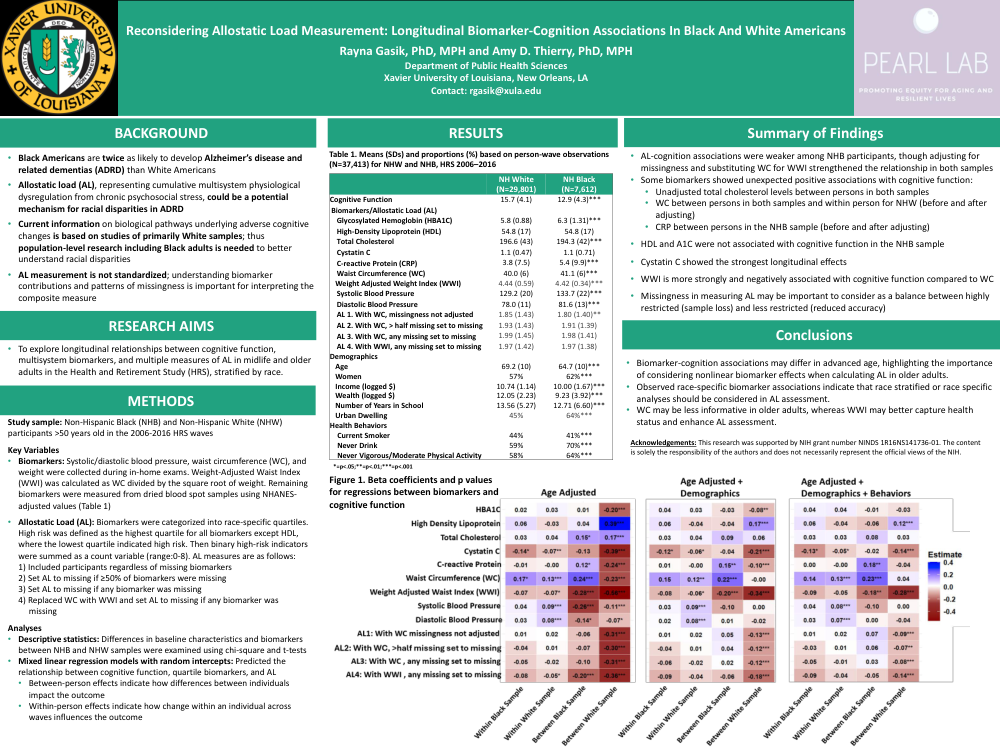
Background: Black Americans face higher risk of Alzheimer’s disease, related dementias (ADRD), and elevated allostatic load (AL) compared to White Americans. Previous cross-sectional research links AL to cognitive function, but studies largely use majority-White samples and show inconsistent results depending on the biomarkers and calculation methods used. Understanding racial differences in the longitudinal relationship between AL-related biomarkers and cognition is critical for addressing Black-White disparities in ADRD.
Methods: Using 2006-2016 Health and Retirement Study (HRS) data, we examined associations between cognitive function, biomarkers representing cardiovascular, metabolic, and immune function, and multiple AL measures (range:0-8) with mixed-effects models stratified by White and Black subsamples. AL was calculated by summing the number of biomarkers with values in the high-risk quartile. Alternate AL measures were created based on missingness and which biomarkers were included. Age-adjusted models were run with group-centered variables to measure within-person effects and means to measure between-person effects.
Results: Globally, results suggested stronger associations for biomarkers and AL between rather than within individuals over time, with stark differences for some biomarkers between the White and Black subpopulations. Expected negative associations with cognitive function were generally stronger in the White subpopulation, particularly for hemoglobin A1C and high-density lipoprotein. Other biomarkers, such as waist circumference (WC) and C-reactive protein (CRP), had opposite associations between racial groups, where higher WC and CRP between individuals were positively associated with cognition in the Black subsample. Once WC was weight-adjusted, the association became negative. Similarly, replacing WC with weight-adjusted WC in the AL measure strengthened the association with cognitive function in both subpopulations.
Conclusion: Results suggest individual biomarkers may have varying relationships with cognition in Black versus White samples. As AL becomes an increasingly popular measure in ADRD studies, careful attention must be paid to how indicators are selected and whether these selections are based on standards derived primarily from White samples. Research is needed to determine which biomarkers are most predictive of physiological burden and cognition in Black subsamples.
Comments
Email is required but is not shown publicly.
Loading comments...