4,068 posters, 219 videos, 101 topics, 69 sessions, 14,365 authors, 6,128 institutions
ePostersLive by SciGen Technologies S.A. All rights reserved.
Alzheimer's Association International Conference 2026
July 12-15, 2026 | London, United Kingdom, and Online

9915
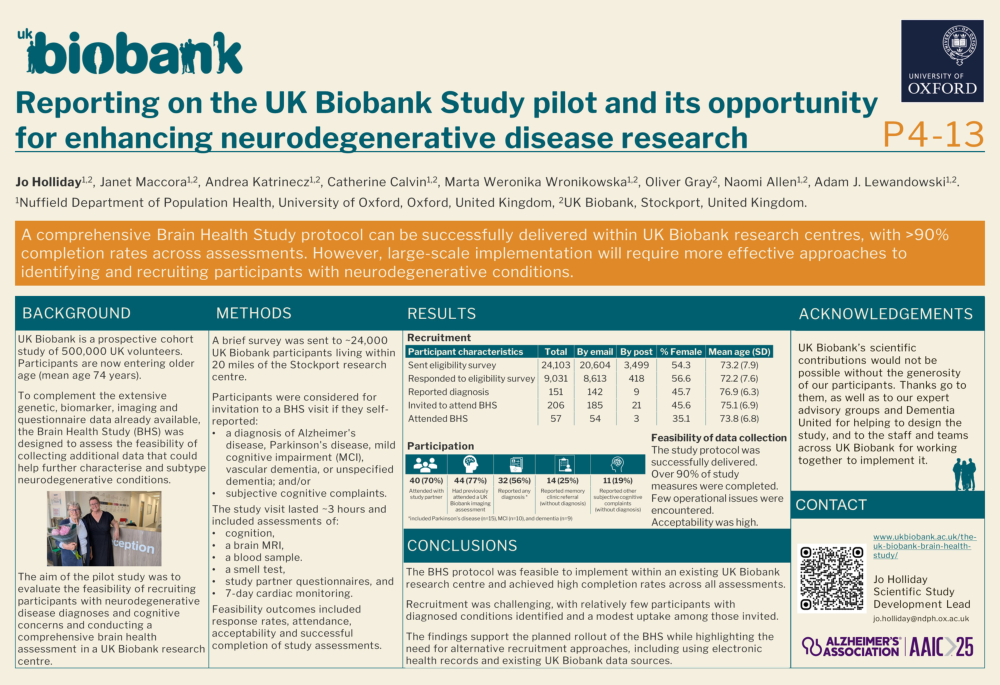
Reporting On The UK Biobank Brain Health Study Pilot And Its Opportunity For Enhancing Neurodegenerative Disease Research
Poster Presenter
Part of Topic
Background
UK Biobank is a prospective cohort study of 500,000 UK volunteers. Participants are now entering older age (mean age 74 years).
To complement the extensive genetic, biomarker, imaging and questionnaire data already available, the Brain Health Study (BHS) was designed to assess the feasibility of collecting additional data that could help further characterise and subtype neurodegenerative conditions.
The aim of the pilot study was to evaluate the feasibility of recruiting participants with neurodegenerative disease diagnoses and cognitive concerns and conducting a comprehensive brain health assessment in a UK Biobank research centre.
Methods
A brief survey was sent to ~24,000UK Biobank participants living within 20 miles of the Stockport research centre.
Participants were considered for invitation to a BHS visit if they self-reported:
- a diagnosis of Alzheimer's disease, Parkinson's disease, mild cognitive impairment (MCI), vascular dementia, or unspecified dementia; and/or
- subjective cognitive complaints.
The study visit lasted ~3 hours and included assessments of:
- cognition,
- a brain MRI,
- a blood sample.
- a smell test,
- study partner questionnaires, and
- 7-day cardiac monitoring.
Feasibility outcomes included response rates, attendance, acceptability and successful completion of study assessments.
Results
Participant characteristics
|
Total |
By email |
By post |
% Female |
Mean age (SD) |
|
|
Sent eligibility survey |
24,103 |
20,604 |
3,499 |
54.3 |
73.2 (7.9) |
|
Responded to eligibility survey |
9,031 |
8,613 |
418 |
56.6 |
72.2 (7.6) |
|
Reported diagnosis |
151 |
142 |
9 |
45.7 |
76.9 (6.3) |
|
Invited to attend BHS |
206 |
185 |
21 |
45.6 |
75.1 (6.9) |
|
Attended BHS |
57 |
54 |
3 |
35.1 |
73.8 (6.8) |
Participation
|
40 (70%) |
44 (77%) |
32 (56%) |
14 (25%) |
11 (19%) |
|
Attended with study partner |
Had previously attended a UK Biobank imaging assessment |
Reported any diagnosis * |
Reported memory clinic referral (without diagnosis) |
Reported other subjective cognitive complaints (without diagnosis) |
|
*included Parkinson’s disease (n=15), MCI (n=10), and dementia (n=9) |
||||
Feasibility of data collection
The study protocol was successfully delivered.
Over 90% of study measures were completed. Few operational issues were encountered.
Acceptability was high.
Conclusions
The BHS protocol was feasible to implement within an existing UK Biobank research centre and achieved high completion rates across all assessments.
Recruitment was challenging, with relatively few participants with diagnosed conditions identified and a modest uptake among those invited.
The findings support the planned rollout of the BHS while highlighting the need for alternative recruitment approaches, including using electronic health records and existing UK Biobank data sources.
Acknowledgements
UK Biobank’s scientific contributions would not be possible without the generosity of our participants. Thanks go to them, as well as to our expert advisory groups and Dementia United for helping to design the study, and to the staff and teams across UK Biobank for working together to implement it.
Contact
www.ukbiobank.ac.uk/the-uk-biobank-brain-health-study/
Jo Holliday, Scientific Study Development Lead, jo.holliday@ndph.ox.ac.uk
Comments
Email is required but is not shown publicly.
Loading comments...